
The Story of the Pioneer Press: Progress by Rhodesian Newspapers
This article is taken from the Rhodes Centenary Supplement published by the Chronicle in Bulawayo on the 3rd of July 1953 Page 35 and was written anonymously. The article reflects the attitudes and opinions that were prevalent at the time. Other sources and notes have been added.
In no type of human activity have the years since the occupation of Southern Rhodesia seen greater development than in the conveyance of news to the public and in none is there likely to be greater development in the next half century.
The new Federation will have no reason to be ashamed of its press in all three territories. In fact, considering the small number of their European population and the mere fraction of the non-European population which reads newspapers, the daily and weekly organs can hold their own with those in any part of the world for appearance, contents, up-to-dateness and quality of news.
It all started when W.E. Fairbridge,[1] in the year after the pioneers reached Salisbury, brought out No 1 of the ‘Mashonaland Herald and Zambesian Times’[2] which with the alteration of the first word of the title to read Rhodesia still exists and flourishes today. It was handwritten and cyclostyled and the first number, a later copy of which lies before us, appeared on Saturday 27 June 1891.
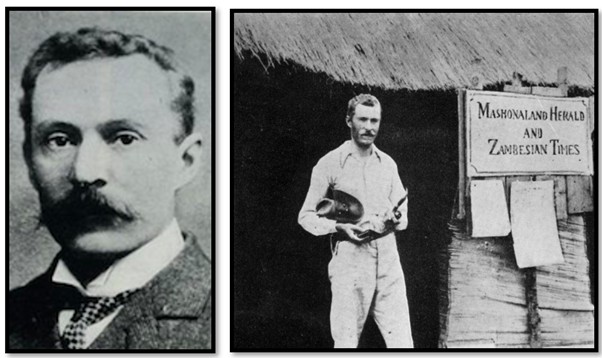
W.E. Fairbridge Offices of the Mashonaland Herald and Zambesian Times
Fairbridge constructed the inking roller for his cyclostyle machine from imported treacle and locally produced glue cast in a German sausage tin. Early issues of the paper looked as if they had been blacked out by a severe censor. Owing to the scarcity of paper, the editor was often compelled to use anything he could find, and some of the issues appeared on double-column money foolscap.
Fairbridge, apart from writing the whole of the paper by hand - and his writing was excellent - was his own sales agent, riding round the camp to deliver the paper. As there was no silver or change to be had, he frequently took payment in kind. The charge was a shilling a week; that is for one issue. Items taken included such things as a packet of candles, a pot of marmalade, and even, in one instance, an old spade. Nevertheless, it was a paying concern.
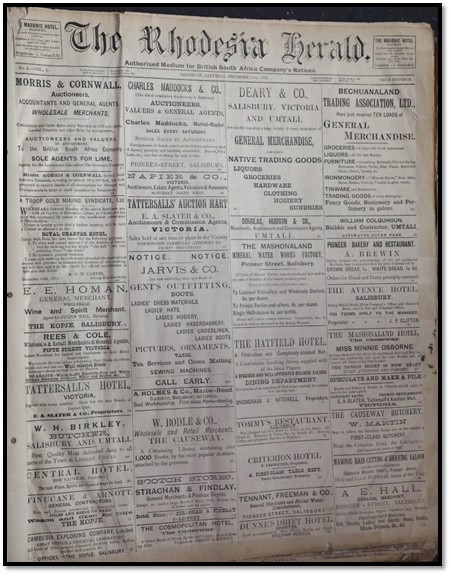
NAZ: an early edition of The Rhodesia Herald
The Mashonaland Herald ran for something like a year as a cyclostyled production before Mr Dormer, the managing director of the Argus Company in South Africa sent up a complete printing plant, with instructions to Mr Fairbridge that the board had decided that the title of the paper should become The Rhodesia Herald - possibly the first use of the word ‘Rhodesia’ as a compliment to Mr Rhodes.
The first number of the type-set paper appeared on 29 October 1892, the year which saw the telegraph line to Salisbury completed, the Beira Railway Company floated, the first brick church erected, the first bank opened and Government offices built.
Meanwhile, to bridge the gap between the cessation of the cyclostyled ‘Herald’ which ceased publication on the 8 September 1892, several printed issues of a four-page paper called ‘News and Advertisements’ were brought out by Mr Fairbridge. It was about this time that a cyclostyled paper was issued at Fort Victoria (now Masvingo) which threatened to come to Salisbury to “wipe out” Fairbridge, but it died before the transfer could take place.
The four pages of ‘News and Advertisements’ sold for 6d and it was a strange, if useful production. A line under the main heading of the front page of the issue of 17 September read: “Issued pending completion of arrangements for the printing of the forthcoming Rhodesia Herald.”
A publisher’s notice carries the story further; “In bringing out this little sheet of news and advertisements - the very first matter ever printed in Mashonaland - the publishers ask the public to bear in mind the fact that only a portion of the plant, type and material is as yet to hand, and that the first issue of that long and ardently awaited newspaper will not appear for several weeks to come.”
It is clear from the issue before us that type at any rate was in short supply, for the issue is set in a wide variety of very large types suited to advertisements and handbills. The back page carries the apology: “The news matter in this publication has been set up in ‘jobbing type’ in default of the usual type which, together with full sized printing paper, is daily expected. This will account for several shortcomings and ommissions (sic) more particularly in our report of the races, where, through the insufficiency among the type of tHe letter M, gentleman riders do not get the usual Mr before tHeir names.”
Eighty percent of the news space of this issue was taken up with the report of a two-day meeting of the Mashonaland Turf Club. There is a brief announcement of a Pioneer and Police dinner, and the following paragraph: “On Friday Mr and Mrs Pascoe became the happy parents of a fine young Rhodesian, the first white child, we believe, born in Salisbury.”
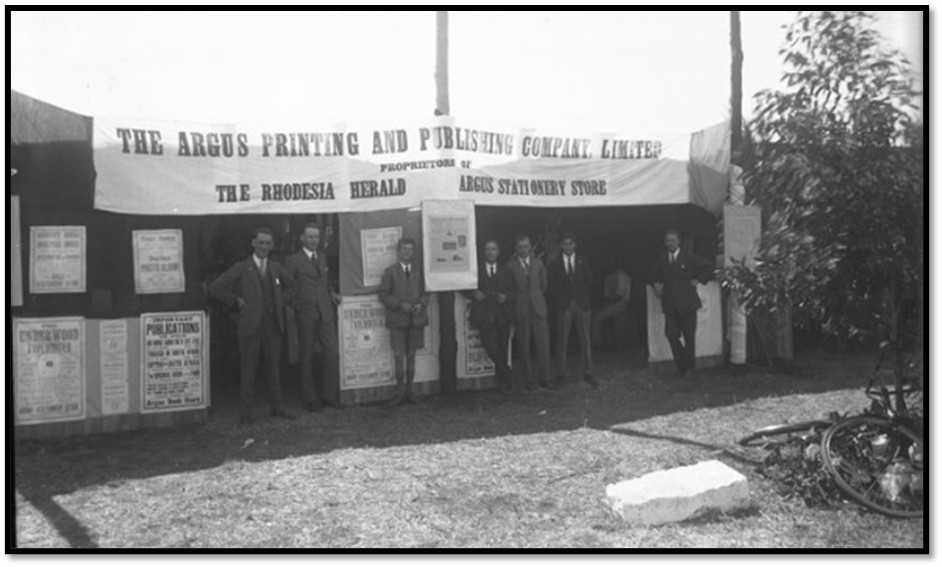
NAZ: Stand of The Rhodesia Herald at the 1953 Central African Rhodes Centenary Exhibition
Other interesting items in this issue are: “On occupation Day in the evening a large bonfire was lit on Market Square and attended by the public. Cheers were given for His Honour the Administrator, and a free drinks round were ordered by some gentlemen present.” “Mr Rhodes and Sir John Siveright were thrown from a cart at Touws River, but both escaped unhurt.” “14 September. Special. Amidst ringing cheers from a crowd of 2,000 people representing all classes of Randites, the first thro train from Cape Town full of passengers steamed into Park Station at 11:43 today after doing the journey in 62 hours.”
The first copy of the Rhodesia Herald on 29 October was of four pages of the same size as the present pages of The Chronicle. The front page was all advertisements - hotels and bottle stores, auctions, coaches, blacksmiths and farriers - with special emphasis on liquors and cigars. The second page contained public notices, with a few ‘smalls’ and two leading articles. Then followed, overflowing on to the other pages with no break, eleven almost unbroken columns of news in the same type as this article and with only a few very tiny headlines.
Worthy of preservation is the first paragraph of the initial ‘leader:’ “There is a contemptuous view of journalism which rates the functions of the press lower than worthy of honest men's esteem, and there is the exaggerated view which regards its powers as mightier than those of angels, good or evil. The truth - doubtless is to be found in the mean between these estimates, and a newspaper may be well content to take the homely status of a news collector, news distributor, notebook and an echo of the public mind of the time being.”
The Bulawayo Chronicle appeared two years later, on 12 October 1894, a few days after the production of a cyclostyled paper, ‘The Matabeleland News’ which had only a short run. In his reminiscences, Fairbridge wrote, “The Herald parted with some of its best men to inaugurate another Argus newspaper at Bulawayo, The Chronicle, and particularly in the person of Mr J.W. Howard, who became manager and editor of that very successful paper.”
The first issue of The Chronicle consisted of four pages of eight columns each. The leading article of the first day was entitled, “We Make Our Bow.” It contained the following passage, “Bulawayo, long the centre of unspeakable crimes against humanity, has already taken its place as one of the brightest spots in a civilised and virile state, and the journal which makes its appearance today is launched with unbounded confidence in the future of the country whose fortunes it must plough.”
References
‘Anon. The Story of the Pioneer Press: Progress by Rhodesian Newspapers
The Chronicle, P35. 3 July 1953. Rhodes Centennial.
The Rhodesian Graphic Jubilee Number: Southern Rhodesia 1890 – 1950: A Record of Sixty years progress
https://archive.org/details/SouthernRhodesia1890-1950ARecordOfSixtyYearsProgress/page/n77/mode/2up
Notes
[1] William Ernest Fairbridge (1863 – 1943) was the publisher of Rhodesia’s first newspaper the Mashonaland Herald and Zambesian Times in 1891. He also served as Salisbury’s first Mayor in 1891. Described by Marshall Hole as a man, "whose indomitable pluck in the face of endless discouragements deserves an honourable place in the history of journalistic enterprise." He later became the general manager of the Argus Group of newspapers in South Africa and managing director of the Cape Argus
[2] According to the website ‘The handwritten Newspapers Project’ had a weekly circulation of about 180 copies https://handwrittennews.com/2011/07/13/mashonaland-and-zambesian-times-zim-1891/