
White Rhino Shelter – Matobo National Park
GPS location: 20° 28´ 35"S 28° 31´ 25"E
Cran Cooke in his introduction to the rockart of the Matobo / Bulawayo area writes that that the small overhang so close to the road to Malindidzimu (World’s View) contains some of the finest examples of outline San art in the country - this is no exaggeration. The strange almost disproportionate outlined appearance of five wildebeest is mirrored perfectly by the artist. The heavy shaggy coat over the shoulders with dark vertical stripes and slender spindly legs led to their description by early hunters of “wild beast.” Wildebeest have a unique body profile that features a high forequarter, then a sloping back that tapers down towards the hindquarters. Even the hooves are shaped individually and the effect of the shaggy coat is achieved in a minimal way by emphasizing the hairs at the top and bottom of the body and the vertical lines.
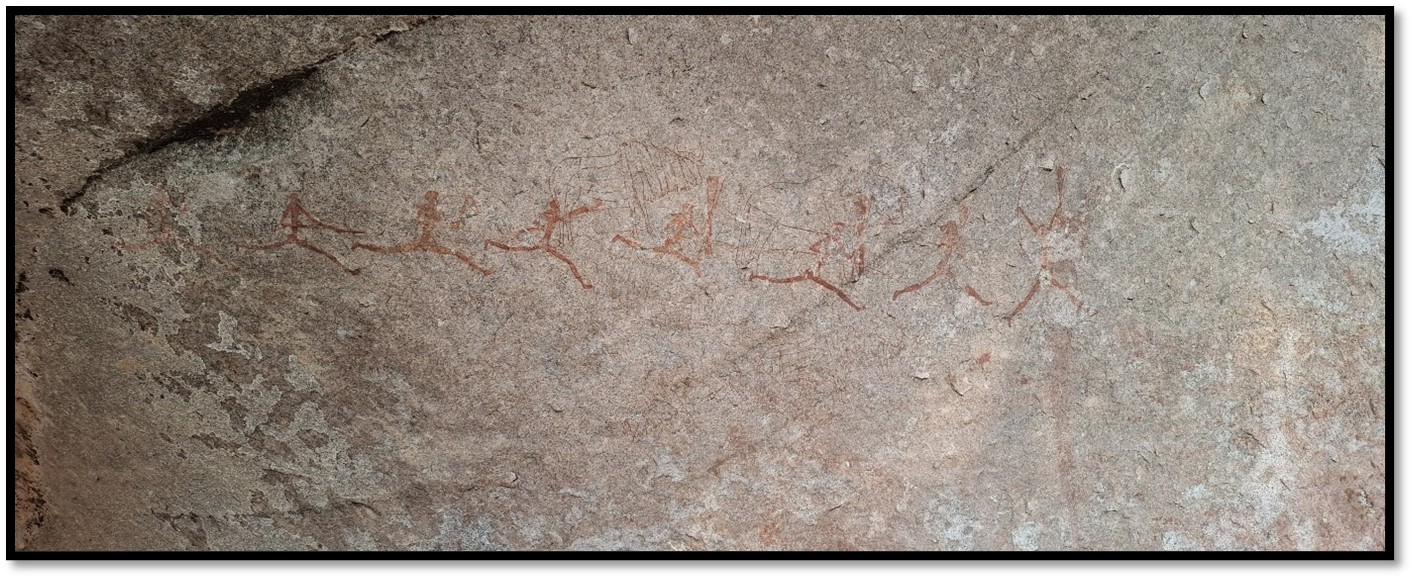
Image of the wildebeest and San hunters frieze – one of the best executed and finest scenes in Zimbabwe
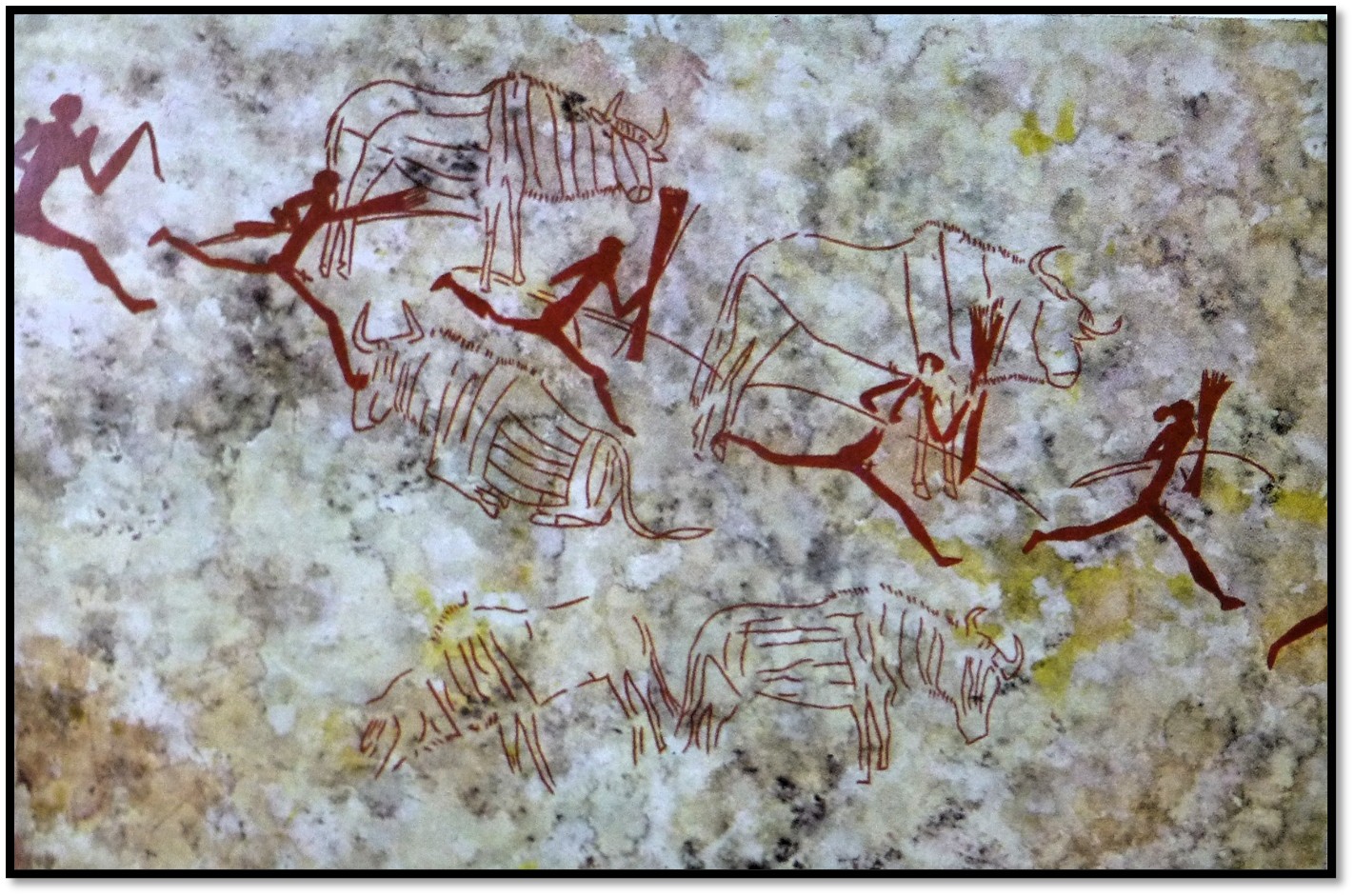
Cran Cooke’s painted depiction of five of the eight running hunters and the five wildebeest
The wildebeest below the line of hunters have become very much faded in comparison to those above the hunters – fortunately we have Cooke’s illustration to remind us of how the original frieze looked. The more detailed wildebeest are above the line of solid painted hunters, the remaining three including one wildebeest lying down just below them. The two standing wildebeest below the hunters appear to have been drawn in less detail.
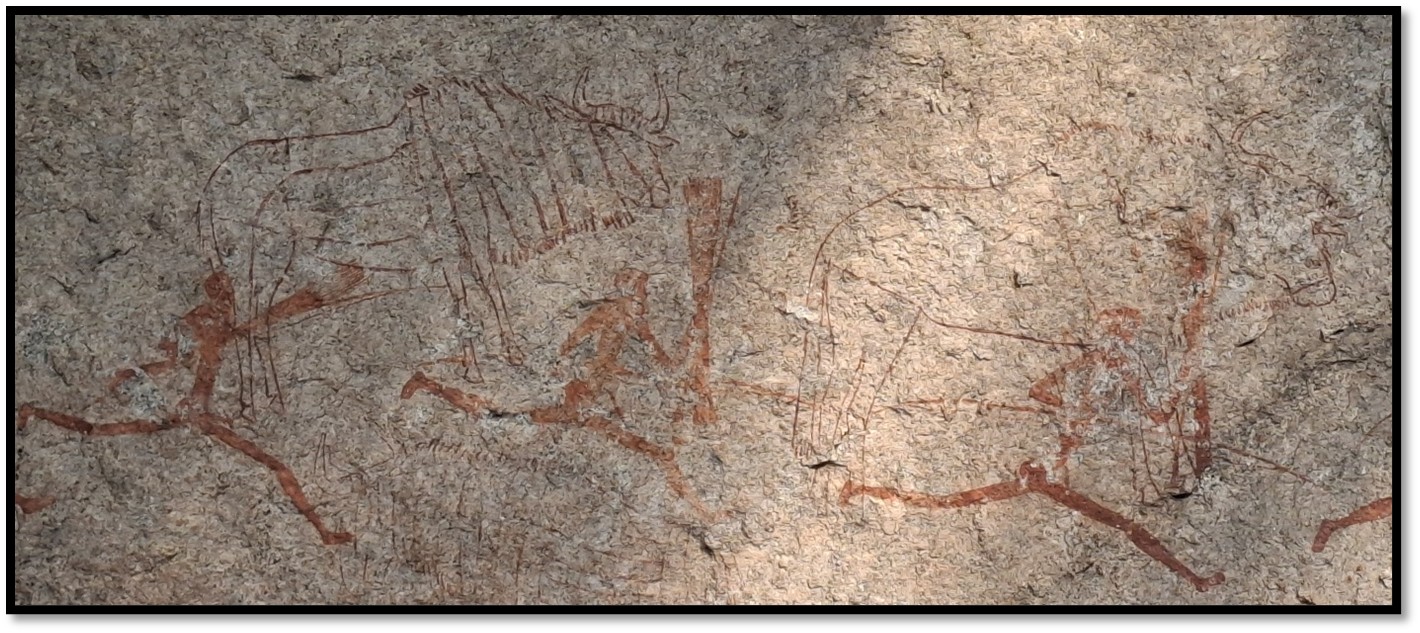
Closeup of wildebeest and hunters
The eight hunters are depicted in full stride running from left to right; the last three hunters on the left appear to be carrying sticks rather than bows and quivers. The other five hunters have bows all realistically shown at different angles as one would expect of hunters engaged in a chase; their arrows are shown in great detail protruding from their quivers Cooke says the wildebeest are superimposed upon the hunters; he may be correct, but it is difficult to tell as faint ochre of the fourth and sixth hunter’s bodies does not obscure the wildebeest outlines.
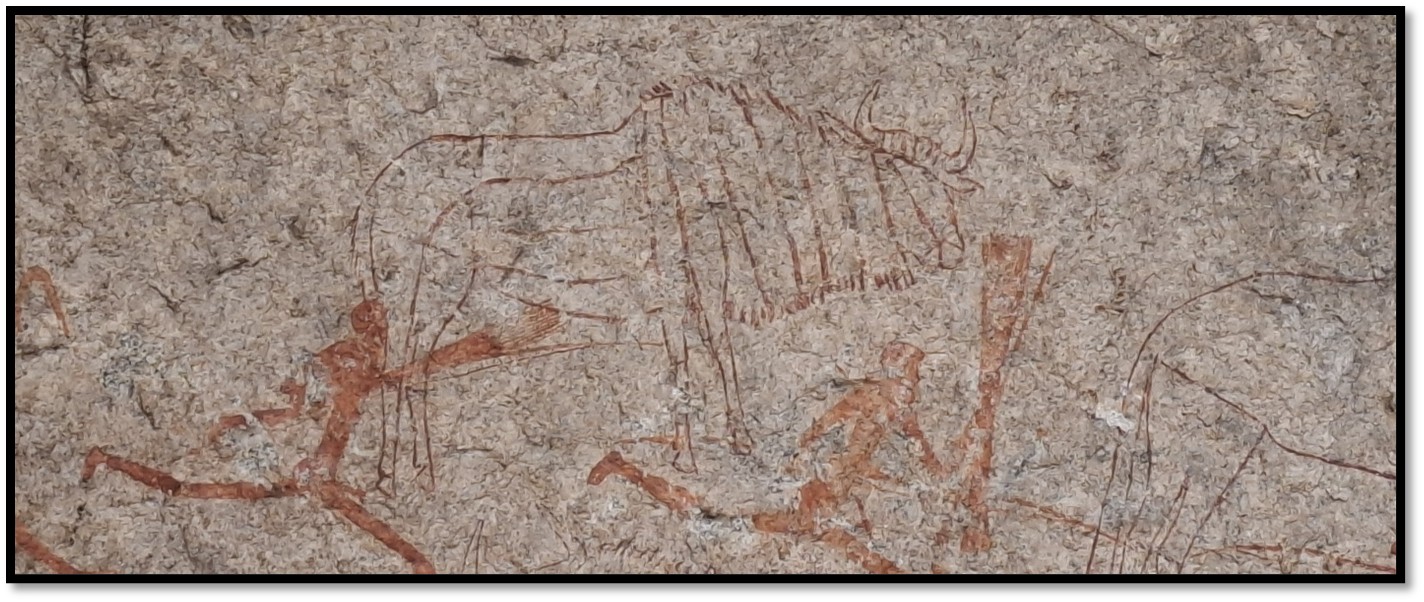
The wildebeest above the line of running San hunters are drawn in exquisite detail and the proportions are drawn true to life.
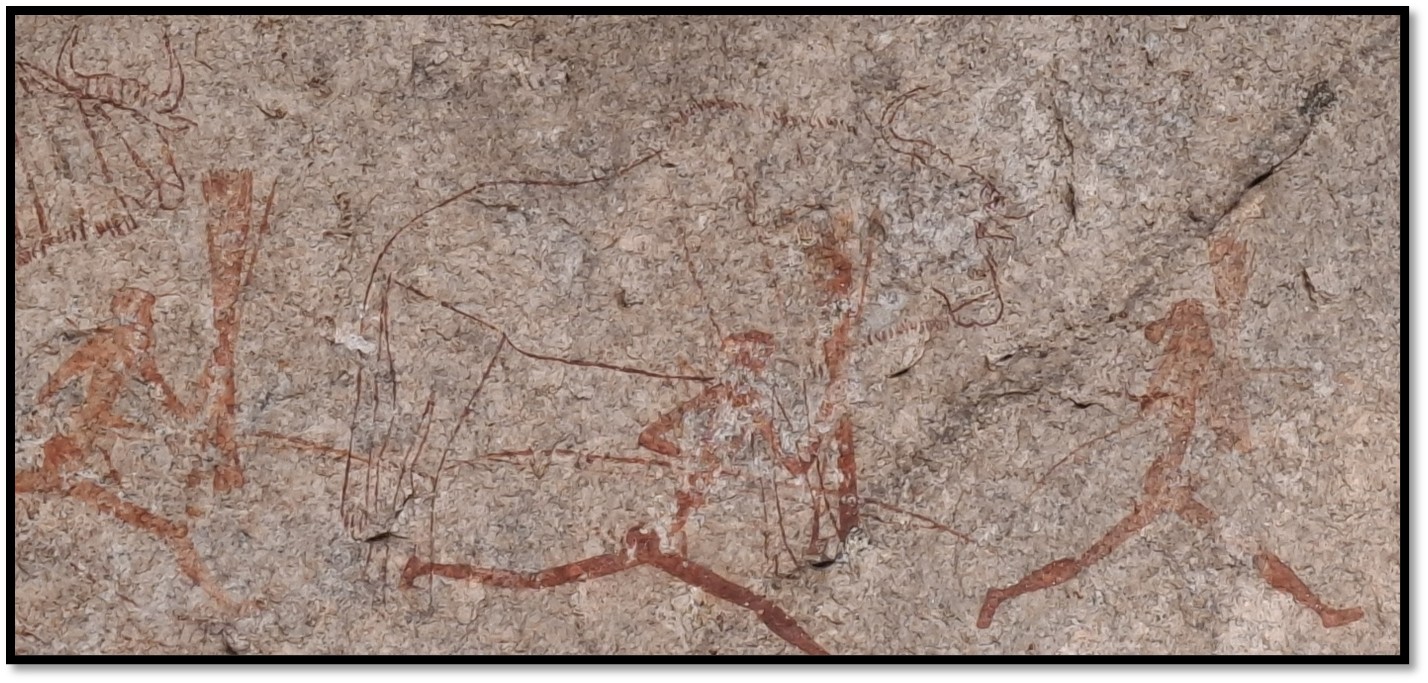
Enlarged image of the second wildebeest and San hunters to the right of the first wildebeest
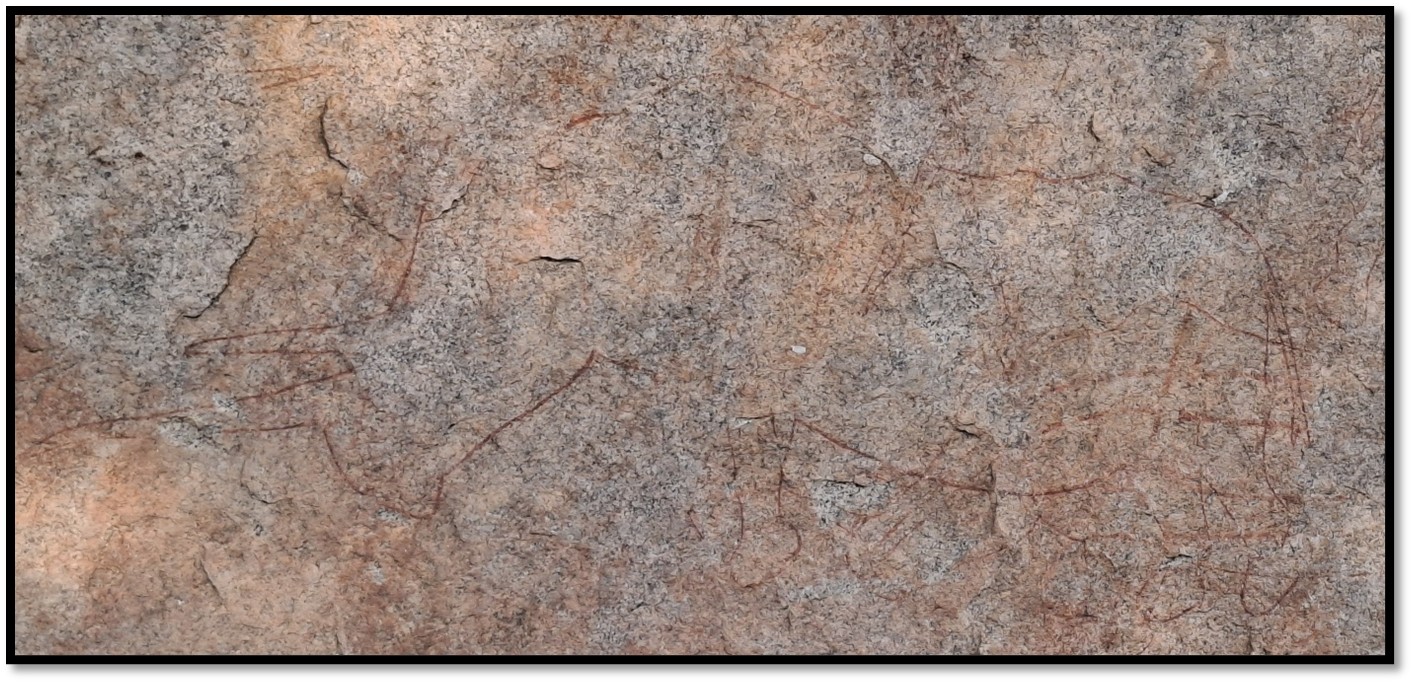
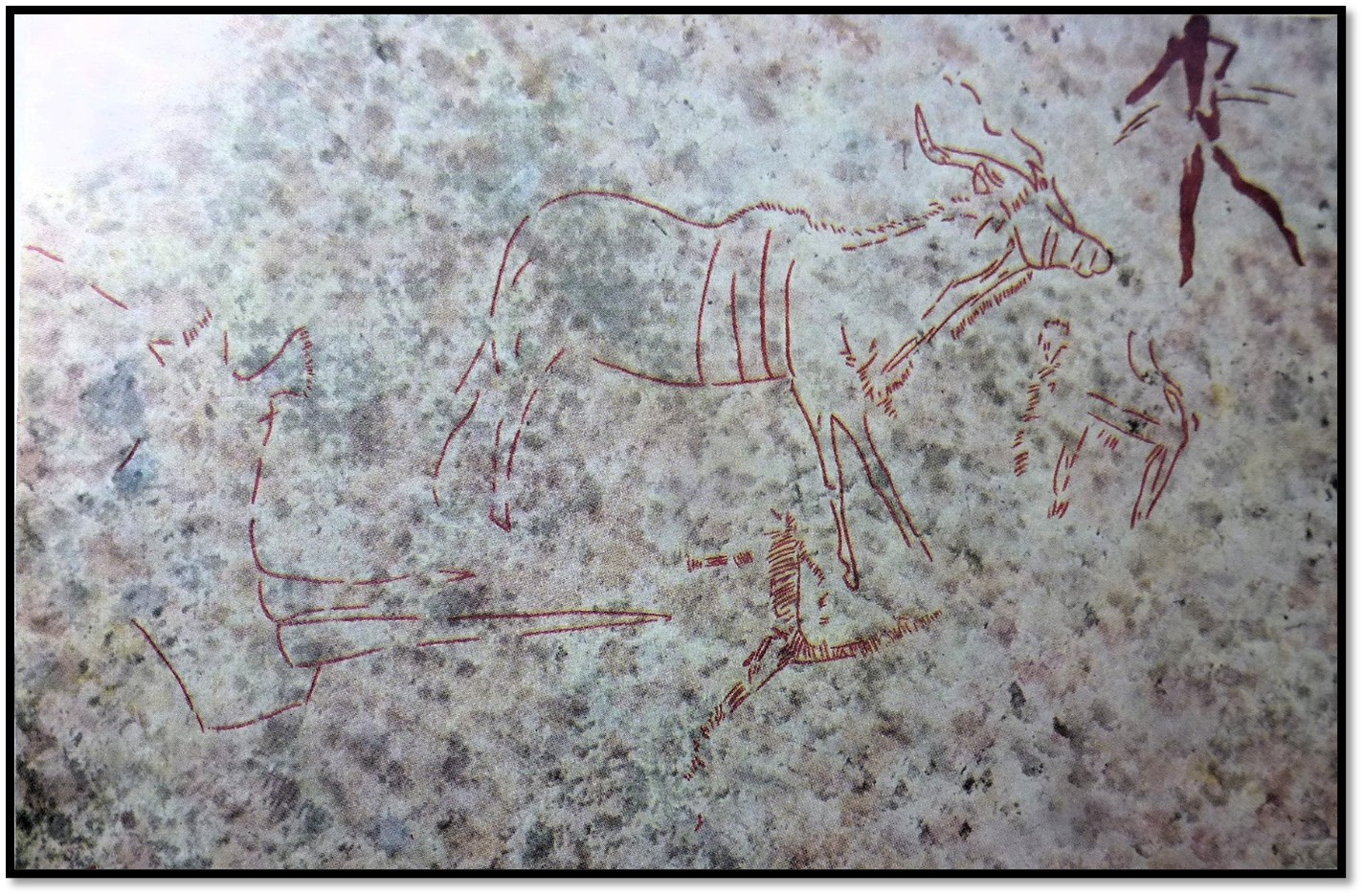
The outline of the rhinoceros is becoming faint; Cooke’s outline below may help the reader see its image in the photo above. The outline of the male figure is even more indistinct.
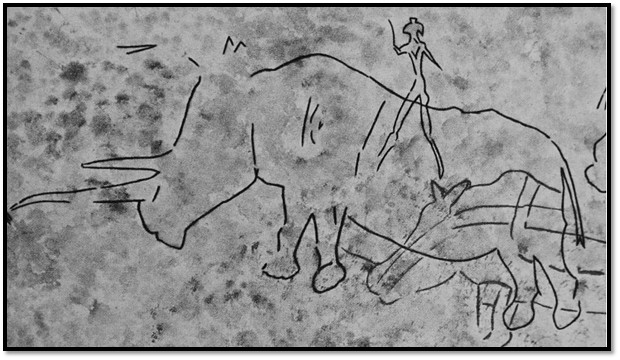
Cooke: Image from A Guide to the Rock Art of Rhodesia
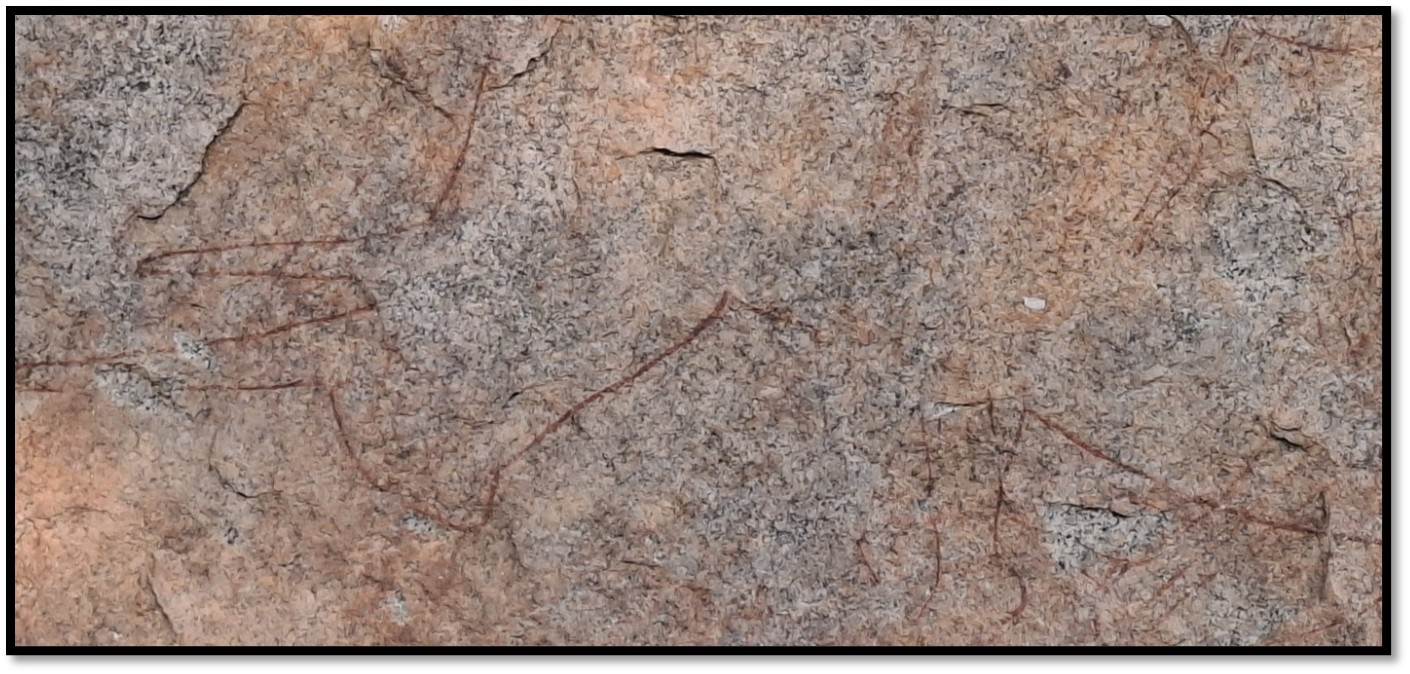
Enlarged view of the rhinoceros’ image The long skull of the white rhino very obvious here and one of its defining characteristics. White rhinos also carry their heads lower than black rhinos.
These images that Cooke writes are on the far right of the frieze I missed completely and will have to photograph on another visit.
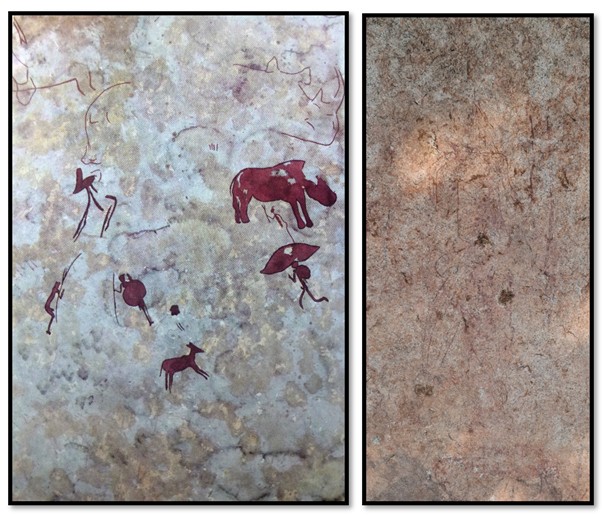
Peter Garlake writes that there are the outlines of five large rhino and that traces of them can be seen under the belly and behind the white rhino photographed above. Also human figures similarly underneath and to the right of the rhinos. These all seem to have faded completely or become indistinguishable.
One of the figures Garlake describes as having a conical headdress, carrying a stick with rattles on its shoulder and a line from its penis. He says the Henri Edouard Prosper Breuil (28 February 1877 – 1961 often described as Abbé Breuil described this figure as “a stranger with something of an Assyrian Air.”
Finally, at the base of the shelter Garlake describes a group of birds, a hippo, hunters, a female gatherer with a large bag slung across her body and a thin figure with a line coming from its body. All seem to have faded and were too faint for me to identify.
References
C.K. Cooke. A Guide to the Rock Art of Rhodesia. Trustees of the National Museums and Monuments of Rhodesia. Longman Rhodesia (Pvt) Ltd Salisbury, 1974
P.S. Garlake. Painted Caves: Prehistoric Art in Zimbabwe. Modus Publications (Pvt.) Ltd, Salisbury 1993