
Rhodes’ Three Peace Indabas
This article is taken from the Rhodes Centenary Supplement published by the Chronicle in Bulawayo on the 3rd of July 1953. The author was Jeannie M. Boggie after an interview with Mrs Alphonse Colenbrander (née Elizabeth Mullins) who came up as Mrs Smith and was Mollie Colenbrander’s sister. There were actually four Indaba’s. The article reflects the attitudes and opinions that were prevalent at the time.
Mollie Colenbrander was married to Johan Wilhelm Colenbrander who became the British South Africa Company’s representative at the King’s kraal or Umvutcha in 1889. He spoke the Zulu language fluently having been brought up in present day Kwa-Zulu Natal and often acted as Lobengula’s interpreter. Mollie was his first wife but died in 1900 and he remarried in 1902.
My sister, Mollie Colenbrander and I are the two women of whom Sarah Gertrude Millin speaks in her book Rhodes, “Rhodes, with him four other white men - two bringing their women - set out on horseback to meet the Matabele chiefs.”
Historically, this is not quite correct and the true story of how I came to be associated with Rhodes’ Peace Indabas is as follows:
In August 1896. I had arrived in Bulawayo on a visit to Mollie. That same evening, Mr Rhodes came to see Mollie's husband, Johann. He told Johan that he was terribly worried about the difficulties connected with the Matabele Rebellion. Rhodes and Johann both knew that the food problem in Bulawayo was becoming serious, owing to rinderpest having been responsible for the terrible cattle losses. Also, the expense of keeping troops in the field was very heavy. [It was obvious to all that the military force was too small to subdue the amaNdebele and General Carrington came to the conclusion a force of ten thousand soldiers would be necessary. Rhodes said the BSA Company could not face this scale of expenditure and made up his mind only a speedy peace would help.]
Rhodes had made up his mind that something must be done at once to try to end the fighting; he thought the rebels might be only too glad to surrender if given the chance. They had suffered several severe defeats and were now sitting tight among the caves and hills of the Matopos and reported to be almost starving. Rhodes’ idea was to go with a few friends to the camp of the troops at Umlugulu, [a fort on the eastern side of the Matobo that can still be visited] open negotiations with the rebels and then go unarmed with Johann only to meet the chiefs and discuss the situation. He insisted that he should have Johan as interpreter.
Johann agreed. But Molly gasped, “Oh no, Johann. Too dangerous. They are killing every white person they can find. Impossible, I refuse to let you go.”
Rhodes had no such word as impossible in his vocabulary. One of his well-known sayings was, “Never think a thing is impossible. Make up your mind to do it and mostly you will succeed.” [The Indaba was held against the military advice of Lieut-Gen Carrington, but Rhodes felt if he listened to the Induna’s grievances, he might be able to fix things and so it proved.]
Cleverly and at once Rhodes asked Mollie if she would consent on condition that she and I accompanied the party to Umlugulu. Molly and I left the room to discuss the suggestion. Then we consented.
Early next morning we started in two wagonettes. The party consisted of Rhodes, Mr (later Sir) James G. McDonald, Doctor Sauer, Vere Stent, war correspondent for the Cape Times, Johann, Mollie and myself.
There was also an old black woman who sat with her legs hanging out over the end of the wagonette. I supposed her to be a servant, but one of the party told me she had a very important job to do in Rhodes’ peace negotiations. She was the mother of one of the rebel chiefs and had previously been taken prisoner. [She was Nyambezana “child of tears” one of the few surviving wives of Mzilikazi and the mother of Nyanda, who was with Sikombo.] The old lady was to be sent, alone, in charge of one of Rhodes' trusted servants [actually J.P. Richardson, District Commissioner for Essexvale, now Esigodini district] to a hill where the rebels could see her. She was to shout to the rebels that if they wanted peace they could come and talk about it with her. This was Rhodes' plan to open negotiations.
At Umlugulu the flies were awful and Rhodes got so angry with them that he wanted to camp outside. However, after Mollie and I had been consulted, it was decided to remain within the camp. despite the flies.
The first Indaba [Friday, 21 August 1896]
I remember the old black woman being carried to a small mountain where a hut was erected for her. She had been given two flags, one white, the other red, and was instructed that if the rebels wanted to continue fighting she was to fly the red flag under the white one. Several days passed, then there was great excitement for Rhodes’ messengers reported that the white flag was flying alone - the sign that the rebels wanted peace.
A messenger was sent to begin negotiations [John (Jan) Grootboom and James Makunga] and the chiefs asked for Johann, who was known and respected by the natives. They said they were afraid to ask for such a great man as Rhodes, but they begged that no more than four white men be present at the proposed indaba.
Rhodes insisted on going and he set off accompanied by Sauer, Johann and Stent. When they returned safely, Johann gave Mollie and me all the news. About forty chiefs had been present. Rhodes stood up to address them and forgot the proper native greeting. “What's that word again, Johann?” he asked. “Umhlope” replied Johann, “It is the customary salutation of peace after war.”
The chiefs poured out their grievances, one being that they were driven to rebellion mainly by the official bullying of the native police. These had become “the masters of their fathers,” as one old chief put it. Rhodes promised to help all he could.
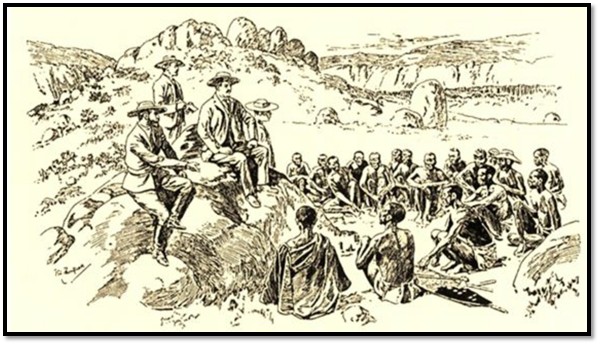
A sketch of the First Indaba by Lt-Col (later Lord) Robert Baden-Powell who was at Fort Umlugulu
Once, when the party glanced at their horses, which were tied to a nearby bush, they saw that the animals had become tangled up with the reins about their legs. If the rebels had intended treachery, no white ma n could have mounted instantly and galloped away. “Were they afraid?” I asked Mrs ‘Phonsie’ She smiled and said “Yes.”
Johann said there was great delight among the chiefs when tobacco was handed around. The indaba ended by the chiefs agreeing to bring all the other chiefs and their followers to another indaba.
The Second Indaba [Thursday 27 August 1896]
Next Thursday, Mollie and I accompanied Rhodes and six or eight other white men to the place selected for the second peace indaba. We were all mounted on reliable horses. There was only one side-saddle available, so Mollie rode a man’s saddle, sitting sideways. Johann told us not to dismount, so Mollie and I stayed under the shade of a big tree close to the indaba. We heard every word that was uttered. [Those present included Rhodes, Johan and Mollie Colenbrander, her sister Mrs Smith, Chief Native Commissioner H. Taylor, J. Grimmer, J. G. McDonald, FitzStubbs, Mangwe Native Commissioner, Bonar Armstrong. Colonel Plumer, Lieut Moncrieff, Tpr Laurie, Vere Stent (Cape Times) and Witt (Bulawayo Chronicle)
The danger of this second indaba was thoroughly appreciated and our instructions - awful instructions - were that if the rebels began to kill the white men, Mollie and I should gallop to Fort Usher, about a mile away. The guns at the fort were trained on the spot and the garrison with horses saddled, stood to arms during the indaba.
I remember how the chiefs soon began to arrive, dressed mostly in skins. They were in a miserable, wretched condition. As they were carrying assegais, guns and shields, Rhodes got Johann to inform them that all arms must be laid down before he could speak to them. Rhodes was unarmed; the others carried revolvers carefully concealed. No cameras were allowed.
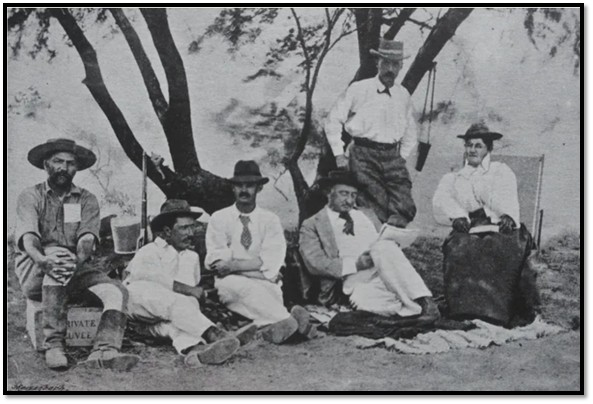
Frank Sykes; (L-R) Johan Colenbrander, J.G. Macdonald, Rhodes secretary, Rhodes, unknown, Mollie Colenbrander at the second Indaba
Tell them, Johann,” commanded Rhodes, “that I come with peace in my heart. I do not come to fight when I have women with me.” Then he pointed to Mollie and me and Johan heard old Babyaan say, “Yes, it will be all right. Johwane (as they called Johan) has brought his N’Kosikas and another N’Kosikas.”
The main question discussed was whether it was to be peace or continuation of the war. The younger warriors, of whom great numbers were present, appeared to be still eager to kill every white person in the country; their remarks began to border on the insolent. But one of the big chiefs, Dhliso, authoritatively and successfully called for silence.
While the white men were mounting., Mollie called to Babyaan to come to speak with her. She begged him to do what he could for peace. He agreed. Afterwards, Rhodes praised Mollie for that bit of diplomacy and said that our presence had helped him greatly. Later, Rhodes remarked that if the young warriors had got out of hand, not one of the party would have escaped.
The Third Indaba [9 September 1896]
Following the second indaba, Rhodes gave my brother, Lieutenant Mullins, £30 to go and collect all the rebel chiefs for a third indaba. Meantime, he moved his camp from Umlugulu closer to the strongholds of the rebels. The chiefs were encouraged to visit him; day after day they arrived until Rhodes' party became exasperated with their yapping. Not so Rhodes - we all thought his patience in listening to their grievances was marvellous.
[The third Indaba was held at Fort Usher: present were Sir Richard Martin, Queen Victoria’s representative with an escort of twelve mounted Lancers, Earl Grey, the Administrator, Rhodes, Colenbrander, Rev. D. Carnegie, Father Barthélemy, Chief Native Commissioner H. Taylor, Col. Plumer, Major Robertson, Lady Grey and her daughter and Mollie Colenbrander]
I remember a good story. Rhodes asked one chief if he and the others really thought they had a chance of succeeding in the rebellion. “Yes,” came the reply, “We felt sure we could beat you. But we know now we could no more beat you than we could lick our elbows.” After the chiefs had gone Rhodes and all of us tried to lick our elbows. We couldn't!
Before the third indaba I had gone back to Bulawayo, but Mollie and Johann remained. Johann acted throughout as Rhodes' interpreter. Mollie told me all about it. The third indaba was an official one - an imposing, spectacular affair, with the recently appointed Administrator Earl Grey, Lady Grey and many other notables present.
Rhodes told the rebels that Earl Grey had come in the name of the Great White Queen to tell them about the terms on which the Queen would accept their surrender. They must give up their arms, come down from the hills and plant their crops.
Finally, in October there was another, but smaller indaba, when complete understanding was reached. Rhodes bade the chiefs farewell. “Forget the past,” he urged, “Be loyal to your Queen and to the promises you have made to me. I don't think you will want to fight again.” “No, no,” came in a shout from the chiefs.
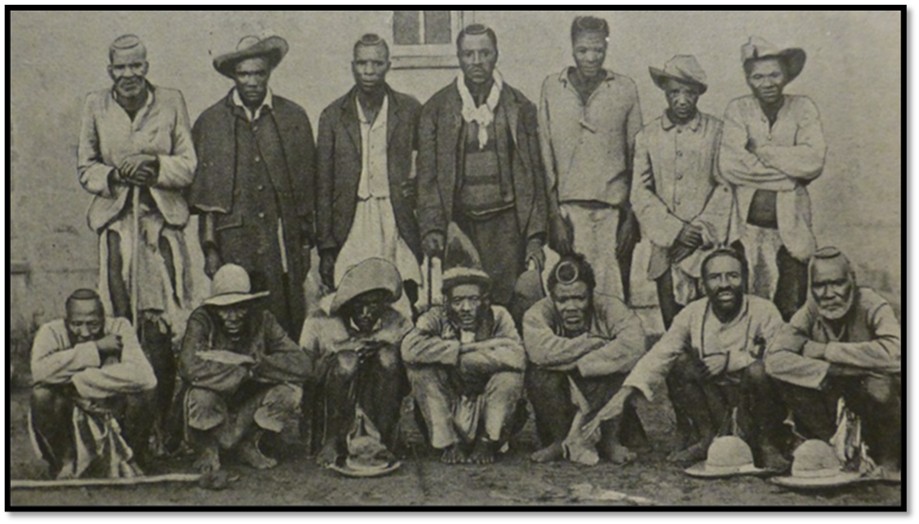
NAZ: amaNdebele Chiefs at the Indaba negotiations following the Matabele Rebellion (Umvukela)
Back (L-R) Faku, Ndibali, Malevu, Sikombo, Mbambeleli, Mazwi, Nhlukoniso
Front (L-R) Mapisa, Somabulana, Nykomo, Mtokana, Manyoba, Umlugulu, Mlegela“
References
Elizabeth Colenbrander as told to Jeannie M. Boggie. Rhodes’ Three Peace Indabas. The Chronicle. 3 July 1953. Rhodes Centennial Supplement, Page 41
Sarah G. Millin. Rhodes. Chatto and Windus, 1933
Jessie M. Lloyd. Rhodesia’s Pioneer Women (1859 – 1896) Rhodesia Pioneers' and Early settlers' Society, 1960