
Our Covered Wagon Heroines
This article is taken from the Rhodes Centenary Supplement published by the Chronicle in Bulawayo on the 3rd of July 1953 Page 43. The author was Margaret Cawood[1] The article reflects the attitudes and opinions that were prevalent at the time. Additional sources have been used and notes added.
“An Eveless paradise” was the description given to this country by one of the Pioneer Column in 1890; and he did not only mean the country as the column found it, but for at least a year or so after the occupation. But this amusing masculine label was not entirely correct for women were living and struggling in Rhodesia when Cecil Rhodes was only six years old.
The experience of these early women settlers shows us how much, and how little, this country has changed; for some of their troubles are so very similar to our own, though their major difficulties prove how far every year of progress has taken us from them.
Mrs Moffat[2] and Mrs Thomas, who arrived at Inyati in 1859, were forty-two days in the ship that brought them from Britain to South Africa. From Cape Town the entire journey of nearly sixteen hundred miles had to be endured in ox-wagons. “It was deplorably slow work and such long pauses! We do literally creep. If Africa is destined to be Christianised and civilised at ox-wagon pace, the end of the world cannot be so near as some believe.” This was the feeling comment of Mrs Emily Moffat.
The journey from Kuruman to Inyati (Inyathi) in more detail
On 14 July 1859 three ox-wagons left Kuruman with John Moffat[3] and his wife Emily, Thomas Morgan Thomas and his wife Anne, eight Kuruman artisans and two girls carrying two years supply of stores. Robert Moffat and William Sykes left on 1 August and the party united at Bakwena.
After a long and hard journey, frequently short of water, they reached the amaNdebele outposts and Mzilikazi, now in Matabeleland, sent a messenger to say, “The king longs exceedingly to look on the face of Mtjete[4] again.” By 10 September they reached the western edge of the Matobo Hills at Makobi’s kraal and saw running streams once again but halted because they heard that cattle lung sickness had broken out and did not wish to spread it amongst the amaNdebele herds.
A messenger came and urged them to hasten on. Six days later, they were halted, Mzilikazi had sent his young warriors (Majakas) who inspanned themselves and pulled the wagons in relays, singing and chanting, to Mzilikazi’s royal cattle post at New Matlokotloko on the Bembesi river. Emily Moffat wrote, “I was surprised to see the eagerness and power of the men…the two sets of men had a race - it reminded me of the omnibus drivers vying with one another. We gained the advantage at first, and the lumber waggon, tortoise-like gained upon us afterwards. At any difficult place the men’s recourse was to sing very vigorously and then a mighty pull and on we went.”
The missionaries high expectations were soon dashed however, when Mzilikazi refused to discuss the possibility of a mission station, then after three weeks keeping them on tenterhooks, he inspanned his wagons and left them in solitude. Sykes kept the LMS directors informed, “We reached Moselkatse’s kraal on Friday the 28th of October 1859…His treatment of us till about a fortnight ago was peculiar. During the first three weeks we often saw him and generally made some effort for trading, but his unreasonable demands in nine cases out of ten, were an insuperable barrier in barter. He would ask twice, thrice or four times the price for different things which we required, that we could purchase those same things for at Kuruman, or from any other of the tribes lying between. My impression was, before long, that he designed to fleece us and send us about our business. Such was out getting on during the first three weeks.”
“On November 22nd, the King’s wagons were inspanned and away he led us to a town more than seven miles distant…During the next four weeks we were, to all intents and purposes, prisoners.” Their spirits fell just as the rains started leaving their camp a quagmire and messengers began to arrive from the king accusing them of being spies and demanding guns and ammunition from them.
Their spirits sank, although Moffat’s messages to the king were always dignified, as they were forbidden to move, or to hunt, when suddenly they were told the Inyati valley and its spring were for their use as a Mission station. Mzilikazi sent oxen and a guide, Monyebe, although the two day journey, in the wet conditions, took a week’s travel, before they forded the Ingwingwisi stream and trekked to the head of the valley, the long low hill of Ndumba (bean) behind, that was reached on 26 December 1859.
Monyebe said, “The king says ‘if the valley you see pleases you, it is, with the fountain, at your service. Choose where you wish to build and occupy as much land as you please. If you are satisfied, the king will be glad.’”
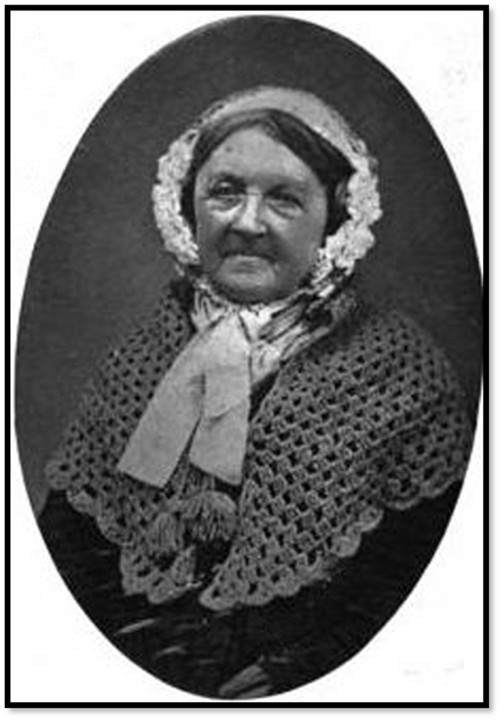
Wikipedia – Mary Moffat (1795 – 1871)
The fortitude of the missionaries’ wives seems almost incredible to us today.
When the Inyati party - the Moffat’s, Thomas’ and Sykes’ left Cape Town on the long trek all three women were expecting babies, as was Mrs Livingstone[5]who was travelling with them as far as Kuruman, the Moffat Mission station about halfway to Inyati and itself an outpost. They were going on a journey of many months into an entirely wild country where there would be no doctors, no nurses, no emergency medical supplies and they were women brought up in civilization and unused to hardship. Mrs Moffat’s son was born at Beaufort West and baby Morgan Thomas at Griquatown.[6] Then came the disastrous stop at Kuruman; both Mrs Sykes and her baby died, and also Mrs Moffat's four-month-old son.
But the missionaries continued on their way to Inyati. The year after they arrived in April 1860, Livingstone Moffat, the first Rhodesian born baby arrived. But in 1862 young Mrs Thomas died, as did her youngest child. Also in that year, the second Mrs Sykes had a daughter. Is it any wonder that by that time Mrs Thomas and Mrs Moffat were in poor health, worn out by great privation, babies, overwork, and a very real shortage of food?
It is, indeed, some of the household problems that bridge the years; above all ants...ants, black, red, sugar and the termites, the fifth column that infiltrates into Rhodesian households. The black ants swarm into the food and drink and the termites gnaw anything gnawable, even books and clothes. The Inyati party were pestered by them. It was, In fact, extremely difficult for them to get servants at all, but Mzilikazi eventually sent each missionary two of his little slave children, though the actual help given by these piccanins cannot have been very great.
But the Inyati women were comparatively fortunate. They were not without companions of their own sex as was Mrs Thomson, who arrived in Matabeleland in 1870.[7] She did not see a white woman for about five years, but she said she was quite happy at Hope Fountain Mission. Also, though they were at times short of food and in poor health, they did not suffer so much as the farmer settlers who came to the Eastern Districts nearly forty years later - the Martin Trek and the Moodie Trek. Bad luck, illness and death were waiting for these settlers wherever they settled. The fate of the Hesselman family is but one example. Called in to help by one of the young daughters, another member of the Martin Trek, found Mrs Hesselman[8]had been dead for two days, her husband was lying unconscious, the youngest child almost dead and three other children lying too ill to do anything.
But saddest of all is the story of Mrs Dunbar Moodie. Gordon le Sueur, one of Rhodes’ secretaries, tells us in his Life of Rhodes. In January 1897, Mrs Dunbar Moodie's two children fell ill and shortly afterwards her husband.[9] Then her youngest child was born, no other white person being near. When her baby was a few weeks old, her husband died. On his deathbed he wrote his will, but there were no witnesses to sign it. The woman was alone with her dead and sick and the will was declared worthless.
She decided to go to the mission station in search of medical attendance for her children and with these sick children and a baby in arms, she walked twenty miles in the burning tropical sun. Locusts then swept off her crops and rinderpest carried off all the cattle; and, to crown all, Mrs Moodie, the widow, received a letter from the Chartered Company to the effect that all her land, with the exception of the farm she was living on, was confiscated on account of non-occupation - this after paying £54 annually since 1893 and having the farm surveyed by order of the Company.
On his deathbed her husband directed her to see Rhodes about the cattle commandeered. To the last he pinned his faith on Rhodes' sense of justice. In Mrs Dunbar Moodie's own words: “After my land was taken after all are wandering and trials, with dishevelled hair and fever-stricken, I often went to his grave and called for help - called him, but he did not come. I could get nobody to live with me, and I was there, in that lonely wilderness with my little one stricken, smitten of God and afflicted and forsaken by man.”
But the tragedies were fewer as the country grew, though the difficulties remained. Early settlers who are still alive to appreciate our progress will tell you of the emergencies they themselves had to face. One particular appeal is told by a lady who is now a great-grandmother. It is of a frantic call by an almost hysterical neighbour. The neighbour’s young son, showing off in the bedroom, had managed to get his mouth over the entire brass knob with which the beds of those days were ornamented - but he could not get his mouth off the knob. Neither could his mother and the child was in danger of choking: he could not be left there for the hours and hours necessary to call for further help - something had to be done immediately. Our great-grandmother who was the standby of the district for emergency casualties hurried back with the distracted mother. Greasing the boy’s mouth, she dislocated his jaw to get him off the bed knob, quickly snapped his jaw back into place and went off home to carry on with her housework.
Today you'll hear these grand old ladies, listening to the complaints of their children and grandchildren about the troubles of modern life, telling them impatiently. “Inconvenience? Pah! You don't know what inconvenience means.”
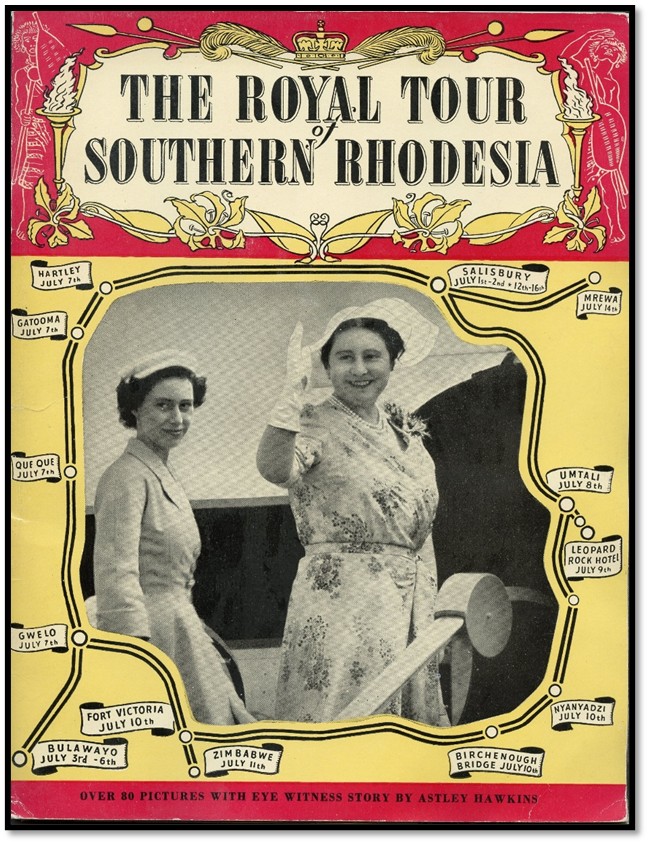
The Queen Mother and Princess Margaret, travelling by Comet to open the Central African Rhodes Centenary Exhibition, will touch down here in an easily countable number of hours after they leave London.
The 1953 Central African Rhodes Centenary Exhibition
The Centenary Exhibition was held at Bulawayo from 30 May to 29 August 1953 and was designed to celebrate the centenary of Cecil Rhodes birthday on 5 July 1853. As a secondary objective it signalled the start of the Federation of Rhodesia and Nyasaland (or Central African Federation on 1 August 1953.) The Exhibition was opened by Queen Elizabeth, the Queen Mother accompanied by Princess Margaret. George VI had died on 6 February 1952 and Queen Elizabeth II’s coronation took place on 2 June 1953.
They flew from Britain in a Comet jet airliner belonging to British Overseas Airways Corporation (BOAC) landing at Salisbury on 1 July 1853 where they were welcomed by Sir John Kennedy, the Governor of Southern Rhodesia. From here they took the royal train made up of fifteen freshly painted ivory white coaches (keeping them clean in the age of coal-burning steam engines must have been a nightmare!) The royal party had three airconditioned coaches left over from the 1947 Royal Tour of South Africa equipped with all the luxuries to which they were accustomed.
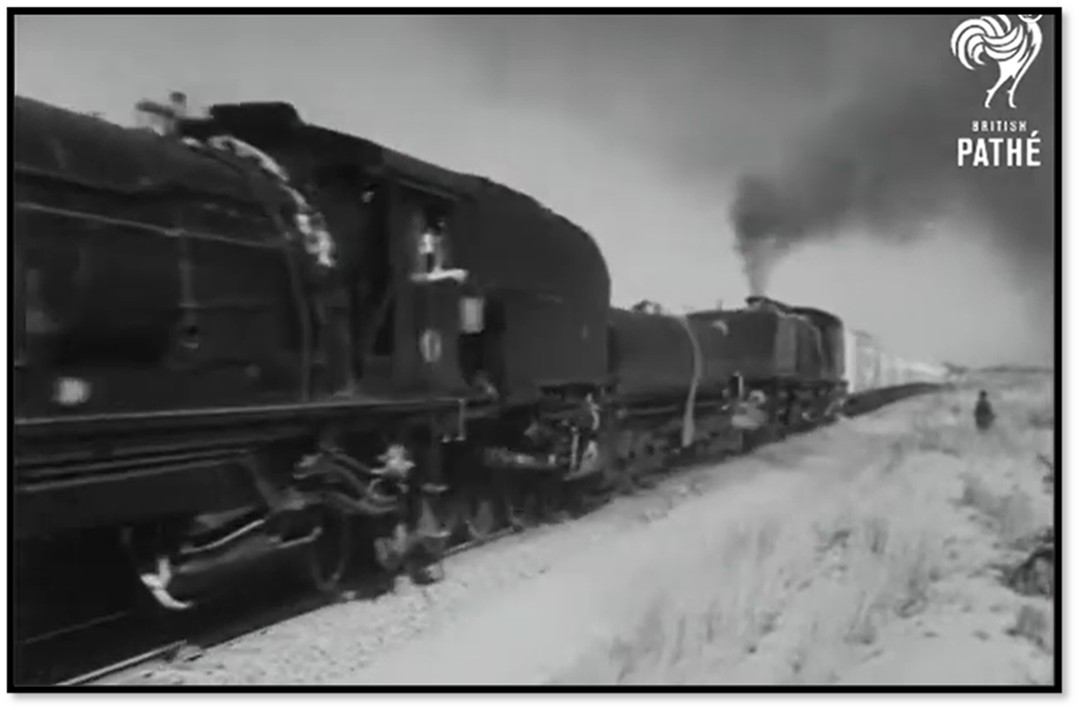
Two Beyer-Garratt 15th Class locomotives pulled the royal train
After an overnight journey, the royal party arrived at Bulawayo on 3 July where they were welcomed by the Mayor and an honour guard with the Queen Mother opening the Centenary Exhibition in the afternoon. The Bulawayo Chronicle reported twenty-five thousand people were present; the largest single gathering in Bulawayo. Next day they visited all the pavilions of the eighteen countries represented, where they accepted gifts and watched tribal dancing. In the afternoon there was a mayoral garden party in Bulawayo’s Central Park attended by approximately ten thousand guests.
Various activities were organised for the 4th; on the following day there was a visit to Rhodes’ grave at Malindidzimu in the Matobo Hills. Their visit to Bulawayo ended on 6 July with a pageant in Exhibition Park depicting scenes from Rhodes’ life and the royal train left in the evening for the start of the royal tour.
The Royal Tour of Southern Rhodesia
Salisbury July 1 -2
Bulawayo July 3 – 6
Gwelo, Que Que, Gatooma, Hartley July 7
Umtali July 8
Leopard Rock Hotel July 9
Nyanyadzi (between Hot Springs and Birchenough Bridge) July 10
Birchenough Bridge July 10
Fort Victoria July 10
Great Zimbabwe July 11
Salisbury July 12 – 16
Mrewa July 14
References
Margaret Cawood. The Chronicle. 3 July 1953. Rhodes Centennial Supplement.
Jessie M. Lloyd. Rhodesia’s Pioneer Women (1859 – 1896) Rhodesia Pioneers' and Early settlers' Society, 1960
S.P. Olivier. Many Treks made Rhodesia. Books of Rhodesia, Silver Series Vol 6, Bulawayo 1975
https://www.rhodesianstudycircle.org.uk/1953-central-african-rhodes-centenary-exhibition/
https://www.rhodesianstudycircle.org.uk/royal-tour-1953-queen-mother-and-princess-margaret/
Inyati and the activities of the London Missionary Society in Matabeleland from 1859
Hope Fountain Mission. www.zimfieldguide.com
[1] Margaret Cawood is possibly related to Elizabeth Anne Cawood (née Hulley who travelled up with her husband, niece and four sons by donkey wagon from Pretoria. Their experiences are told by her niece, Mrs. Carey, on pp. 293 to 300 in “First Steps in Civilizing Rhodesia,” by Jeannie M. Boggie.
[2] Mary Moffat (1795 – 1871, née Smith] was the missionary Robert Moffat’s wife, the mother of Mary Moffat Livingstone who married David Livingstone. Their first Mission station was at Griquatown before they moved to Kuruman in 1824.
[3] John Smith Moffat was the son of Robert Moffat. Like his father he became a missionary of the London Missionary Society (LMS) first at Inyati in 1859 before taking over the Kuruman Mission in 1865. He resigned from the LMS in 1879 and joined the Bechuanaland colonial service and was heavily involved in persuading Lobengula to sign the Rudd concession for the British South Africa Company. However he fell out with Rhodes over what he believed were his duplicitous methods
[4] Mtjete was Mzilikazi’s name for Robert Moffat
[5] Mary Livingstone (née Moffat) daughter of Robert and Mary Moffat, married David Livingstone in 1845. Mary initially stayed in Scotland with their five children but in 1858 she accompanied Livingstone on his second Zambezi expedition but became pregnant on the way out and left Cape Town with the party referred to by Mrs Cawood for her parent’s home at Kuruman and stopped there for the birth of her sixth child Anna Mary in November 1858
[6] Originally established as a London Missionary Society station Griquatown, now called Griekwastad is a small town in the northern Cape, west of Kimberley
[7] John Boden Thomson (1841-1878) and his wife Elizabeth (née Edwards) were both from Scotland and left Newcastle-upon-Tyne on 9 August 1869; arriving at Inyati Mission Matabeleland on 29 April 1870 where John Moffat, William Sykes and Thomas Morgan Thomas were already based.
Thomson met with Lobengula at his new kraal at KoBulawayo, which means, “we have been killed” o hoping to negotiate a location for a second mission station near the King’s new kraal. Lobengula gave Thomson permission to seek a new location. Thomson was assisted by Hartley and Baines and they found an ideal location besides a natural spring, and called it Hope Fountain Mission. The land was granted to the London Missionary Society on the 16 November 1870, with the King retaining right of possession if the Society ever left.
[8] Mrs Hesselman (née Gertruda Ferreira) referred to as Mrs Herselman (1894) in Rhodesia’s Pioneer Women (1859-1896) by Jessie M. Lloyd and in Many Treks made Rhodesia by S.P. Olivier. Husband was Jacob; children Fredericka, Jan, Gertruida, Magdalena, Jacob
[9] George Benjamin Dunbar Moodie was employed as the manager of the Sabi-Ophir Syndicate at the Bartisol Reef at Penhalonga in 1889 before the Pioneer Column arrived at Salisbury. Later he witnessed the capture of Col Paiva D’Andrade by Patrick Forbes at Mutasa’s kraal on Binga Guru and accompanied Dr Jameson and Doyle to visit Chief Gungunyana in Gazaland.