
Home >
Mashonaland West >
Dr Arthur H. Newnham’s personal account of the siege at Hartley Hill fort from 16 June to their relief by Capt White’s column on 22 July 1896
Dr Arthur H. Newnham’s personal account of the siege at Hartley Hill fort from 16 June to their relief by Capt White’s column on 22 July 1896
Acknowledgement
I am extremely grateful to Philip Crennell who spotted the article on the Hartley Hills fort on my website[1] and sent Dr Newnham’s personal account of the siege. There were three British South Africa Company (BSAC) officials at Hartley Hill at the time; Mining Commissioner Edward T. Carrick and District Medical Officer Dr Arthur H. Newnham, the author of this account. David Moony,[2] the Native Commissioner and most senior official, was away collecting hut taxes and was killed at the Nyamachecha river between Chief Chinengundu Mashayamombe’s kraal and Hartley Hill on the 15 June 1896, one of the earliest victims of the Mashona rising (First Chimurenga) Carrick left Hartley Hills for Salisbury on the evening of 17 June and was killed enroute leaving Dr Newnham in charge of the small group manning the fort. I have not seen any previous references to Dr Newnham’s account and as far as is known it is the only personal account of the longest siege of the Mashona rising (First Chimurenga) lasting 37 days and even exceeding that of the Abercorn siege that lasted 23 days.[3]
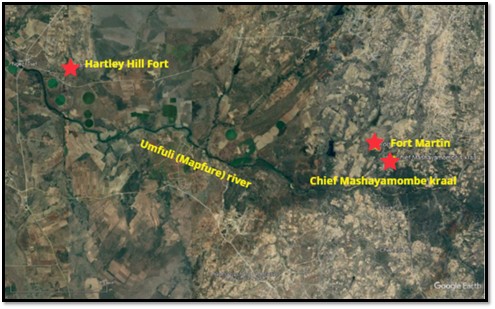
Google Earth image of the area in the article
Background
I think Peter Garlake’s introduction to his article The Mashona Rebellion East of Salisbury[4] best summarises the general situation in 1896-7 of the Hartley Hill district. “The initial murders and acts of heroism when the outbreak caught all settlers unawares, then a period of strong patrols, kraal burnings and reprisals, all largely ineffective, followed by equally ineffective attempts at conciliation, and finally, a realisation of the true obstacles to a settlement, a firmer definition of aims, consolidation, and strong and continuous action leading eventually to the crumbling of the rebel leaders.”
Arthur Newnham’s account – preparations prior to the siege
As will be remembered from my letters home, we, the inhabitants of Hartley, had built a very strong fort, on the top of the kopje (small hill) where the Hospital and most of our residences (huts) were; this we did hearing that the Matabili[5] were raiding within 60 miles of us and intended paying us a complimentary visit. Hartley Hill is a station nearly on the borders of Matabililand[6] and is on their way Zambesiwards,[7] so, it will be seen, that we might very easily be involved in a ‘scrap’ with them either raiding the Mashonas for food[8] or escaping to the Zambesi. We held a meeting here and elected a ‘Defence Committee’ of which I was the Hon Sec.
I called three meetings[9] before I could prevail upon the men to build a fort, at the last I managed by one vote to get the fort passed. The others wished us to go into a store, built of unburnt brick and zinc roofed[10], into which, had we gone, I am sure none of us would ever have emerged alive. Three days the fort took of hard work and when finished it was practically impregnable. All the trees were cut down, the kopje surrounded with an entanglement of barbed wire, nearly a mile of which we used. The fort itself was about 50 feet long, varying from 15 to 25 feet broad and divided into two compartments the smaller of which about 18 feet by 15 feet, faced the other kopje. Hartley Hill is so named from two small rocky kopjes about 140 feet[11] and 150 feet respectively above water level[12] - we were on the higher one. Into this smaller one we intended to rush and make our last stand were we rushed. The fort walls were from 3 feet 6 inches to 4 feet 6 inches in height, composed of a thick wall of stones and a double row of sandbags on top.
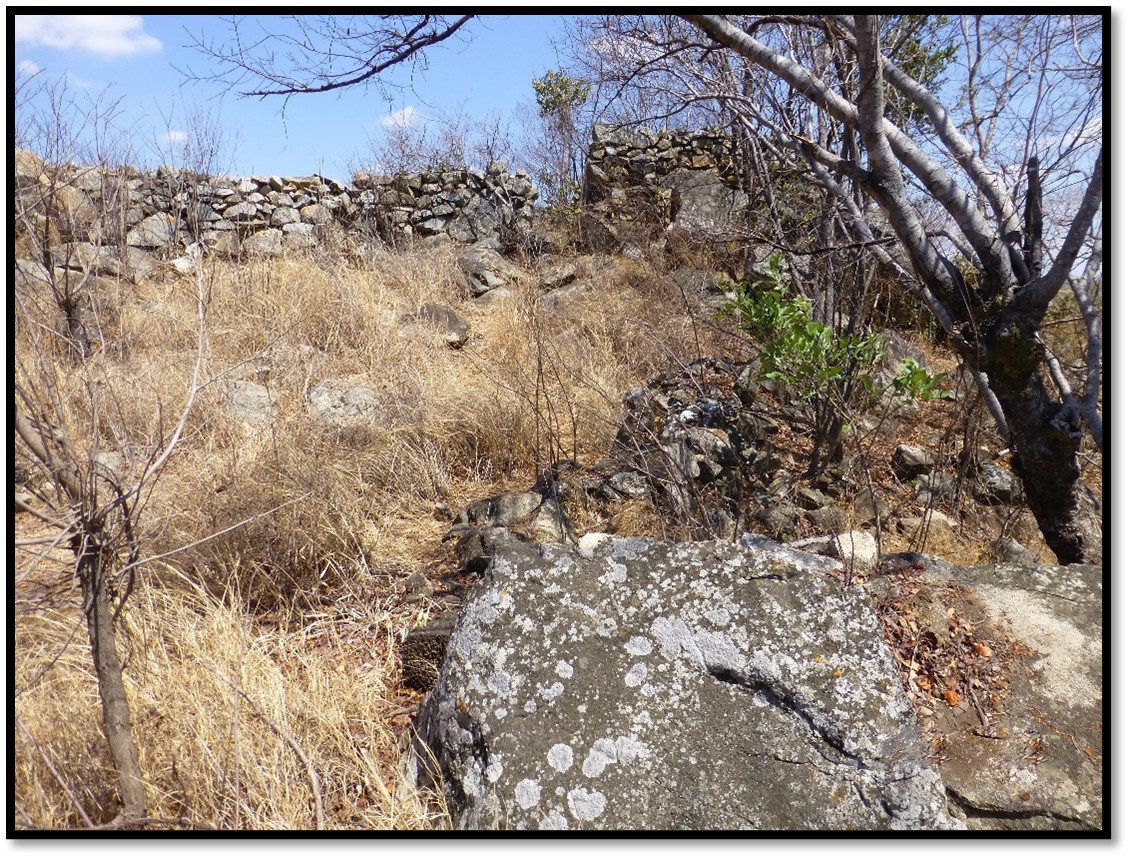
Author photo: the fort’s small enclosure on the right of the entrance, the stonework is still well-preserved
News of the Mashona rising and the killing of Native Commissioner David Moony
16 June. January,[13] a Police boy[14] belonging to Moony, Native Commissioner, came in about 10am reporting as follows. The Mashonas all over the country have risen and intend wiping out all the white men. At this time, the Mashonas had a funny idea that we in this country were all there [because] some other tribe had driven us out of our country and we had come here and when they [the Mashona] had wiped us out there would be no more whites. As we had broken the back of the Matabili nation,[15] they the Mashonas having now got lots of arms, etc., could defy all other comers, could carry on the inter-tribal feuds and, in fact, have a good time all round. No work, no hut tax, no raiding Matabili, no detested whites. Oh, it was their Golden Age, that is what they thought then.
On the 14 June they had murdered three coolie[16] traders at Mashayagombe’s[17] He and his witch doctor[18] were the instigators of the rising, his kraal is only 12 miles from here. On the 15 June they killed David Moony, Native Commissioner, out hut tax collecting at 10am and about 4pm the same day they murdered Street [Stunt] and Shell, two Hartley prospectors who went out to Mashayagombe’s to buy mealie meal.[19]
On receiving this news, we were rather alarmed and provisioned the fort with food and water. All quiet that night. All the boys ran away today, but this one a coolie belonging to the store and my own boy ‘Blanket’ a Manica boy of Mutasa’s,[20] who I may here say, has proved himself one in a thousand. I hired him in Makombi’s country on 28 March 1895 and he is still with me, of him more anon. Sent in dispatches to Salisbury, which never arrived.
17 June. No sign of natives. Carrick, the Mining Commissioner, elected to try and get into Salisbury (now Harare) and took a man Turner by name, [assistant storeman] who was helping in the store here. It was much against my will that he went, yet he was my superior, I only being District Medical Officer[21] and he would not be dissuaded. I learned later on that he got some 25 miles from here when the natives surprised him and murdered them both.[22] Also the boy January who went as guide to them [and was also murdered]
I must hear say a word to testify to January. First he was warned of the rising and implored to leave Moony, he would not. He escaped Mashayagombe by the skin of his teeth and gave us warning, else someone else might have told this tale.[23] By so doing, he gave up two wives and £30 in cash, left in his hut. After giving us the warning, he volunteered to guide Carrick and Turner into Salisbury and lastly (this is from native evidence obtained during the last few days) when the three were surprised at night, he said, “Kill me but let these two poor tired whites go.” His answer was an assegai. Requiescats in pace[24] for if ever true heart beat in any breast, white or black, it beat in his. I collected the three skulls on the patrol to Mashayagombe and had them buried on the Serin river, where they had eaten their last meal. When Captain White and his patrol relieved us they found the three skeletons and a letter written by myself to the Administrator which conclusively proved their identity. Carrick and co left us at 6:30pm.
At 9pm I was in my hut, just under the fort walls, rolling a cigarette, preparatory for bed. I was even in pyjamas, when Bang – Bang – Bang – Bang – Bang - Bang – Bang, suddenly rang out seven shots, our sentries (we had two on since the news night and day) shouted out, “Tumble up chaps, here they are,” and the firing went on very briskly. Then there was a hasty getting into revolver belts, bandoliers, etc., and collaring rifles. Suddenly the upper half of my door opened and a black man put his head in – I covered him in a second and asked what he wanted. “It is only I nkosi,” said Blanket, “I want a gun.” I said, “there you are” pointing to a Martini-Henry and ammunition and the brave fellow was up and firing away like fun long before his master.
I forgot to say that I got the government to send us out 12 Lee-Metford magazine rifles with 2,000 rounds of ammunition and the same amount for Martini’s of which we had a fairish supply, in all we had about 22 rifles, 10 shotguns, 6 revolvers and some 6,000 rounds of ammunition for the 10 whites and my boy. The coolie did not fight. Well, we were all soon well in it firing at flashes for it was dark. They were not more than 20 guns against us and they made execrable shooting, all the bullets going well over our heads. There were several huts on the opposite kopje[25] and the natives had taken possession of them and were potting at us from the doors and windows. There was a half-moon shining in our faces which made the opposite kopje look very black and indistinct. The fun went on ‘till midnight when they ceased firing one by one and drew off slowly. At 12:30 the moon went down and our senses were most painfully on the alert, suspecting a rush every moment for we never expected the natives would be contented with fireworks alone, but no, hour after hour passed (it was bitterly cold mid-winter) and no signs of them. At last dawn, then sunrise.
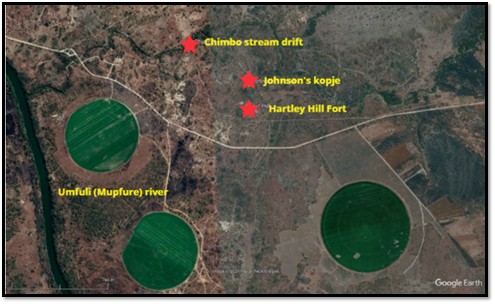
Google Earth image of the area around Hartley Hill Fort
18 June. A messenger from Carrick came back with a note saying he had got to a station (Cape bays) about 18 miles off at midnight. It was sacked and he was going on. I then called for volunteers to go over to the opposite kopje and burn the huts. Ackland and McRae volunteered. The brave remainder said they would cover us. About halfway up I heard someone following us running and saw it was Blanket. He asked me why I had left him behind and I answered bitterly, “I thought you might like to stay with the others and cover us.“ “Hau” he said, spitting. “Do you not know me better than to think me like those curs there?”
We found all the natives gone and also saw that some of our bullets had been very well aimed. Having burnt the huts we retired. I may mention here that John Dyke Acland of New Zealand and Oxford University was my most able and willing coadjutor.[26] Had it not been for him, I could not have kept order. I was in command simply because I was the only Company official[27] here and in the matter of requisitioning for and commandeering of food etc., I was the only one whose hand the Government[28] would recognise.
20 June. We saw 100 armed natives come along the road towards this place quite a mile away. They turned off into the bush and we heard no more of or about them. We have food for six months at a push but we must go to water 500 yards off every four days. Before going we put a volley or two down and around the watering place. We go at dawn.[29]
Every now and then a stray shot comes Bump into the kopje, or whistles, or hums over our heads from the woods around us and occasionally we see natives crossing a long vlei at ranges from 1,000 to 2,500 yards and we pump Lee-Metford bullets into them, or rather as near them as we can get and much amusement too, we derive from it as we manage to get very near and to see the brutes drop their bundles and scoot is very cheering to us poor chaps shut in by the dusky devils.
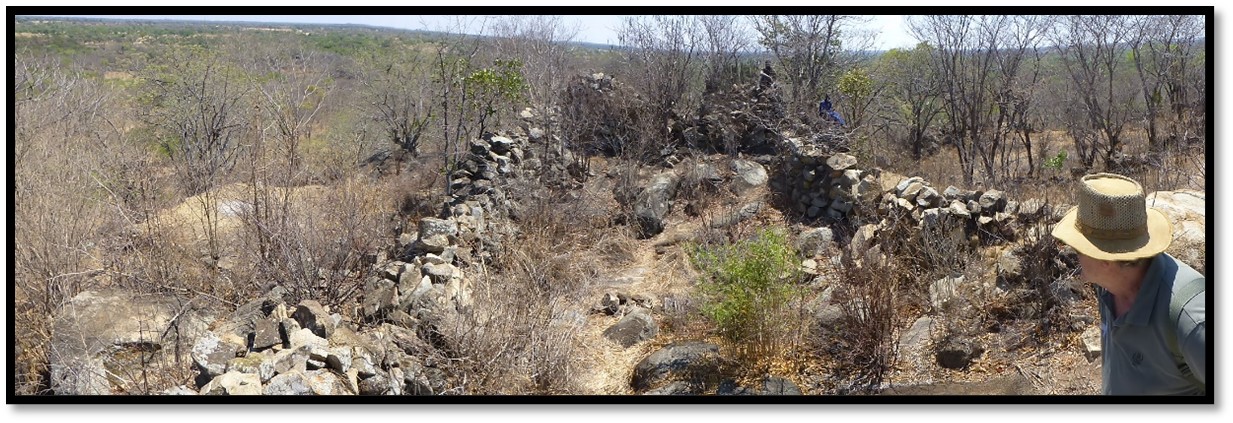
Author photo: Hartley Fort looking north, Johnson’s kopje just visible on the left
26 June. Saw a native behind a stone watching our water. Could not dislodge him as he ducked his head every time a puff of smoke came from the fort.[30]
28 June. Reduced flour rations to half, almost a mutiny. Threatened to shoot the first man who helped himself like a mad dog and meant it too.
2 July. Another night of fireworks. More natives this time and a very hot fire with bad shooting, lasted from 8:30pm to 12:30am. Jeered at the natives, insulted them in every way I could think of. Towards the end of it their leader gave them a speech saying, “Young warriors, you have greatly distinguished yourselves, you have stood the fire of the white men very bravely (from behind big rocks, I interpolated[31]) and have answered shot for shot. Now go and worry them from the rear.”
I interpreted this to the men and we gave them three ironical cheers. The answer came slowly and hesitatingly. “No, we think it is very cold now and late, let us get back to our wives, our huts and our fires.” Oh, we did laugh at them, calling them women and children and anything insulting and opprobrious[32] that we could think of. They then retired behind their kopje and had a song the words of which I could not hear.
5 July. About 4pm heard some 20 shots in the direction of the native encampment, which was about two miles from us, we could see their smoke by day and their fire glare by night. Then one man ran across the long vlei about 2,000 yards off followed by 21 natives in batches of seven some 500 yards behind the first. They all disappeared into the thick bush towards the Umfuli (Mupfure) river. Shortly 8 shots were heard and the 21 all returned in a line, making towards the Salisbury road. They then disappeared for about 15 minutes, then 8 more shots were heard and we saw them all return towards their camp. I was certain we had looked upon the slaughter of the messengers with dispatches from Salisbury. Found out afterwards that I was right. Two native police had volunteered to try and get through to us for £10 apiece and they were killed. By this time we of course knew that Salisbury was in difficulties, so there was nothing for it but to consume our souls in patience as best we might.
Nothing of great interest ‘till 22 July; a few snapshots from either side, but no damage done. I had a narrow shave one day. I was mending some clothing standing in my hut doorway when Bang and a bullet screamed over our heads. To snatch up rifle and bandolier and be out on my favourite rock was the work of 5 seconds. Then Bang again, this time a Lee-Metford from the sound. We located the beggars and ousted them with a volley or two. On entering my hut the first thing I saw was a Lee-Metford bullet lying on an overcoat. I made investigations and found that it had come in through the upper half of my door and had plugged the wall at an angle knocking down chunks of plaster and ricocheting around ‘till it stayed where I found it. Had I stayed 10 seconds longer where I was I should have got it Kerplunk in the wind box.
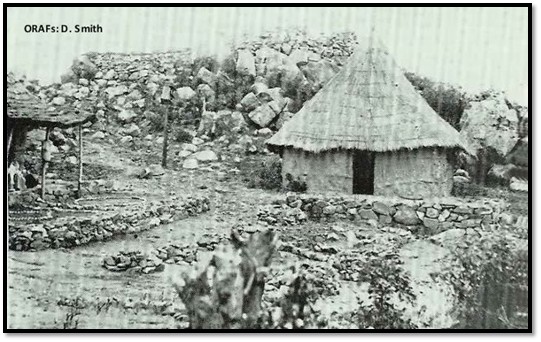
NAZ photo: Photo taken shortly after the rising, the hut may be Dr Newnham’s below the Hartley fort, the Hospital on the left
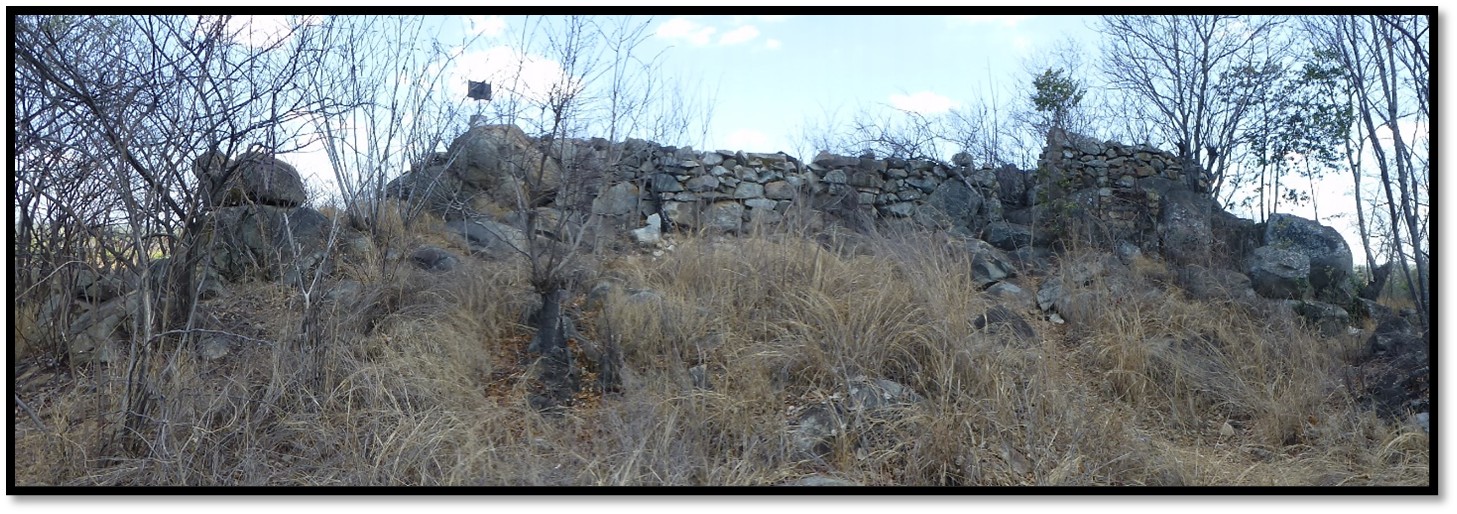
Author photo: Hartley Hill fort from the east and the former site of the hospital, The same south – north orientation as the photo above
The Relief Column arrives!
22 July. A day none of us will ever forget, as long as we live. For 37 days we had been pent up knowing that at any moment the natives could force us to take to the open by simply ‘sitting down’ upon our water in force. Once in the open they would have shot us down one by one. The anxiety and suspense were awful, never knowing what was going to happen next. Moreover I am sorry to say we had several men who were ‘wasters’ malingerers and cowards. Men on whom no dependence was to be placed.
Our feelings may be imagined but never expressed when about 9:30am 22 July our sentry shouted out, “10 horsemen! 20 horsemen!! 50 horsemen!!! 100 horsemen!!! Wagons, carts. Hurray, hurray, hurray!” I fancy that cry would about have waked us had any been dead. And it was true too. On they came filing along. I was out with my glasses and there about two miles away was a huge column advancing, they came on steadily until about a mile off when they were coming straight end on to us with flankers on either side. I then heard the charge sounded and instantly 150 horsetails flicked up in the air and at full gallop came the mounted part of “White’s Hartley Relief Patrol.”
The scene in the square is just indescribable, such a lot of my friends were there, among them Nesbitt[33] and it was he who first spotted that there were white men there at all. He saw me standing alone dressed in white and he said to Captain White, “there are white men there and I fancy I can spot old Newnham.” White said, “Thank God, I wouldn't have missed this day for £5,000.”[34]
The column was 260 whites and 80 blacks strong and they had to fight their way to us.[35] We got back to Salisbury on 30 July and received quite an ovation, everyone without exception, believing us dead long ago.
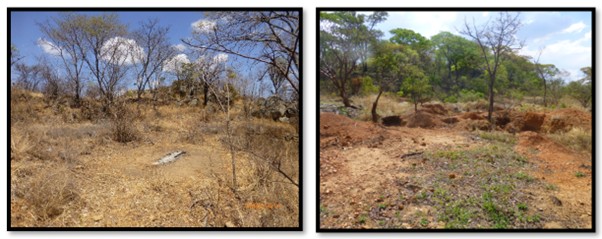
Author photos: (L) below the Hartley fort, hospital was on the flat ground on the left; Johnson’s kopje, artisanal gold mining in the foreground
Serving with the Mashonaland Field Force – meet Alderson’s force at Marandella’s
Directly I arrived in Salisbury, I offered my services as a volunteer and was taken on as Surgeon-Lieutenant to the Mashonaland Field Force (MFF) My first patrol was the Marandella (Marondera) one.[36] Marandella’s is a station 54 miles from Salisbury on the Umtali (Mutare) road. We never saw any natives at all but met Colonel Alderson[i] and his column[37] some 20 miles from Marandella’s; took over some wagons of food from him and some cattle with which we returned Salisbury.[38]
Hunyani (now Manyame) river patrols
Nesbitt (now a Captain) was in charge and it was called Nesbitt's Flying Patrol as we covered 180 miles in 10 days. My next patrol was also with Nesbitt to sweep the kraals along the Hunyani river about 12 to 20 miles from Salisbury. This we did and burned 30 kraals and took no end of grain and also looted some cattle, sheep, goats and donkeys.[39] We had two scraps with the natives but did not do much as we had no ordnance and the natives were in strongly fortified positions where without a 7-pounder you could do no good; this patrol lasted 6 days.[40]
The attack on Simbanoota’s kraal
Next one was to a very strong place belonging to a Chief Simbanuto [Simbanoota] by name, his place was roughly like a ‘W;’ two streams about 200 yards apart ran down into another stream at right angles and the whole place was a nest of caves, which were all fortified, and stockaded kraals, one after another, so that when you broke through one you came upon another, the diagram is a rough representation of the place.
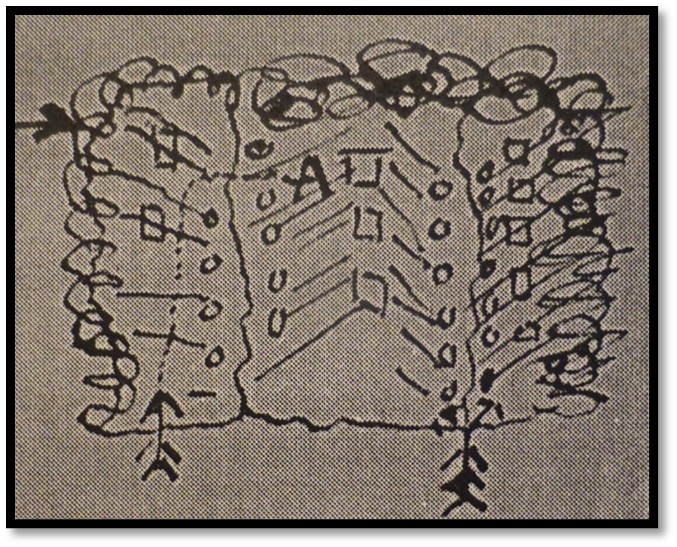
Dr Newnham’s sketch of Chief Chikwakwa’s kraal
The Caves are shown as B, stockaded kraal as a square, trees as whirligigs. You see there were two small valleys lined with caves running into one big valley, no caves, the stockades were on the heights of the watersheds. We attacked on three days before we busted them, the feathers on the arrows show the number of attacks. The patrol was a very large one under Major Tennant[41] and on the second day I had the warmest time I ever had in my life. A man was wounded at A and the doctor was shouted for. I had to go and the dotted line shows my course. My orderly stayed behind, found it too warm, I had to double and run, turn and twist, a native guiding me and at every open space I came to I'd go like lightning across and as sure as fate, Bang-Wallop, gun and bullet came in front of me, behind me, over me and under me. I have never been in such an awful fright in my life. I passed two dead bodies of ours but didn't stop. We had killed and wounded in each attack and oh, my hands were full, as I was alone. This was a nine day patrol.[42]
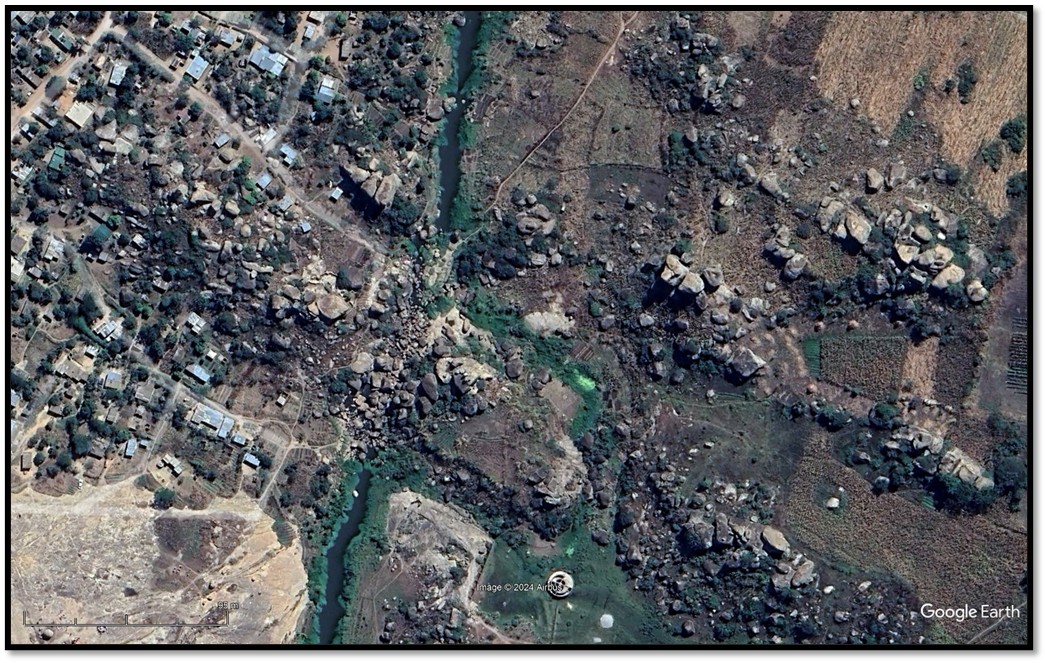
Google Earth Image: Headman Simbanoota’s kraal at GPS 17°55´7"S 31°10´19"E. This is 2.6 kms south of Garlake’s position for the kraal but still on the Ruwa river – the justification being that there are no granite kopjes at Garlake’s indicated site on his map
Patrol to Mazoe
The next patrol was with Imperial troops under Captain Sir Horace W MacMahon, [McMahon] the best and nicest of all the officers who came out, cool and calm under fire, yet with a keen eye towards strategic movements and never exposing his men too freely, at the same time inclined to be reckless. He got wounded later on in the foot at Mashayagombe’s. This was the Mazoe Patrol and we had three scraps here.[43] I killed my one and only native at 700 yards on the fourth shot. The scoundrel was creeping over a rock to have a shot at the mounted infantry who were on the other side. Three times I made him come down, but the fourth he chucked his gun away and peeled off the rock backwards - crash. Had a narrow squeak a few minutes after. The stone in front of me was hit fair and square at chest height. At the place I plugged the native we found his blood the next day. This was a twelve day patrol.
Patrol to Chief Chikwakwa’s near present-day Goromonzi
My next patrol was to Tshikwakwa’s, about 25 miles from Salisbury, but we went out as peacemakers and after ten days returned without firing a shot having held no end of indabas and heard no end of lies which I'm afraid our O.C. took in.[44] In addition to Newnham, Colin Harding and Hubert Howard with Father Biehler from Chishawasha translating took part with a dozen mounted troopers. (Far Bugles P57-8) and writes that for their days of negotiation they received nothing but abuse!
I now made up my mind for a visit home, but no, Colonel Alderson and Judge Vincent made me promise to return to Hartley as there was not a man in the country whom they could get so I gave up my idea of a holiday and once more returned to Hartley under very different auspices to my last day there. Havoc and ruin stared us in the face, the natives had just smashed the place up, it was awful. I found a Bible given me by my godmother in 1878, coverless lying out in the veld and also the Ingoldsby Legends,[45] given me by ‘ye little mother.’ All else was chaos and desolation.
I came out here with volunteers who were shortly after relieved by the new police, amongst whom were Major Hopper and Lieut Stocker, both old acquaintances of mine, the latter indeed, I saw a great deal of them in Umtali [Mutare] on my compulsory retirement from Melsettu [Melsetter]
Nothing of import happened ‘til a few days ago when an attempt was made to crush Mashayagombi. Great preparations were made, Dr Fleming from Salisbury came down to lend me a hand and at sunset off we rode. Off saddled at 10pm, then on again at midnight. A terrible ride through thick bush and over very rough country, spills were frequent, but I was fortunate in having a good horse and managed all right. About 3am in the morning we came near and on sending scouts forward, found that the natives seemed prepared, they were singing and shooting off guns. We learnt next day that it was only a big beer drink. But our OC Col the Hon F de Moleyns[46] would not attack, so we returned to a small eminence some four miles off the kraals where we started building a fort.[47]
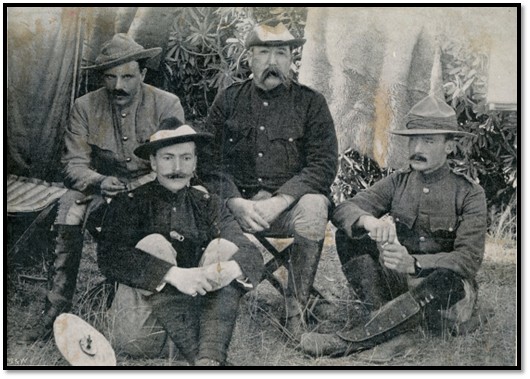
The Hon Lt-Col FRWE De Moleyns, Lieut Ferguson, Gen Sir F. Carrington, Lt-Col R. Baden-Powell in Bulawayo in 1896
It rained without intermission all that day and night and we dossed down as best we could. Next day Stocker and I rode in here and I went down with 48 hours fever. At Mashayagombi’ s I had my narrowest shave, a native deliberately potted at me as I was crossing the river bed. The bullet whizzed past me, giving me a regular buffet of air, the same moment I saw the native in front of me wheel around two or three times and drop. He was dead before I got to him; it was most evidently meant for me as I was the only white man for several yards.
The rebellion is over now, but none of the really active insurgents will come in, they fear retribution and it almost seems to me as if we should have to Indulge in a war of extermination against them. They are leaving the country by degrees and going out into almost inaccessible places in the fly.[48]
Family details for Dr Arthur Henry Newnham
He was the son of William Orde Newnham (18.03.1825 – 5.10.1893) and [married first] Clara Campbell née Wilson (12.01.1828 – 29.06.1857) who married on 2.01.1855. Their children were:
- William Devereux Orde Newnham (15.04.1856 - )
- Clara Campbell Newnham (16.06.1857 – 15.12.1857)
[Married second] Fanny Charlotte née Day (1843 - 8.03.1927) on 31.10.1862. Their children were:
- Arthur Henry Newnham (13.09.1864 – 5.03.1923) born in Natal, South Africa who married Gertrude Ethel née Makins (25.01.1875 - 1959) on 2.08.1906. Their children were:
Arthur Clifford Hugh Newnham (c1907 - 1994) born in Southern Rhodesia
Evelyn Maud Newnham (c1911 - ) born in Southern Rhodesia
- Lilias Maude Newnham (c1867 – 26.6.1929) who married Bell George Lloyd (12.05.1865 –3.12.1936) in 1893
At some time Author Henry Newnham remarried as the Probate Register records the death of Arthur Henry Newnham, of Isle of Wight, on 5 March 1923. Probate to widow Emma Jane Newnham. Source: http://www.natstand.org.uk/pdf/NewnhamWO000.pdf
References
Dr Arthur H. Newnham. Account of the Mashona Rising in as far as A.H. Newnham was personally concerned
The ’96 Rebellions. The British South Africa Company Reports on the Native Disturbances in Rhodesia, 1896-7
P. Garlake. The Mashona Rebellion East of Salisbury. Rhodesiana Publication No 14, July 1966, P1 - 11
Lt-Col Colin Harding. Far Bugles. Simpson Marshall Ltd, 1932
Notes
[1] See the article Old Fort Hartley and the Cemetery at Hartley Hills goldfield under Mashonaland West Province on the website www.zimfieldguide.com
[2] The ’96 Rebellions states that the body of David Enraght Moony (or Mooney) was recovered and buried in July 1896
[3] See the article The Siege of Deary’s Store at Abercorn June 21st – July 13th 1896 under Mashonaland Central on the website www.zimfieldguide.com
[4] The Mashona Rebellion East of Salisbury, P1
[5] Matabele, amaNdebele
[6] Matabeleland
[7] To the Zambesi river via the Hunyani (Manyame)
[8] In fact the amaNdebele had last raided the Fort Victoria (Masvingo) district in 1893. See the article The build-up the 1893 Matabele War under Masvingo on the website www.zimfieldguide.com
[9] Hugh Marshall Hole, the Civil Commissioner and Magistrate at Salisbury, writes in the ’96 Rebellions that the first meeting was held on 4 April 1896, soon after news of the Matabele Rising (Umvukela) was received. Twenty-five of the residents at Hartley Hill and neighbourhood attended (nine others did not) and Dr Newnham was requested to remind the BSAC that the Umfuli (Mupfure) river was considered the Matabeleland boundary of influence and they needed arms and ammunition. Twelve Lee-Metford rifles and several thousand rounds of ammunition were sent to them from Salisbury to supplement their own firearms. On hearing that the residents intended remaining at Hartley Hill, Percy Inskipp, the BSAC under-secretary wrote asking if they had enough supplies saying, “we presume that you are satisfied that in deciding to remain at Hartley you are confident of being able to maintain your position.” A few days later came news that HB Taylor and another man only three days march from Hartley had been murdered. Dr Newham in informing Salisbury wrote, “we feel perfectly safe, are well off for food, and unless, peremptorily ordered, we mean to stick to our guns.” But Judge Vintcent, the Administrator at Salisbury, did not share their confidence when he heard the residents at Hartley had been reduced to nine and wrote to Dr Newnham urging him to come into Salisbury. On 24 April a prospector (name unknown) was attacked and killed only 35 miles from Hartley Hill, his servant escaping to bring the news. At this time the residents built the fort and Dr Newnham reported to Judge Vintcent that the remaining residents were determined to hold out and protect their property. (The ’96 Rebellions, P52) In fact although amaNdebele raiding parties came into the Hartley district they did not attack the Hartley Hill fort. It was Chief Mashayamombe’s men who conducted the siege.
[10] Corrugated iron
[11] The lower kopje is usually named Johnson’s kopje after the camp built on the summit by the firm of Johnson, Heany and Borrow in 1890-1 but soon abandoned by them and is about 80 yards (74 metres) apart
[12] i.e. above the Umfuli (now Mupfure river) 1,850 yards (1,690 metres) to the south
[13] David Beach believes his name was actually Jarivan
[14] January (Jaivan) is elsewhere described as a native detective
[15] In the November 1893 invasion of Matabeleland
[16] Today this is considered an offensive term relating to people from India or Goa
[17] Chief Chinengundu Mashayamombe
[18] Chief Mashayamombe’s spirit medium was Dekwende but he was also heavily influenced by Gumboreshumba (Kaguvi) although they soon quarrelled and Kaguvi moved south of the Umfuli (Mupfure) river to Chena’s kraal
[19] For a detailed account of the murders see the article ‘Chimurenga’: The Shona Rising of 1896-7; a summary of David Beach’s article under Mashonaland East on the website www.zimfieldguide.com
[20] Chief Tendai Mutasa of Manicaland
[21] Hartley Hill was very bad for malaria. See the article The story behind Derick Hoste who died of blackwater fever at Hartley Hills in 1893 under Mashonaland West on the website www.zimfielfguide.com
[22] Edward Thomas Carrick, AL Turner and January were killed on their way from Hartley Hill to Salisbury on 19 June 1896
[23] Most of the murdered traders, prospectors and farmers were taken by surprise with no chance of defending themselves
[24] Rest In Peace
[25] Johnson’s kopje about 80 yards (74 metres) away to the north and slightly lower
[26] Coadjutor meaning someone who assists and often succeeds another, but usually applied in a religious context
[27] The Company being the British South Africa Company – Newnham stepping up as District Medical Officer as Carrick, the Hartley Hill Mining Commissioner, had left on the 17 June 1896 with Turner and January to inform Salisbury of the attack on the fort by Mashayamombe’s men
[28] The Government also being the British South Africa Company who were in charge of the administration of Mashonaland and Matabeleland
[29] The distance from Hartley Hill Fort to the Umfuli (Mupfure) river at its nearest point is 1,840 yards (1,680 metres) so clearly the Chimbo stream 470 yards (430 metres) away was their water source and must still have had pools of water in mid-winter.
[30] The Lee-Metford rifle used a black powder loaded cartridge. Starting from around 1895 the Lee-Metford’s were starting to be replaced by Lee-Enfield’s that used a cordite cartridge that was smokeless
[31] Interpolated – interject or insert into a conversation
[32] Opprobrious – scornful or critical
[33] Randolph Cosby Nesbitt, a Captain in the Mashonaland Mounted Police was one of the rescuers of those men and women besieged at the Alice Mine, Mazoe (Mazowe) The three wives were safeguarded in a wagonette armoured with steel sheets and drawn by mules and the men fought off the Mashonas who attempted to stop them coming into Salisbury along the Tatagura river from Mazoe. In the heavy fighting three men were killed and five wounded. Nesbitt was the only military man amongst the civilians and thus the only one eligible to be awarded the Victoria Cross. Many of those actually present thought Dan Judson should have received an award. See the article The June 1896 Mazoe Patrol skirmish with detailed accounts from those besieged and their Mashona attackers under Mashonaland Central on the website www.zimfieldguide.com
[34] Lieutenant The Hon. Charles White was the first of three brothers to arrive at Ft Tuli on 15 June 1891 to join the British South Africa Company Police (BSACP) and as a Lieutenant put in command of Ft Tuli. The BSACP was largely laid off in 1891 to save money and replaced by volunteers in the Mashonaland Horse. In 1892 the Mashonaland Mounted Police was formed and Charles moved from Ft Tuli to command the 150-strong force as Chief of Police with the rank of Captain. He was made chief of scouts in the Salisbury Column under Major Patrick Forbes in the Matabele War of 1893.
In 1895 his elder brother Major the Hon. Henry Frederick White came to Rhodesia and was promoted to Chief Commissioner of the BSACP and their youngest brother Captain the Hon. Robert ‘Bobby’ White arrived and became Chief Staff Officer to his brother and Commissioner, Henry. There is no doubt their peerages influenced their selection by Rhodes to these senior positions.
[35] White’s Relief Column was made up of 65 Grey’s Scouts, 75 men of the Natal Troop under Captain Taylor, 60 men from A and C Troops of the Salisbury Field Force under Captain St Hill, a 7-pounder with detachment of 10 men under Captain Tyndale-Biscoe and forty Zulu’s – total of 250 men
[36] The aim of this patrol that left Salisbury on 2 August with 50 troopers and 50 native ‘friendlies’ and a Maxim gun under the command of Captain Randolph Nesbitt was to repair the Salisbury-Umtali telegraph line and clear the road and meet up with Lieut-Col Alderson’s Mounted Infantry coming from Umtali and Major Watt’s troops who had come through Charter and were going onto Umtali.
[37] Lieut-Col Alderson brought a force of 380 regular troops, mostly Mounted Infantry, up from Beira on the narrow gauge railway (2 feet 6 inches gauge) that at the time extended as far as Chimoio with the first contingent reaching Umtali on 10 July 1896. This force combined with a volunteer force at Umtali under Major G. Hamilton Browne and the combined force left Umtali on 28 July. For details see the article Fort Haynes and the fight at Chief Chingaira Makoni’s Kraal under Manicaland on the website www.zimfieldguide.com
[38] Food was short in Salisbury with the transport system almost completely paralysed and Col Alderson abandoned his siege of Makoni’s kraal in order to deliver the food and supplies he had with him to Salisbury
[39] As Peter Garlake writes in P3 his article The Mashona Rebellion East of Salisbury, “For the next six months the only means of attacking the rebels was by means of patrols leaving Salisbury and making brief forays towards their strongholds. Successes may have looked impressive in official reports, kraals were burnt and grain collected but rebel casualties were negligible; most frequently the kraals were found deserted and the true strongholds within neighbouring caves were untouched. Where resistance was met the defenders had an overwhelming advantage and caused a steady trickle of casualties, never showing themselves and picking off their attackers as they climbed the kopjes.”
[40] This was one of a number of small forces sent out in the vicinity of Salisbury including a force to Mazoe and Amanda’s kraal under Duncan, another under Lieut St. Aubyn to Six Mile Spruit, Captain Jenner to Chief Chikwakwa’s kraal and further away attacks on Chief Makoni’s kraal by Lieut-Col Alderson enroute to Salisbury and then Major Watts which resulted in the capture of Makoni who was shot by firing squad under the command of Colin Harding. (Far Bugles P42)
[41] The Simbanoota engagement included detachments from the Mounted Infantry and West Riding Regiments and Volunteers with a 7-pounder and Maxim and took place from 10 September 1896. The rocky nature of the site and the caves made the 7-pounder and Maxim ineffective. The defenders were only dislodged from the caves into which they retreated after a patient and dangerous process. ‘Family guns’ were often fired from narrow openings in the rocks at very close range and this deadly hazard meant that the attackers often resorted to dynamiting the caves.
[42] Clearly this attack on Simbanoota’s kraal was not a success. On 10 January 1897 Kaguvi's wives passed through Chiremba's (close to Cleveland Dam) on their way east from Chena’s kraal and cattle stolen from the outskirts of Salisbury were driven through Simbanoota's kraal. They were not recovered and clearly every single chief and headman in the district was clearly in support of Kaguvi. On 13 January Lieut Harding, now heading up the BSA Native Police force and twenty-five men destroyed this kraal, which had previously successfully resisted the much larger force.
[43] This mixed patrol of regular troops and volunteers left Salisbury on 18 September 1896 with an object of harassing the natives by burning kraals and taking grain, restoring the telegraph line and with the hope of capturing Nehanda Charwe Nyakasikana the spirit medium of Nehanda a female Shona mhondoro who was staying at Chiwi’s kraal and who exerted a significant influence over the Mashona Chiefs. She had fled, but much loot from murdered victims was found. Peace negotiations started with Chief Sitamba but came to nothing. In fact Harding (Far bugles P31) describes how three rebels attempted to shoot McMahon during the indaba but were spotted and the alarm given by a native policeman. So his kraal and that of Chief Gadowa and Chiwi were burnt after strong resistance in which McMahon’s force received casualties. The Mazoe hills were cleared, at least whilst the force was present and some grain and guns captured.
[44] This patrol of regular troops and volunteers was led by Captain Jenner. Some grain was collected and Chief Marandella’s kraal burnt down
[45] The Ingoldsby Legends, or Mirth and Marvels) is a collection of myths, legends, ghost stories and poems written by an English clergyman Richard harris Barham. First published in book form in 1840, the book was very popular and ran through many editions in the nineteenth century
[46] Lt-Col FRWE de Moleyns was selected with Robert Baden-Powell on 1 October 1896 to train and set-up a new police force in Mashonaland which was accomplished by 1 December 1896. On 7 May 1897 he was awarded a Companion of the Distinguished Service Order (DSO) and promoted to Major the following year.
[47] This was named Fort Martin. See the article Chief Chinengundu Mashayamombe’s stronghold, Fort Martin and Cemetery under Mashonaland West on the website www.zimfieldguide.com
[48] The tsetse-fly belts to the north and south of the watershed where the Mounted Infantry are unable to follow them with their horses
When to visit:
All year around
Fee:
n/a
Category:
Province: