
UDI rebellion: Rhodesia defies the world
A Rhodesia Herald supplement with the above title was published around November 11, 1971, to mark the sixth anniversary of the Unilateral Declaration of Independence (UDI) and this article is taken from the front page of the supplement as the author, Ian Mills, Herald Political Reporter at the time, reconstructs the issues and decisions of six tumultuous years.
An uneasy quiet settled over Rhodesia at 1:15pm on Thursday, 11th of November 1965.[1] Save for an occasional pedestrian or car, the streets were deserted. Almost to a man, Rhodesians were gathered around their radio sets.
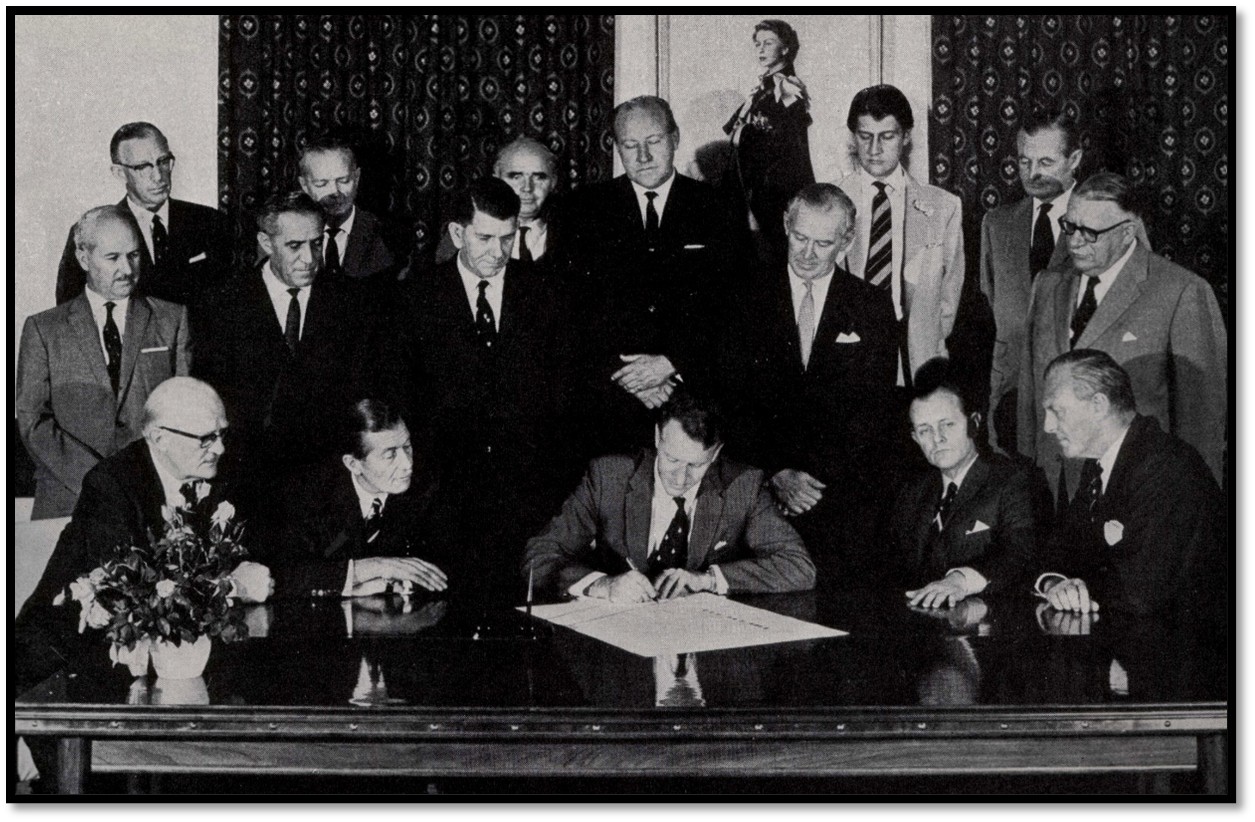
Back (L-R) Philip Smith, Ian Dillon, Lance Smith, Ian McLean, P.K. van der Byl, Brig. Andrew Dunlop
Middle (L-R) Jack Howman, Philip van Heerden, Jack Mussett, John Wrathall, George Rudland
Front (L-R) Desmond Lardner-Burke, Clifford Dupont, Ian Smith, William Harper, Lord Graham
They heard the Prime Minister, Mr Ian Smith, announce Rhodesia's Unilateral Declaration of Independence. The deed was done. Months of speculation ended with what seemed to be a final, drastic action. The Rhodesian government had finally cut Rhodesia’s ties with Britain. So ended nearly three years of negotiation with two British governments to resolve the problem of Rhodesia's independence. In his customary unemotional monotone, Mr Smith told Rhodesians, “In the lives of most nations, there comes a moment when a stand has to be made for principles, whatever the consequences. This moment has come for Rhodesia.”
The consequences followed quickly. Soon after Mr Smith had finished his 20 minute broadcast, the British Labour government of Mr Harold Wilson labelled the declaration illegal and imposed economic sanctions against Rhodesia. In Rhodesia itself, a state of emergency was already enforced. New emergency regulations were introduced. Press censorship was imposed, the resulting blank spaces immediately becoming a feature of the daily newspapers. They remain so until censorship was lifted in April 1968.
The three-year struggle between Britain and Rhodesia appeared to be over. It was not; but no one knew that at the time. Rhodesians had to wait six years for the final result. Why was UDI taken? Why was it necessary? These were the questions being asked here and abroad.
Stalemate
The answer lay in the Rhodesian Front (RF) government’s policies and plans. The RF wanted to rid the country of the 1961 Constitution, the provisions of which would lead inevitably to majority rule. That was its intention, however slow the progress might be.
The RF had other ideas about African political advancement and a system of government for Rhodesia. In fact, it supported an entirely different system - provincialization. On the 11 November 1965, Mr Smith told The nation that stalemate had been reached in the negotiations. The government therefore decided on UDI, seemingly not without a struggle among themselves.
Many Rhodesians hoped and believed that the break with Britain was final. The nature of politics decreed that it was not. Within months of UDI, reconciliation moves were underway. A negotiated settlement remained a major political goal. Mr Smith later labelled it the ‘first prize.’ But the leaders on both sides in the six years to come could not grasp it. In fact, at times the dispute seemed to be more of a personality clash between the principals.
UDI had created the difficult problem, one which touched on basic beliefs and fears. The British wanted to guarantee African political advancement; the Rhodesians wanted to prevent majority rule. Hope and optimism were always present in the Anglo-Rhodesian negotiations and in the minds of the negotiators. Hope was certainly present when Mr Smith and Mr Wilson met for the Tiger ‘floating summit’ and later aboard HMS Fearless.
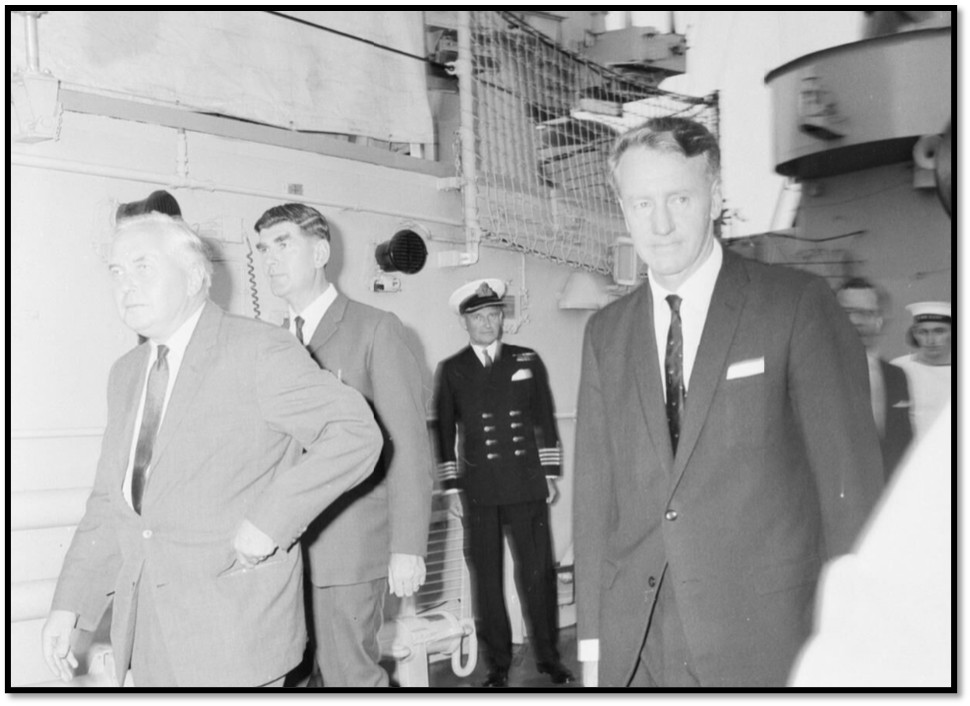
Harold Wilson and Ian Smith met on HMS Tiger (1–4 Dec 1966) and HMS Fearless (9-13 Oct 1968)
Each new failure brought its repercussions and a hardening of attitudes. Wilson jokes became the staple diet of Rhodesian cabaret artists. Mr Wilson's retaliatory moves were not so funny. He took the problem to the United Nations for mandatory sanctions and introduced NIBMAR - no independence before majority rule. Anglo-Rhodesian relations, already seriously strained, reached rock bottom. Matters weren't improved when attempts began to devise a purely Rhodesian constitution. This exercise was to cause more dissension in RF ranks than anything connected with the Anglo-Rhodesian dispute.
The Whaley Commission under the chairmanship of Mr (now Senator) W.R. ‘Sam’ Whaley, was set up early in 1968 to gather evidence and to devise a new Rhodesian constitution. The Commission's report was published on 10 April 1968. Its main recommendation was the introduction of the parity system of parliamentary representation.
Whaley Plan
By early May opposition to the Commission's recommendations had emerged at all levels in the RF. Some RF parliamentarians labelled it a “monumental disappointment.” Opposition and disappointment over the Whaley plan resulted in the RF taking over the reins.
The result of the RF's labours was a document which became known as the ‘Yellow Paper Constitution,’ so named because of the colour of the paper it was printed on. The Yellow Paper retained the parity idea, but with the important difference that two provincial assemblies for Africans should be established within five years. It also slashed African freely elected representation in the central parliament to six, although there would be a total of sixteen Africans in the House of Assembly.
Ink on the Yellow Paper had hardly dried before the storm broke. It was attacked from all sides, within and outside the RF. At a special RF Congress in September 1968, it was passed by a wafer-thin eleven vote margin, and only after fierce, even bitter, argument. It was obvious that the Yellow Paper would have to be changed. But how?
Someone, as yet unnamed, came up with the idea that was to solve the problem. Mr Smith took the new idea on what became known as the ‘whistle stop tour’ of the party’s six divisions in February 1969. It was accepted almost unanimously. It introduced a new concept in gauging African representation which had been the thorny problem all along. Representation would be based on income tax contributions to the Exchequer.
The new proposals form the basis of the present constitution and were accepted readily by the electorate at a referendum.[2] Meanwhile, something of a race had developed. Which would come first - a settlement or a new Rhodesian republican constitution?
The new constitution won. But contrary to what Mr Smith or anyone else said at the time, it did not mean the end of negotiations with Britain. The settlement search might have been abandoned if the British electorate had not decided to return the Conservatives to power at the 1970 general election. The Tory government's promise of a ‘last try’ for a settlement was implemented almost stealthily.
The first bites at the cherry went unnoticed. The British government’s special envoy, Lord Goodman (who had acted also in a similar role for Mr Wilson) came to Salisbury in secret. Later, his bulky figure was to become a familiar sight in the city. Under his leadership, the pace of the negotiations increased rapidly.
But as Mr Smith had predicted some months earlier, it was the two men at the top, himself and Sir Alec Douglas-Home who eventually had to get around the table in November this year, a few days after the sixth anniversary of UDI, to resolve the dispute. In coming to Salisbury for some hard bargaining, so Alec found himself in a position he had sought to avoid. He wanted things buttoned up by Lord Goodman, leaving him with the job only of signing the agreed settlement document. It transpired that ten days of Sir Alec’s time were needed to clinch the deal.
How did the Tories succeed where Labour had failed? Basically it was a matter of the approach, the changed conditions, timing and the personalities involved. In London and Salisbury settlement pressures had increased since the last Labour attempt. In the Tories, the Rhodesians had a more sympathetic British government. Economic and political forces had also come together at a critical time. Participants in the final act of the drama could deservedly echo the elation of My Fair Lady's Professor Higgins and Colonel Pickering in declaiming, “We…did it!”
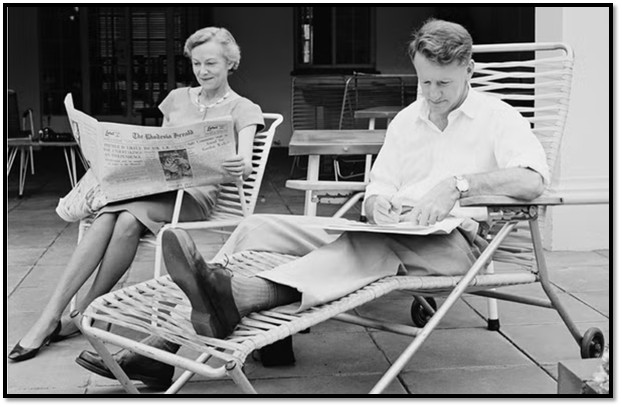
Ian Smith and his wife Janet at home in Salisbury (now Harare)
The sequence of events – year by year
1965 - Within months of the declaration of UDI in November 1965, moves were underway to bring about a reconciliation between Britain and Rhodesia.
1966 - 13 August, Britain announced the start of ‘exploratory talks’ between officials of both governments.
19 September, Herbert Bowden, British Commonwealth Secretary and Sir Elwyn Jones, Attorney General, flew into Salisbury for hush-hush talks with Mr Smith. They flew back to London nine days later. On 14 October, a top British official, Sir Maurice James arrived in Salisbury with what was described as the ‘final offer’ of terms by the United Kingdom.
25 November, after the Rhodesian government had considered the offer and communicated its reply to London, Mr Bowden made another visit to Salisbury, leaving two days later.
1 December, events took a dramatic turn. A Rhodesian party headed by Mr Smith and including Sir Humphrey Gibbs,[3] flew to Malta to rendezvous with the British Prime Minister. Harold Wilson on board HMS Tiger.
4 December, the Rhodesian team flew back to Salisbury and the next day after a marathon, 9 hour cabinet meeting, Mr Smith announced the rejection of the British proposals. The break may have looked final but within six months, peace feelers were being put out again.
1967 – 28 June, former Conservative cabinet minister and High Commissioner in Salisbury, Lord Alport arrived as an emissary of the British government.
8 November, British Commonwealth Secretary George Thomson flew to Salisbury for talks with Mr Smith.
1968 – 24 February, visit by former British Foreign Secretary, Sir Alec Douglas-Home.
20 September, James Bottomley, Under Secretary of the Foreign Office, arrived for talks with Sir Humphrey Gibbs and Mr Smith.
9 October Mr Smith and a team of nineteen flew to Gibraltar to meet Mr Wilson on board HMS Fearless.
13 October. Talks broke down. “Differences too great” said Mr Smith.
15 October, Fearless terms published. British demands include a ‘blocking quarter’ made up of African members in the Rhodesian legislature, extension of the B-roll franchise for Africans over 30 years old and a Royal Commission on racial discrimination and land apportionment. But the main stumbling block was Britain's insistence on appeal to the judicial committee of the Privy Council on any move affecting the entrenched clauses of the constitution.
2 November, George Thomson arrived in Salisbury for what was considered to be the most crucial round in the talks since UDI.
9 November, Mr Thompson left, avoiding the third anniversary of UDI and returned four days later to continue talks.
15 November. Breakdown. Britain’s insistence on a second safeguard against amendment of the Constitution seen as the major reason for failure.
1970 - For more than two years there was no official contact between Britain and Rhodesia. But soon after the Conservative government of Edward Heath gained power in June 1970, work began on preparing for more negotiations.
1971 - February, Mr Smith confirmed that he had been in touch with the British government on the possible re-opening of talks. In the past month, at least three British government envoys have been in Salisbury.
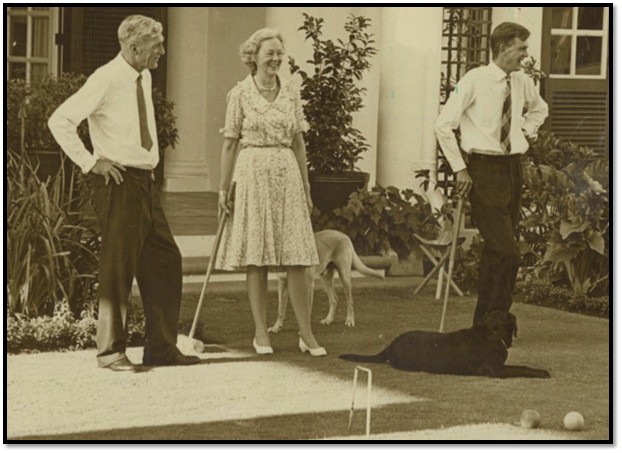
Sir Humphrey Gibbs and his wife Molly
Sir Humphrey Gibbs as Governor of Southern Rhodesia
Sir Humphrey Gibbs had come to Southern Rhodesia in 1928 and farmed at Nyamandhlovu, near Bulawayo. In 1959 he was appointed as Governor of Southern Rhodesia.
As the Wikipedia article states, UDI by the Rhodesia Front Government placed Gibbs in a very difficult position as a loyal Rhodesian and close friend of Ian Smith, he was divided by his loyalties to the British Crown.
Soon after you UDI Prime Minister Smith and his deputy Clifford Dupont called on Gibbs. Whithall had directed Gibbs to use his governorship powers and dismiss Smith and his entire cabinet from office for declaring UDI and this he did.
His message read,[4] “I have it in command from Her Majesty to inform you that it is Her Majesty's pleasure that, in the event of an unconstitutional declaration of independence, Mr Ian Smith and other persons holding office as Ministers of the Government of Southern Rhodesia or as Deputy Ministers cease to hold office. I am commanded by Her Majesty to instruct you in that event to convey Her Majesty's pleasure in this matter to Mr Smith and otherwise to publish it in such manner as you may deem fit.”
The message continued, “In accordance with these instructions I have informed Mr Smith and his colleagues that they no longer hold office. I call on the citizens of Rhodesia to refrain from all acts which would further the objectives of the illegal authorities. Subject to that, it is the duty of all citizens to maintain law and order in this country and to carry on with their normal tasks. This applies equally to the judiciary, the armed services, the police and the public service.”
However, the Governor’s statement was simply ignored by Smith and his cabinet who replied, "in view of the new [Rhodesian] constitution..., he no longer has any executive powers in Rhodesia"—and therefore, his power to sack them no longer existed.”
[1] The independence proclamation document was signed by Ian Smith at 11am local time on 11 November 1965, during the traditional two minutes’ silence to remember the fallen of the two World Wars
[2] Wikipedia: The referendum was approved by 81% of registered votes. Votes in favour 61,130 (81%) Votes against 14327 (19%) Invalid votes 1,207
[3] Sir Humphrey Gibbs (1902 – 1990) was Governor of Southern Rhodesia during the tumultuous years of UDI from 1959 when he was appointed by Queen Elizabeth II until 1969 when he resigned. Few know that he had bought a farm in Nyamandhlovu, north of Bulawayo in 1928 and remained in Rhodesia, then Zimbabwe all of his life. In 1965 the British government directed Gibbs to use his power to dismiss Smith and his entire cabinet from office. Gibbs complied with the order, declaring that by declaring UDI, Smith and his government had committed an act of treason. However, Smith and his ministers simply ignored the dismissal, advising Gibbs that, "in view of the new [Rhodesian]constitution..., he no longer has any executive powers in Rhodesia" and therefore, his power to sack them no longer existed.
[4] Wikipedia: Humphrey Gibbs https://en.wikipedia.org/wiki/Humphrey_Gibbs