
Administration and Government 1889 – 1953
Background
This article is taken from the Rhodes Centenary Supplement published by the Chronicle in Bulawayo on the 3rd of July 1953 Page 11. The author is unknown. The article reflects the attitudes and opinions that were prevalent at the time. Additional sources have been used and notes have been added.
The newspaper upon which the article is based lays out, but in very abridged form, the chronological developments of the rise of nationalism and the sense of identity that grew from early days and culminated in the referendum of 1922 that was a major influence in persuading the Rhodesian electorate to decide on self-government and reject integration into the Union of South Africa as a fifth province in the referendum of 22 October 1922. Di Perna says, “…this event could be regarded as a precursor to Rhodesia’s UDI of 1965.”[1]
In 1906 because of widespread dissatisfaction amongst the whites of Rhodesia, particularly amongst farmers and small mine owners, Lord Selborne visited the country and listened to their grievances that mostly revolved around the British South Africa Company (BSA Co) failing to separate clearly its administrative and commercial revenues. This became a recurring issue because settlers felt by diverting revenue away from administration the company denied the country much needed development capital and secondly, it fattened the commercial side of its accounts.[2]
Also they felt by diverting revenue away from administration expenses the BSA Company was delaying self-government because the Crown would think the settlers would be unable to bear its burden.[3] In response the BSA Co reduced mining royalties and reduced the number of nominated members of the Legislative Council to five. However, although the elected members held a seven-to-five majority no legislation was enacted and finally the Colonial Office called upon the company to honour the pledges made by the visiting directors “at the earliest possible moment.”
The question of land ownership is not considered in the newspaper article but the Privy Council decision of July 1918 that the BSA Company acted as an agent of the Crown and entitled to compensation for its administration expenses was an important decision for the country.[4]
The Royal Charter
The territory in Central Africa, now known as Southern Rhodesia, was declared to be within the British sphere of influence[5] in 1888 and on 29 October 1889, the Royal Charter was granted to the BSA Company.[6]
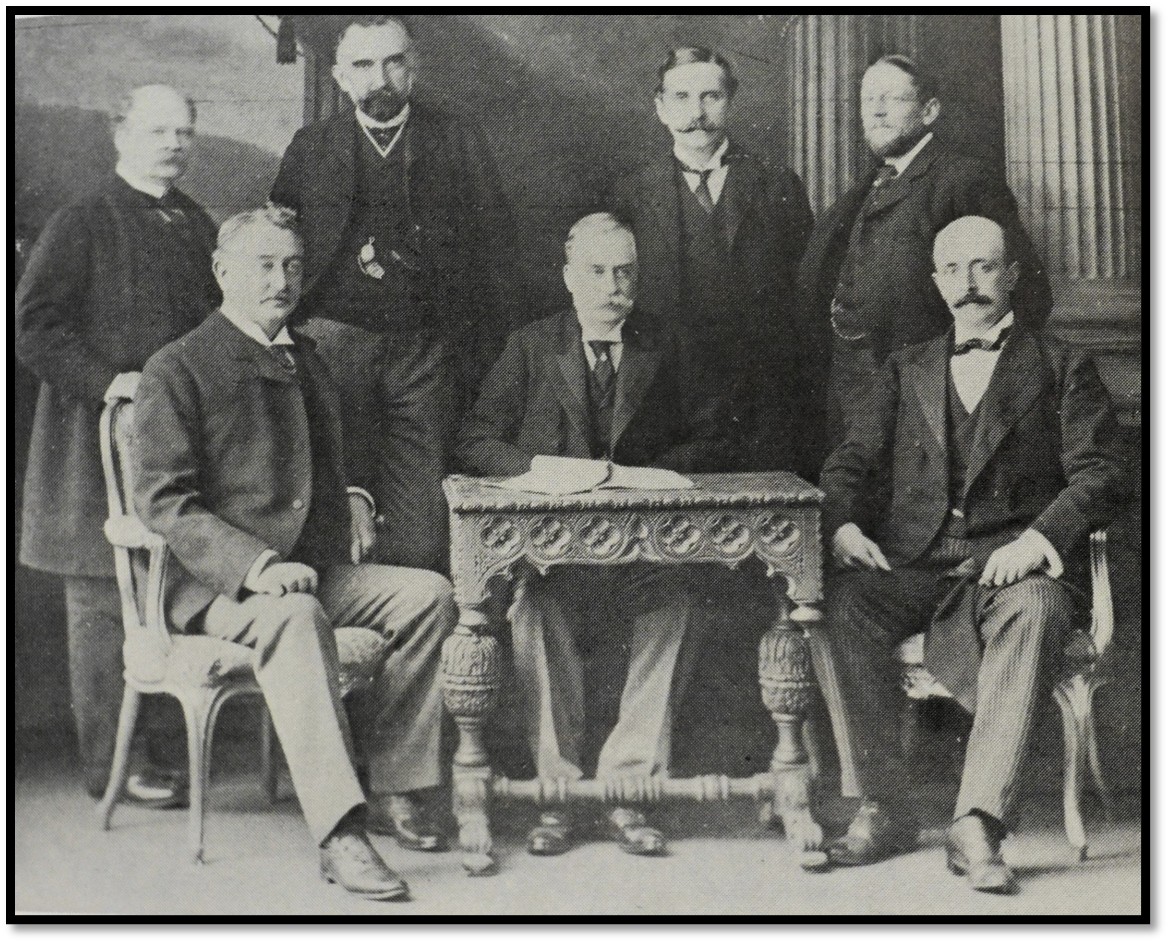
Directors of the British South Africa Company
Standing (L-R) Sir S. Shippard, G. Cawston, J.N. Maguire, Lord Gifford
Seated (L-R) C.J. Rhodes, Duke of Abercorn, Earl Grey
The BSA Co Constitution
Through the Royal Charter the company was granted extensive powers, including the maintenance of a police force, the administration of justice and the making of laws for maintaining peace and good government.[7]
Amendments to the Constitution were made by Orders in Council and later in 1899, shareholders of the BSA Company assented to proposals altering the original deed of settlement of the company by means of a supplementary charter. The alterations, which came into force on 8 June 1900 were:
- Amendments of the powers of the company to make ordinances, by the institution of the Legislative Council.
- Prohibition of the maintenance of military police by the company.
- Definitions of the powers of the Secretary of State to control the ordinances of the Board of Directors of the company, in so far as they refer to the administration of the country.
By a proclamation dated 10 June 1891, the laws of the Cape Colony were adopted for and administered in Southern Rhodesia, unless amended or repealed by the Legislative Council. Laws passed in the Cape Colony after 10 June 1891 did not apply to Rhodesia.
Justice
For the administration of justice, there is a High Court with civil and criminal jurisdiction. Before responsible government in 1923, the judges of the High Court were appointed by the Secretary of State on the nomination of the BSA Co, whereas since they have been appointed by the Governor-in-Council. In each district there is a Magistrates Court.
Before 1920 appeals from the High Court were referred to the Old Cape Supreme Court. Since 1920, the procedure has been to refer appeals to the Appellate Division of the Supreme Court of the Union of South Africa. In recent years, the Appeal Court of the Rhodesia’s and Nyasaland has functioned, dealing with many appeals which otherwise would have gone to the Appellate Division in the Union.
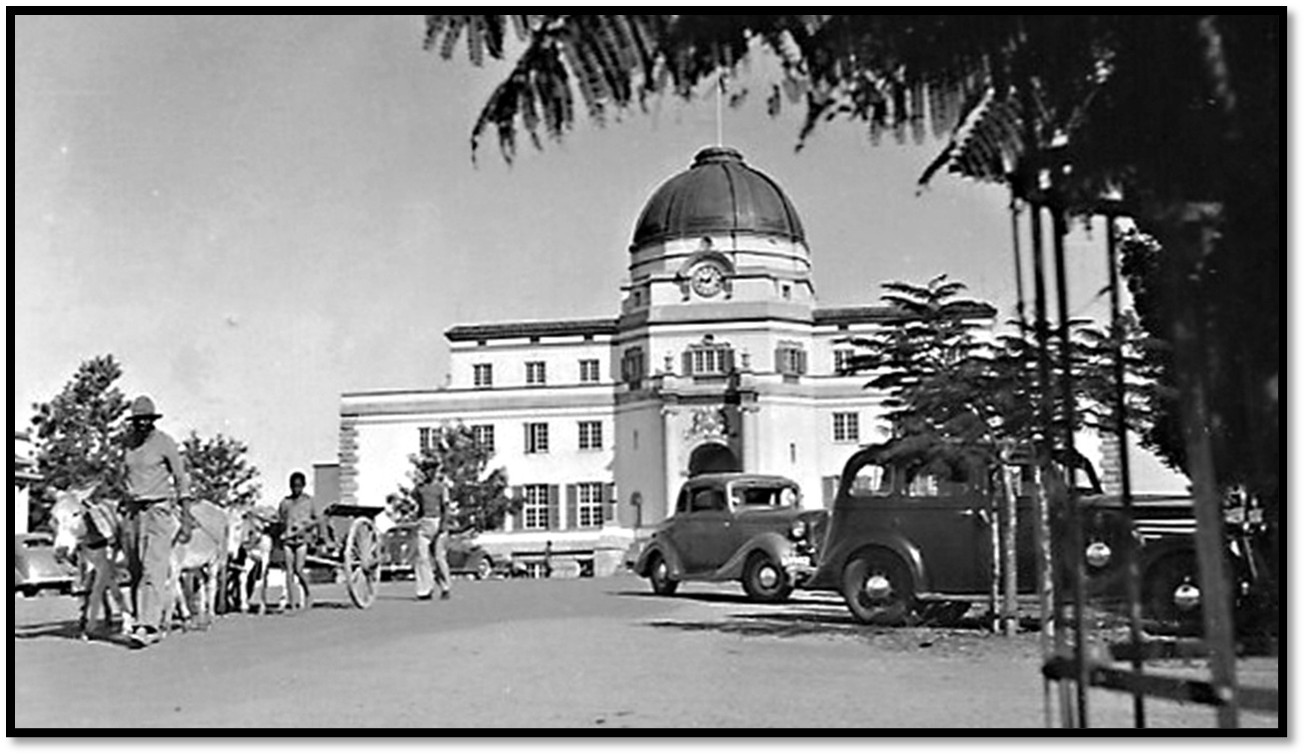
The High Court Bulawayo in the 1930’s
Officials
For the first nine years of BSA Co rule Rhodesia was governed by a one-man government – the administrator.[8]
The first officer appointed to administer the Government to Southern Rhodesia was with the approval of Sir Henry Loch, High Commissioner, proclaimed administrator of Mashonaland and the Banyai in 1890.[9] From 1891 to 1893, the representative of the chartered company was designated Chief Magistrate,[10] and the Office of Administrator only came into statutory existence in 1894.
Jameson was succeeded as administrator of Rhodesia by W.H. Milton (later Sir William) a man of outstanding character, who guided the Colony's affairs wisely and well and it was under him on the 15 May 1899 that the first step towards democratic government was taken with the formation of the first Legislative Council. This had Milton as its president and consisted of the Resident Commissioner, six nominated members who were civil servants (heads of department), and two elected members for each of Mashonaland and Matabeleland, making seven official votes to four elected votes.[11]
In 1898 an administrator was appointed for Matabeleland, the administrator of Mashonaland being styled senior Administrator for Southern Rhodesia. In 1901 the two offices were merged with the title of Administrator of Southern Rhodesia. On the grant of responsible government, Sir Drummond Chaplin retired from the office of Administrator of Southern Rhodesia, and on the 1 October 1923, Sir John Chancellor assumed office as first Governor and Commander-in-Chief with Charles Coghlan as Premier.[12]
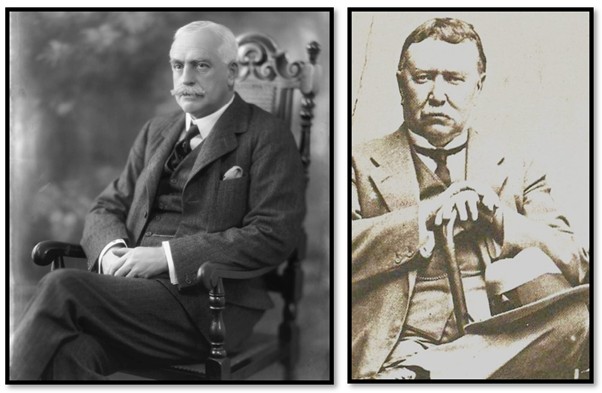
Sir (Francis) Drummond (Percy) Chaplin (1866 – 1933) Sir Charles Patrick John Coghlan (1863 – 1927)
Legislative Council
The early government of the Colony comprised the Legislative Council with the Administrator and the Resident Commissioner. The Legislative Council consisted, when it was constituted on the 20 October 1898 of nine members, of whom five were nominated by the BSA Company (with the approval of the Secretary of State) and four were elected by the registered voters of the territory. For electoral purposes, the territory was divided into two provinces, each returning two members who were elected for three years.[13]
In 1903 the terms of the constitution were amended to provide for fourteen members of the Legislative Council (seven elected and seven nominated) The existing elected members retained their seats and the country was divided into four electoral districts. These districts were: Eastern (one member) Northern (two) Midland (one) and Western (three)
In 1907 the number of nominated members was reduced to five and the Sixth Council, which opened on 15 April 1914 comprised twelve elected members and six nominated members.[14] By then the country was divided into twelve electoral districts, each returning one member.
The Legislative Council elected in 1920 was extended. Into the first period of responsible government and it was automatically dissolved on the 31 March 1924. That council comprised thirteen elected members (on account of the increase in the number of electors) and six nominated members.
Alterations to the Royal Charter
The Crown reserved the power to alter or add to the charter at the end of twenty-five years from the date of the charter and at the end of every succeeding ten years. These alterations applied only to those portions of the charter connected with the administrative and public matters. If no alterations were made within the stated period, the charter was automatically extended for another ten years.[15]
The first period of twenty-five years expired in October 1914 and the Council decided as the first World War having just broken out to recommend its extension for a further 10 years and a supplementary charter was issued on 13 March 1915.[16] It was decided that if, during the ensuing ten years, the Legislative Council should, by absolute majority, pass a resolution requesting the Crown to establish responsible government, it would be lawful for the Crown to make alterations in the charter for that purpose.[17]
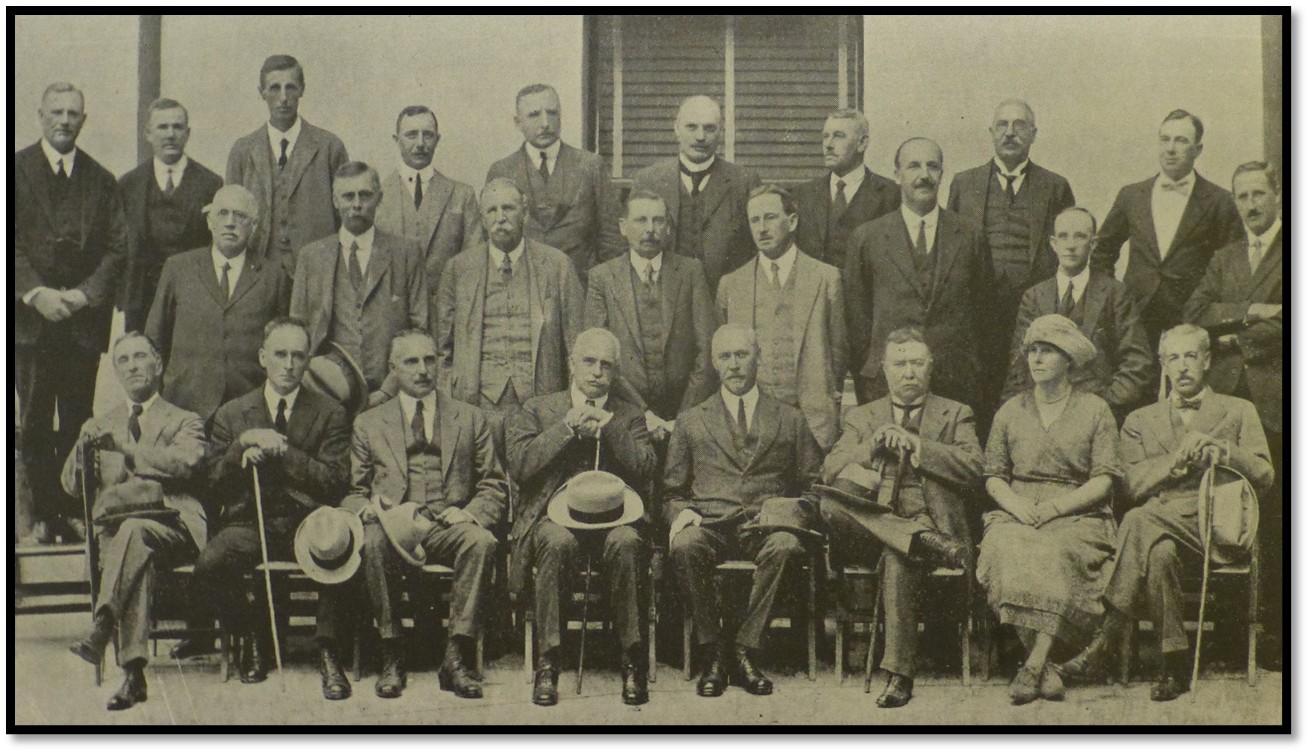
Rhodesian and Union of South Africa delegates 1922
Back row (L-R) J.H. Eskin, A.R. Hone, W.M. Leggate, D. Hawksley, Hon P. Duncan, Right Hon F.S. Malan, G. Johnson, L.F. Moore, J.W. Keller
Middle row (L-R) E.C. Baxter, P.D.L. Fynn, Sir R. Grey, Right Hon Sir T. Smartt, R.G. Garvin, Sir R. Baker, J. Stewart, Capt E. Lane
Sitting (L-R) J.G. McDonald, R.D. Gilchrist, H.T. Longden, Sir F.D.P. Chaplin, Right Hon General Smuts, Sir C. Coghlan, Mrs T. Jollie, Sir B. Wrey
A Referendum and a vote for Responsible Government
In May 1920, the Legislative Council passed such a resolution asking for the establishment of ‘responsible government.’ After investigations,[18] the Secretary for Colonial Affairs in London determined that a referendum should be held to decide whether the country should have responsible government or should join with the Union of South Africa. In agreeing to a referendum on responsible government, the Secretary of State stipulated that the Union should be approached to ascertain the terms on which it would be prepared to admit Rhodesia into the Union.[19]
The draft letters patent and the terms of admission to the Union were put before the electors in a referendum on 27 October 1922, with the result that 8,774 voted for responsible government and 5,989 for joining the Union of South Africa.[20]
The territory was formerly annexed to the British Dominions on 12 September 1923, the thirty-third anniversary of the occupation of Mashonaland. On 1 October, Southern Rhodesia was granted responsible government and became the Colony of Southern Rhodesia.
Reservations in the Constitution
However the Colony did not have full autonomy. Legislation regarding Native affairs, the Rhodesia Railways Limited, and certain other matters were reserved, that is, had to receive the approval of the British Secretary of State before becoming law. The United Kingdom High Commissioner in South Africa had supervisory powers in connection with Native affairs and the trusteeship of Native Reserves was vested in him. However in 1936 the Constitution Amendment Act removed the supervisory powers of the High Commissioner in South Africa.[21]
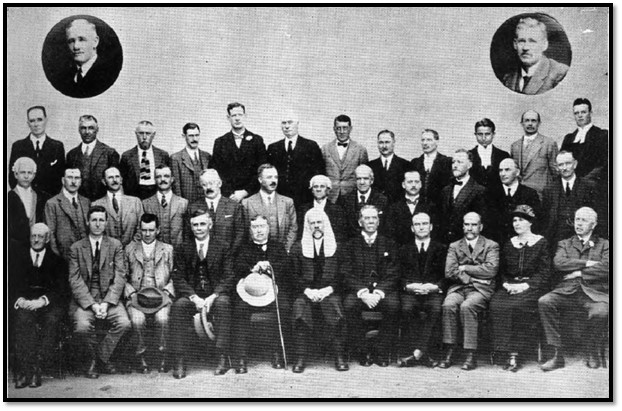
First Legislative Assembly of the self-governing Colony of Southern Rhodesia, 1924
Inset: J.P. Richardson and F.P. Mennell
Back row (L-R) R.D. Gilchrist, J. Martin, C.E, Gilfillan, G.M. Huggins, J. Murdoch Eaton, J. Cowden, L.K. Robinson, H.R. Barbour, E. Edwards (Press) Lewis (Hansard) A. Drew (Clerk) H. Hawtin (Hansard)
Standing (L-R) C.C.D. Ferris (asst Clerk) Col D.C. Munro, Col C.F. Birney, col O.C. du Port, A.R. Thomson, G.F. Elcombe, J. Jearey (House Clerk) W.J. Boggie, H. Bertin, F.L. Hadfield, M. Danzinger, R.A. Fletcher
Front row (L-R) Sir E. Montague, W.M. Leggate, H.U. Moffat, P.D.L. Fynn, Sir C.P. Coghlan, L. Cripps (Speaker) Sir F. Newton, R.L. Hudson, C. Eickhoff, Mrs E. Tawse Jollie, J.W. Downie
What were the terms under which Rhodesia would enter the Union of South Africa?
The key terms are summarised below:
Political Representation: Rhodesia would be represented in the Union Parliament by ten members in the House of Assembly and five members in the Senate with potential future increases
Provincial Government: the Legislative Council would be replaced by a thirty member Provincial Council
Financial: a special subsidy of £50,000 per year plus a development grant of £500,000 per year for ten years
Land and Railway Rights: the Union government would buy the unalienated land and railways from the BSA Co, although the Company would retain its mineral rights
Language and Civil Service: English and Afrikaans would be equal, the Southern Rhodesia civil service and the British South Africa Police (BSAP) would be integrated into the Union of South Africa
Labour and immigration: There would be no restriction on the movement of whites between Rhodesia and the Union of South Africa.
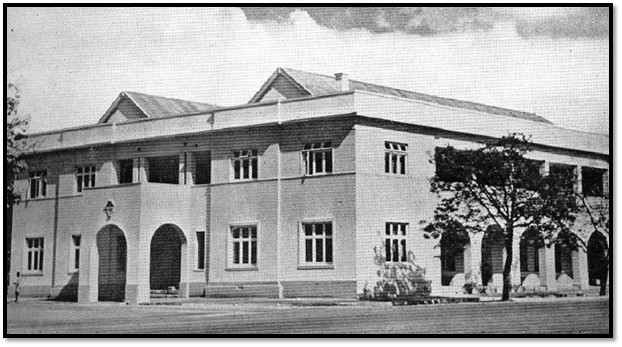
The Legislative Assembly, Salisbury[22]
Federation of Southern and Northern Rhodesia and Nyasaland
In the mid 1930’s there began moves to amalgamate Southern and Northern Rhodesia, but these were unsuccessful and then after the second World War steps were taken to achieve the Federation of Southern Rhodesia, Northern Rhodesia and Nyasaland. These later moves achieved success after lengthy and many conferences at high levels, the Federation issue was put to the voters of Southern Rhodesia and accepted by 25,570 votes to 14,729.[23] There was no voting for or against Federation in Northern Rhodesia or Nyasaland, the issue being decided for them by the United Kingdom Government.[24]
The position in 1953 is that within the next couple of months, concrete steps will be taken to bring the Federation into existence with the temporary capital in Salisbury. A Governor-General will be appointed by the United Kingdom Government and he will nominate an interim cabinet who will do all the groundwork required, such as the holding of elections and so on.
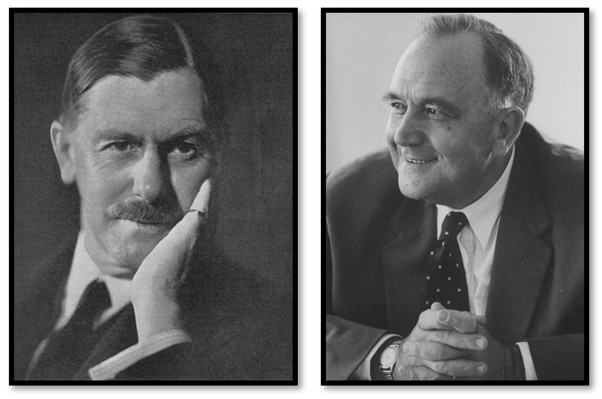
Sir Godfrey Huggins Sir Roy Welensky
Seven Parliaments 1924 - 1953
Seven general elections have been held in Southern Rhodesia since the referendum of 1922. The following is a report listing the seven parliaments, with details of the number of constituencies and the parties contesting the elections.
First Parliament, 1924 – 28
For the election of members held on the 29th of April 1924, the colony was divided into fifteen constituencies, each returning two-members. The Rhodesia Party secured (26) independence (4) Labour (0)
Second Parliament, 1928 - 1933
The colony was divided into twenty-six constituencies, four being two-member constituencies and twenty-two returning one-member each. In the elections held 19 September 1928, The Rhodesia Party (22) the Progressive Party (4) Labour Party (3) Independent (1) Country Party (0)
Third Parliament, 1933 to 1934
There were four two-member and twenty-two single-member constituencies. The elections were held on 6 September 1933. The Reform Party (16) the Rhodesia Party (9) the Labour Party (5) Independent (0) Country Party (0)
Fourth Parliament, 1934 to 1939
This was the last occasion on which there were two-member constituencies. There were four two-member and twenty-two single-member constituencies. The elections were held 17 November 1934 The United Party (24) Labour Party (5) Reform Party (1) Independent (0)
Fifth Parliament, 1939 - 1945
The Colony was re-deliminated into thirty single-member constituencies for the elections held on 14 April 1939. The United Party (23) Labour Party (7) The Rhodesia Party (0) Union Party (0) Independent (0) The life of this parliament was prolonged from five to seven years because of the wall.
Sixth Parliament, 1946 - 1948
The general election was held on the 25 April 1946. United Party (13) Liberal Party (12) Rhodesia Party (3) Southern Rhodesia Labour Party (2) Independent (0)
Seventh Parliament, 1948
Following the defeat of the government in July 1948, Parliament was dissolved and the general election took place on 15 September. United Party (24) Liberal Party (5) Rhodesia Labour Party (1) Southern Rhodesia Labour Party (0) Dominion Party (0) Independent (0)
References
Anon. Chronicle Bulawayo. Rhodes Centenary Supplement, 3 July 1953. Page 11
E. Tawse Jollie. The Real Rhodesia. Books of Rhodesia Vol 19, Bulawayo 1971
A.P. Di Perna. A Right to be Proud; The Struggle for Self-Government and the Roots of White Nationalism in Rhodesia, 1890 – 1922. Books of Rhodesia, Silver Series Vol 22, 1978
J.P.R. Wallis. One Man’s Hand. Books of Rhodesia Vol 22, Bulawayo 1972
Rhodesia 1890 – 1950: A Record of Sixty years progress
https://archive.org/details/SouthernRhodesia1890-1950ARecordOfSixtyYearsProgress/page/n77/mode/2up
Notes
[1] A Right to be Proud, Pxiv
[2] The BSA Company only paid its first dividend to shareholders in 1923
[3] A Right to be Proud, P47
[4] See the article Land and the British South Africa Company - the Renny-Tailyour and Lippert concessions under Harare on the website www.zimfieldguide.com
[5] The British Government was keen to acquire territory ‘on the cheap’ by allowing a commercial company to occupy Mashonaland thereby avoiding the associated administrative costs and this would would also block the Portuguese from claiming the territory for themselves
[6] The BSA Co Royal Charter did not limit the company to trade but included: “Preserve peace and order in such ways and manners as it should consider necessary…establish and maintain a force of police. Discourage and abolish any system of slave trade…aid and promote immigration…grant lands for terms of years or in perpetuity.”
[7] Cecil Rhodes had a wider purpose for the BSA Co and that was the extension of the British Empire in Africa and the acquisition of Mashonaland fitted his plan. The Order-in-Council of 18 July 1894 added Matabeleland and Manicaland to define the present extent of Zimbabwe
[8] Rhodesia 1890 – 1950: A Record of Sixty years progress, P57
[9] The first Administrator was Archibald Ross Colquhoun. See the article Was Archibald Ross Colquhoun; first Administrator of Mashonaland 1890 – 92, a failure or was he actively undermined by Dr Jameson? under Harare on th website www.zimfieldguide.com
[10] The Chief Magistrate (and second Administrator) was Dr L.S. Jameson ‘Dr Jim’ Rhodes’ right-hand man and closest friend
[11] Rhodesia 1890 – 1950: A Record of Sixty years progress, P59
[12] Charles Coghlan was knighted in 1910 and awarded KCMG in 1925
[13] For more detail see the article The British South Africa Company – establishing an administration in the early days of the occupation of Mashonaland under Harare on the website www.zimfieldguide.com
[14] This change occurred after director Rochfort Maguire visited the country and reminded the Legislative Council that the twenty-five year term of the BSA Company rule would be over in 1914 and appealed to them to extend charter rule since it, “will tend more rapidly and surely to advance the development of the country and the aspirations of the people for self-government than any other form of intermediate government that practically can be devised.”
[15] Clearly this initial twenty-five-year ability for the Crown to repeal or vary any section of the Royal Charter was to give the Crown the power if the BSA Company was not living up to the provisions or the objectives of the document
[16] Rhodesia 1890 – 1950: A Record of Sixty years progress, P61
[17] Di Perna writes (P11) “The weight of evidence supports the proposition that one of the objectives that the Crown had in mind when the charter was granted was that the company was to last as the governing body of its assigned territory…until its colonists were ready to govern themselves.”
[18] In January 1921 Lord Milner resigned as Secretary of State in the Colonial Office and was replaced by Winston Churchill. Both Milner and Churchill were strongly opposed to responsible government for Rhodesia. Coghlan in a letter to his wife wrote, “He, Churchill, is bent on driving us into union. If he can, but damn him, he will not succeed if I can help it. I told him that there was a point beyond which we could not possibly go in advising the people of Rhodesia to take on financial burdens which, in the case of other colonies which had got responsible government, had been discharged by the imperial government.”
[19] I have added a paragraph on the terms offered by South Africa
[20] 59% of the white population voted for self-government and 41% for joining the Union of South Africa
[21] Rhodesia 1890 – 1950: A Record of Sixty years progress, P61
[22] The construction of Cecil Building began in 1896 as a hotel, but in 1897 it was taken over by the. BSAP as temporary quarters for their men during the Mashona Rebellion. In December 1898 the Cecil Hotel was sold to the British South Africa Company for £7,000 and provided offices for the Administrator, the Executive Council, the Survey Department, the Postmaster General and above all as a debating chamber for the Legislative Council. The first session in 1924 was held in Princes Hall, Salisbury, but since then they have been held in Cecil building.
[23] 63% of white Rhodesians were in favour in favour of Federation, 37% against. Queen Elizabeth II signed an Order in Council on 1 August 1953 establishing the Federation of Rhodesia and Nyasaland between the self-governing colony of Southern Rhodesia and the British protectorates of Northern Rhodesia and Nyasaland
[24] The two key champions for Federation were Sir Godfrey Huggins, Prime Minister of Southern Rhodesia and first Prime Minister of the Federation and Sir Roy Welensky who became the second and last Prime Minister of the Federation