
The system of Local Government in Southern Rhodesia
This article is taken from the Rhodes Centenary Supplement published by the Chronicle in Bulawayo on the 3rd of July 1953 Page 9 and was written by E.S. White, the Town Clerk of Bulawayo. The article reflects the attitudes and opinions that were prevalent at the time. Other sources have been used and notes have been added.
Definition of local government
Local government in Southern Rhodesia is a general term, applying to municipalities, town management boards, village management boards, road councils, intensive conservation area committees, native councils, trade licencing boards, valuation courts and a host of similar organisations. Most of the bodies have one common denominator - central government creation and localised areas of autonomy.
Up to 1939, the Statute Law of Southern Rhodesia included Dutch placaats,[1] ordinances and Acts of Parliament of the Cape of Good Hope, orders-in-council, High Commissioner’s proclamations and regulations and ordinances of the British South Africa Company (BSA Co)
In 1939 the statute law of the colony was revised and republished. Under this law, the government exercises certain administrative controls over local authorities, relating mainly to approval of town planning schemes, by-laws, alienation of land and the raising of loans.
For years municipalities dealt with separate government departments, but in 1948 the Department of Local Government was established, under an officer styled the Local Government Officer. Act 45 of 1882 of the Cape of Good Hope was the first municipal law in Southern Rhodesia. Many amendments and additions were made and last year there was passed a measure which is now in force, called the Municipal Act 1952.
This Act provides for the inhabitants of every town to be a body corporate with perpetual succession and for the governances of this body corporate by means of a council. The council is not itself the body corporate but acts as agent for that body which is the municipality.
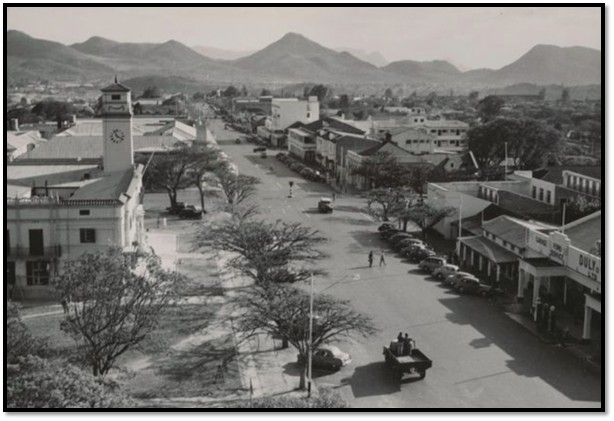
Umtali (present-day Mutare) Main Street in the mid-1950’s
Local councils
The number of councillors may not be less than six or more than 24 and, in the case of municipalities divided into wards, the number produced by the return of four councillors for each ward. Bulawayo is the only municipality in Southern Rhodesia with the ward system, there being 3 wards with four councillors each.
The qualification of a counsellor depends on his ability to be rated. He need not necessarily be a registered voter. Persons not eligible for election are those whose affairs are under liquidation or assignment, unrehabilitated insolvents, aliens who have not been naturalised as British subjects, persons of unsound mind and those who are debarred on account of certain criminal offences.
There is no party politics in municipal government - each councillor is of equal importance and his advancement depends upon his own efforts and interest and not on party manoeuvring. Councillors are not paid for their services in Southern Rhodesia, but, under the Act, a council may approach its ratepayers with a view to obtaining their assent to personal allowances, the amount not to exceed £10 a month for each councillor. The decision of the ratepayers has to be made by poll.
Salisbury City Council has obtained the approval of its ratepayers for personal allowances of £10 a month. A poll held in Bulawayo in 1945 rejected a similar proposal by 680 votes to 110.
A mayor is selected from the councillors each year after the elections. The mayoral allowance may now be determined by the council and approved by the government.
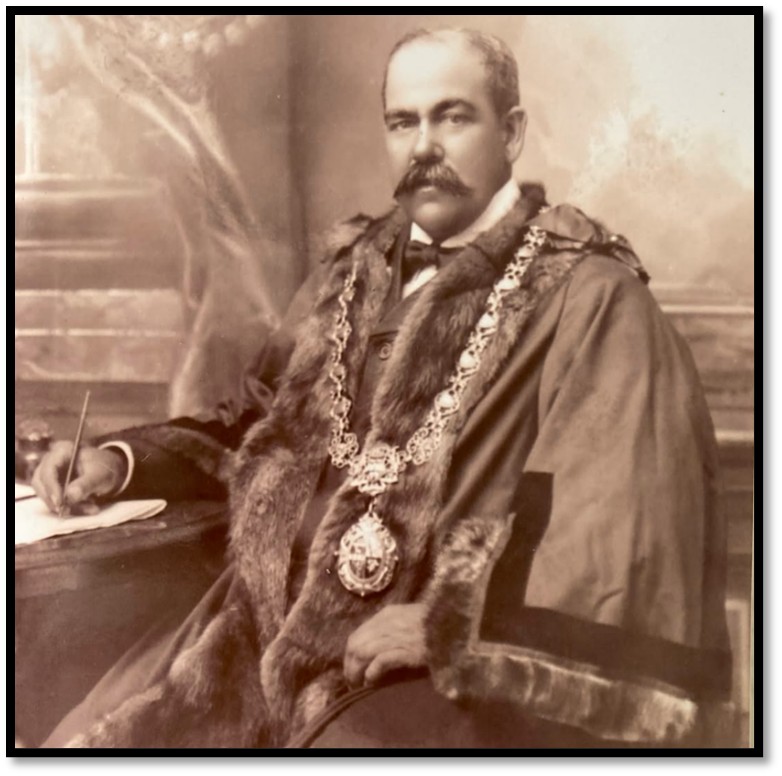
John Pascoe, Mayor of Salisbury 1906-8
Voter qualifications
The qualification for municipal voting is; every person of full age (i.e. 21 years) who on the first day in June in any year, is the owner or occupier of any immovable property[2] in a municipality and who has paid all sums then payable in respect of any rates made three months or more before such day, is entitled to enrolment.
Every married person over 21 years of age, other than a person married under any system of polygamy, is deemed to possess the same qualifications as his or her spouse where he or she does not possess the qualifications in his or her own right.
Each town in Southern Rhodesia has its own officials and departments to fit in with local needs and ideas, but they all tend to follow the patterns of older municipalities. The town clerk is the only compulsory appointment.
Land provisions
The Land Apportionment Act divides the colonies land into three main categories; europeans, native and undetermined. In the european areas, natives may not acquire, lease or occupy land except under certain conditions. With few exceptions these conditions are that the native is employed by the owner of the land, or is resident in native residential areas, or village settlements set aside by the local authorities or the government. Similarly, in the native areas no european may own or occupy land, except for purposes beneficial to natives. For example, educational, religious or administrative, or other approved purposes. These conditions apply also to the occupation of the urban native residential areas.
In other words, this legislation aims at residential segregation and therefore, has some features in common with policy in the Union of South Africa. It differs in that it was not conceived as a permanent solution of what is miscalled the ‘native problem.’ This problem is really that of two races of very different cultural and technical levels living together.
So far as local authorities are concerned, the Land Apportionment Act has three important implications:
- is that they should set aside native urban areas for the occupation and other reasonable requirements of natives.
- natives should not occupy the european area except where they may be living on their employer's premises.
- the third impact of the Act is through the authority it gives to the Minister to allow the Rhodesia Railways and other statutory bodies which employ a large number of natives to provide for their native employees and their wives and children accommodation, schools, churches, recreation grounds and such other facilities as may be necessary.
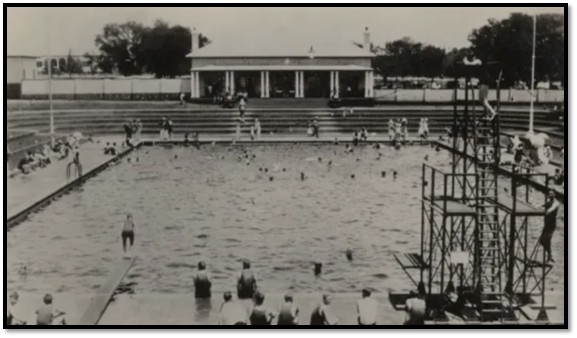
Municipal swimming bath in Bulawayo
Other regulations applicable to municipalities
There are two other Acts which affect the municipality and native affairs.
- the Native (Urban Areas) Accommodation and Registration Act
- the Native Beer Act.
The object of the former is to make provision for employees to provide accommodation for their native servants and certain wives of such servants and for the regulation and control by the local authorities of natives seeking employment or visiting local authority areas and for the regulation and control of contracts of services with the native servants.
The Act makes it obligatory on employers to accommodate their employees and provides that the obligation may be discharged by housing them in the native residential area or on their own private premises. The local authority is thus made responsible by implication for the erection of accommodation in the native urban area and by direction for the inspection and enforcement of suitable standards of housing on private premises.
The Native Beer Act prohibits natives from brewing in the local authorities area. It gives the local authority a monopoly both of the brewing and the sale of beer, except that after consultation, the minister may authorise large employers who have approved housing schemes to brew and sell beer.
In Bulawayo, the City Council has, as a matter of social policy, extended the beer business as much as possible, believing that to give facilities to natives to drink beer in decent surroundings is to strike the most effective blow against the concoction and consumption of illicit brews and the evil consequences which flow from them. So though Bulawayo's population is small compared with those of many other municipalities, its beer production is the third largest in southern Africa - following Johannesburg and Durban. In Bulawayo there are thirteen beer gardens in and around the town. Four of these are in the european area and others will probably be established.
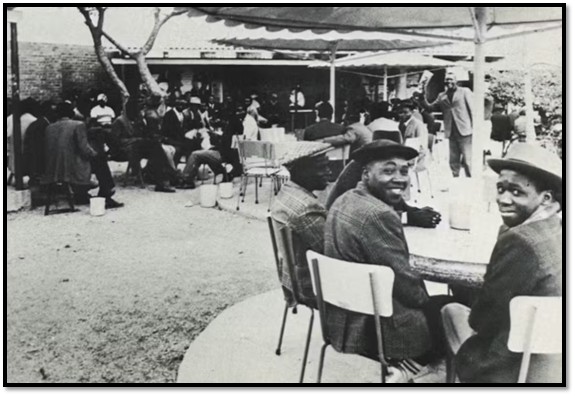
A Municipal beerhall in Bulawayo
Municipalities can control through by-laws
One of the most important powers conferred by the government on municipalities is that of making by-laws. In regard to racial discrimination it is noteworthy to give the following reservations from Section 40 of the Constitution of Southern Rhodesia. No conditions, disabilities or restrictions which do not apply equally to persons of european descent shall, without the previous consent of the Secretary of State, be imposed upon natives (save in respect of the supply of arms, ammunition and liquor) by any proclamation, regulation, or other provisions of any law, unless such conditions, disabilities or restrictions shall have been explicitly prescribed, defined and limited in such law.
The Municipal Act gives municipalities the following express powers to discriminate in by-laws.
- for controlling, regulating and supervising the housing of native servants by their employers and preventing annoyance arising therefrom to other persons.
- for regulating pedestrian traffic in public streets, including the use thereof by natives and prohibiting the carrying by them of knobkerries, sticks, or other weapons.
- for appointing separate omnibuses, or portions of any omnibuses for the use of white persons, of natives, of Asiatics or of other coloured persons respectively, and for restricting the use of such omnibuses or portions thereof to such persons.
- for prescribing what persons, other than natives, who may enter or be in native eating houses and for prohibiting the presence therein of persons other than natives not so prescribed.
The housing problem is not the responsibility of Municipalities
In common with other countries which have had periods of rapid expansion Southern Rhodesia has had a difficult task in trying to keep essential services in step with that expansion. For instance, housing which is a serious post-war problem everywhere, could not be handled by municipalities because of the magnitude of the problem caused by large-scale immigration and the lack of finance.
A National Building and Housing Board was set up by the government in 1946 and has built thousands of houses of pise de terre and ‘no fines’ construction with its own organisation and also a number of brick houses by contracts with private building firms.[3] For reasons stated to be financial the board was wound up on 31 March 1953.
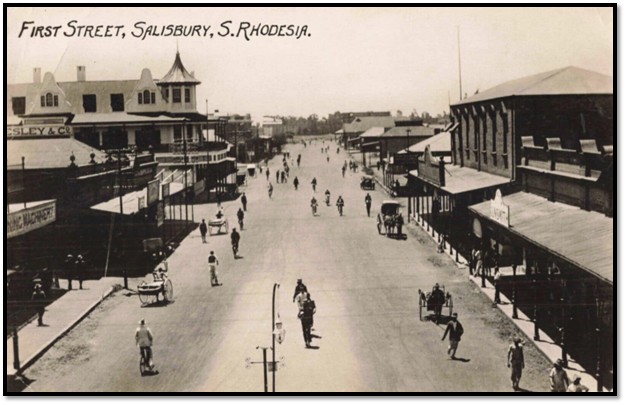
First Street Salisbury in the early 1930’s
Municipal revenue
The revenue needed by a municipality to pay for the services is derived from:
- rates.
- revenues from municipal trading concerns.
- tariffs and fees for services
- licencing and registration fees
- limited subsidies from the government for certain public health work.
The council of every municipality levies rates upon all rateable properties within its jurisdiction. This levy can be an owner’s rate on the value of the land or buildings or both, and the tenant rate upon the annual value of land or building or both. There is a provision that no rate exceeding four pence in the pound on the value, or one shilling and four pence on the annual value of rateable property can be levied unless public notice has been given of intention to levy such rate. Any ten ratepayers can demand that the proposal should be submitted to a poll of ratepayers.
The policy of Southern Rhodesian municipalities has been to obtain revenue for measurable services by special tariffs, and to impose a rate to cover the cost of administration of the town and the general amenities provided for the citizens. The revenue from rates is therefore used for such services and administration, and for roads and bridges, town halls, sports grounds, parks, swimming baths, fire protection, public lighting and so on.
The tariffs and charges for commodities and services provided by the trading undertakings are based on the principle that each undertaking should be self-supporting. In practice, some of these undertakings, particularly that of electricity, earn revenue surpluses.
Power of municipalities to borrow money
Municipalities may only borrow money if it is to be used for
- the construction of permanent works or undertakings
- for the purchase of land
- to liquidate the principle monies owing on amounts of any previous loan.
Twenty ratepayers may demand, except in the case of (3) that the question of whether or not a loan shall be incurred be submitted to a poll. A simple majority against the proposal prevents the municipality from incurring the loan. If no poll is demanded, the council may adopt the proposal to borrow, but only if a majority of the total council agreed to it, and it may not confirm any such resolution if the net loan date plus the proposed loan exceeds one-sixth of the rateable valuation of property in the municipality, unless the Governor assents. The Governor may assent to a borrowing under these conditions if he is satisfied that the proposed undertaking will, by itself, earn sufficient revenue to meet the interest, to amortise the loan, and to maintain the undertaking in a suitable condition. If these conditions do not obtain, the Governor may still assent to the loan if he is satisfied that the loans previously raised by the municipality are so great a proportion of the whole that it would be safe to do so.
References
M.I. Hirsch. African Housing in Southern Rhodesia. The Central African Journal of Medicine Vol 5 No 8, August 1959
E.S. White. The system of Local Government in Southern Rhodesia. The Chronicle, Page 9. 3 July 1953. Rhodes Centennial Supplement
Notes
[1] A Placaat is a Dutch decree or official proclamation of a law, tax or ordinance that were used between the 16th – 18th centuries
[2] Immovable property is defined as immovable property liable to be rated and as shown on the valuation roll for rating purposes as having a value of not less than £50.
[3] The post-war list of completed permanent accommodation in the seven Southern Rhodesian municipalities 1947-S7:
Married Units | Single Individuals Accommodated | |
Bulawayo | ||
Municipal | 5472 | 14556 |
Government Urban African | ||
Village (home ownership) | 2580 | 2113 |
Salisbury | ||
Municipal | 3775 | 20618 |
Government Urban African | ||
Village (home ownership) | 2779 | 3360 |
Gwelo | ||
Municipal | 794 | n/a |
Government Urban African | ||
Village (home ownership) | 260 | 43 |
Umtali | ||
Municipal | 1692 | 6246 |
Gatooma | ||
Municipal | 1534 | 2304 |
Que Que | ||
Municipal | 522 | 264 |
Government (RISCO) | 895 | 900 |
Fort Victoria | ||
Municipal | 553 | 480 |