
Ivon Fry’s reminiscences of Bulawayo and Lobengula in 1888 – 89
Introduction
Ivon Fry’s reminiscences were written down by the Bulawayo Chronicle journalist Foster Windram in September / October 1938 when Fry was 74 years old[1] and they have been lent to me by his son, Alan Windram. I have tried to keep the text as original as possible, although there are sections that have been shortened and where on occasion Fry returned to a subject already discussed, they have been amalgamated into one subject. I have kept the narrative personal by writing in the first person
Being a journalist Foster Windram had the skills to draw out these early memories from Ivon Fry. In 1888 Fry was a young man of 22 years old, and Foster Windram captures the emotion elicited by Fry’s memories. Fry’s father did not succeed in obtaining a concession from Lobengula; cancer forced him to return to Kimberley where he died, Fry clearly felt betrayed and had a great dislike of Cecil Rhodes’ and by association the lawyer Bob Graham and Francis Robert ‘Matabele’ Thompson,[2] the Rhodes’ representative who succeeded him at Bulawayo in 1889.
Ivon Fry’s reminiscences cover a wide period of Zimbabwe’s colonial history and may be unique in including the pre-concession days of 1888 and subsequent events. He marched with the Pioneer Corps in 1890,[3] knew Rhodes, Jameson and Johnson well, took part in the Battle of Massi-Kessi (Macequece) against the Portuguese, rode with the Victoria Column in 1893 to Bulawayo, was involved in the construction of the Beira Mashonaland Railway (1892 – 1898) to Umtali. He does not mention the 1896-7 Matabele (Umvukela) / Mashona (Chimurenga) Rebellions, so perhaps he was in South Africa at this time.
Fry’s memories capture a very special time when the Matabele controlled directly and indirectly a huge swathe of land and were probably at the height of their power. All this changed dramatically with the coming of the white man, but despite this, every account of Lobengula states that he was a man who kept his word and acted honourably towards all his visitors. It is a stain on those he dealt with, including Rhodes through Rudd and his associates, who knew he was illiterate and unversed in law, and took advantage of this in their commercial dealings with him.
Many of the comments made by Fry are about disagreeing points made in the book Matabele Thompson.[4]
Ivon Fry's first visit to Bulawayo in 1886 with his father for a Concession at Tati from Lobengula
My father, John Larkin Fry[5] had a share in the Tati Concession. Sir John Swinburne[6] had the concession for over ten years and he had not paid the rent in all that time. He was supposed to pay £30 a year. Sam Edwards[7] came up to see the King on behalf of a syndicate consisting of Dan Francis,[8] himself, Billy Davin, Thomas ‘Sandy’ Leask[9] of Klerksdorp, my father and others.
Sam Edwards asked the King: “what about Swinburne’s Concession?” Loben said he hadn't heard anything or received any rent from Swinburne for ten years. (Mining had not even started, not by Swinburne) Sam Edwards said: “What about giving it to me?” So Loben gave it to him in 1881, for which he paid all the back rent, £300 and offered Loben £300 a year.
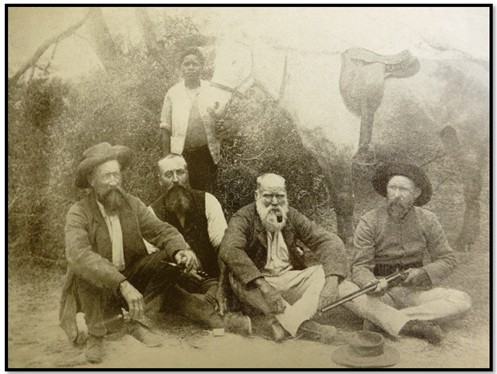
Africana Museum (L-R) Matabeleland traders and hunters: William Tainton, George Phillips, Sam Edwards, Johannes van Rooyen
I was in Kimberley at the time. I came up to Tati in 1887 with my father to test the ground and the different reefs. Early in that year we came up on a visit to the King (Lobengula) at Bulawayo. It was the time of the Great Dance in January, the dance of the first fruits (Inxwala)[10] which is always held in Bulawayo. We stayed here about six weeks. That was my first visit to Bulawayo.
Was there an agreement between John Larkin Fry[11] and Rhodes to secure a concession from Lobengula?
In December 1887 Sir Hercules Robinson[12] authorised Sidney Shippard[13] to direct John Smith Moffat[14] to convince Lobengula to sign a treaty that accepted that Britain was the main power in the territories of the amaNdebele and Mashona.
By mid-February 1888 John Smith Moffat had negotiated the Moffat Treaty with Lobengula in which Lobengula agreed, “from entering into any correspondence or treaty with any foreign state or power to sell, alienate, or cede, or permit or countenance any sale, alienation, or cession of the whole or any part of the said Amandabele country…without the previous knowledge and sanction of Her Majesty's High Commissioner for South Africa.” The Moffat Treaty, “fitted Salisbury’s specifications of imperial influence without imperial responsibility.”[15]
Rhodes was quick to congratulate Shippard, “I am very glad you were so successful with Lobengula…At any rate now no one else can step in.”
Thereafter in 1888 Rhodes tasked John Larkin Fry, an employee of De Beers who spoke fluent isiZulu, to travel to Bulawayo and negotiate a mining concession with the King.
Sadly soon after reaching Bulawayo the elder Fry developed cancer of the jaw and left for Kimberley and died soon after.
Rhodes was already thinking in terms of a charter but after speaking to officials at the Colonial Office understood that it would only be obtained after obtaining a mining concession from Lobengula. He wrote to Shippard, “… I am going to have another try…It is an awful pity that Fry was so ill he could not stop and he has got no concession which I could use as a ground for making an offer to HM Government” and he continued, “I am sending now young Fry to try but he is a mere boy. I know Moffat cannot in any way directly support me, but you can tell him all my ideas and see if my Company is not able to obtain one, that Lobengula does not give away his territory in mining concessions to a lot of adventurers who do nothing but simply tie the country up.”[16]
Later on 1 August 1888 Rhodes wrote to Shippard that he was sending another De Beers representative to Lobengula (the Rudd party) meanwhile young Fry ‘was on the spot’ in Bulawayo and acting for Rhodes, “I have told him (Fry) to make another try when Moffat arrives who is taking a parcel for us to Fry for Lobengula containing a big present though he (Moffat) is in no way aware of the objects.”
From the correspondence there clearly was an agreement between Rhodes and Fry’s father to obtain a mineral concession from Lobengula.
The young Ivon Fry is superseded by Charles Rudd,[17] James Rochfort Maguire and Francis R. Thompson
On 15 August 1888 the Rudd party set off from Kimberley having told everyone they were going on a hunting trip.[18] Despite this, Rhodes did not seem overly optimistic about gaining a mineral concession from Lobengula and told Nathaniel Rothschild, “Still, someone has to get the country and I think we should have the best chance.”
There is no indication either from the sources (Rotberg, ….etc) that Ivon Fry was even told that his efforts were no longer required and that the role of obtaining a concession had been taken over by the Rudd party. Rhodes had squared all the competing concession-seekers. Henry Clay Moore was bought off, Leask, Fairbairn, Phillips and Westbeech were persuaded to sell their concession and Edwards, Usher and Tainton similarly settled. Rotberg includes Ivon Fry amongst those who settled, but Ivon Fry does not say he received any monies or shares from Rhodes; indeed the opposite, he says every time he approached Rhodes he was told, “Bring your agreement.”
Ivon Fry meets Lobengula
We outspanned outside Dawson's[19] place. I was about 21 or 22 at the time. Next day we proceeded to the King’s kraal on the site of the present Government House. (There was no tree there that he held court under. There was a tree towards the northern end of the whole kraal; but it didn't denote anything. That tree was afterwards cut down)[20]
Loben always sat on his wagon box or else on a chair on the ground. He had one of the Players Navy Cut folding chairs, that I gave him subsequently. He came down to my wagon one day and sat on it and I asked him if he would like it.
In approaching Lobengula you gave him his titles: “Kumalo! Bayete! or Nkosi!” and you shook hands with him and sat down. You sat on the ground and you didn't speak to him until he spoke to you. He knew all about you beforehand because you had to send up runners from Tati to ask, ‘for the road.’ You sent to Dawson or some other white man you knew, who would go and ask for permission for you to come. We never took our hats off to the King. That wasn't a native salutation at all.
From Dawson's store where we were camping to the King’s kraal was only about 700 or 800 yards and we walked across. My father, Dawson, Fairbairn, Usher and the other white people all went up together. The King was sitting on the wagon box in front of his wagon. He had a full-tent wagon.[21] We went up to him, gave him his titles and shook hands and then went and sat down on the ground. He asked the usual questions he always asked strangers: where you had come from, what you had come for, and your name and where you were going. You could not go further than Bulawayo unless you got permission.
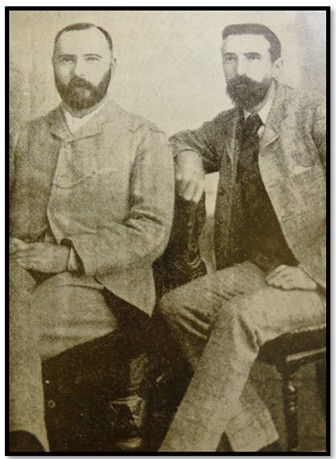
Traders at Bulawayo: James Fairbairn and James Dawson
We all brought presents of some sort. We used to bring half a dozen cases of champagne. He drank some and his Queens used to drink a lot. They would drink it all if they had the chance. Those Gazaland Queens used to drink gin like water.
We discussed no business the first time saying we had only come on a visit.
The King always gave his visitors beer. It was brought along in a billycan by a girl named Velagubi who handed the billy to us. Before she did so, she took a sip herself to show that there was no poison. The King himself never drank with us. I never saw him drink in front of us. He used to eat in front of us sometimes; but he never drank with us.
After that we visited the King nearly every day until we left. We used to go up just to have a chat with him.
After we left Bulawayo I went down to the Tati and stayed there until sometime in 1887. Then I went down to Kimberley for a change and afterwards to Cape Town.
Fry’s Mission to Lobengula on behalf of Cecil Rhodes to negotiate a mineral concession
I do not know how my first father first got the commission from Rhodes to get a concession. I think Rhodes must have asked him to do it. My father knew Rhodes well. In those days Rhodes was not looked upon as a very big man down in Kimberley.[22]
My father and I saw Rhodes in 1887 when he [John Fry] got back from Matabeleland and the Tati; and it was then that Rhodes said to us: “I have just completed the amalgamation of the French and Central Companies. I have made a million and my income is £80,000 a year. Spend that and more if necessary; but get a concession.”
After that we had to get things ready, get a wagon and wait for the rains to finish. My father had a written agreement by which we were to get £55,000 if the Concession was granted, provided we did the spade work.[23]
In the beginning of 1888, my father and I returned to Matabeleland to get the concession from Lobengula. My father told me that we were going back to Matabeleland on behalf of Rhodes and Beit. I had nothing to do with Rhodes then and I did not see him before I came up with my father.
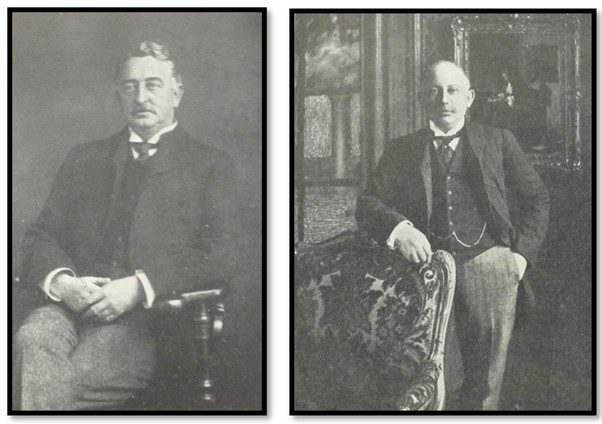
Cecil Rhodes Alfred Beit
We arrived in Bulawayo after resting the cattle for a week or so at Tati. Sam Edwards came up with us. He was always coming up to see the King as he represented him at Tati. He was his Immigration Officer, you might say.
I rode over to Hope Fountain to ask Helm to interpret for us, Helm said; “I would rather not, as the Missionaries are always accused of interfering in politics, etc.”[24] Then I got Usher[25] to interpret for us.
The first day we saw Loben we said nothing about wanting a concession. You had to work up to it in a very quiet roundabout way. It was no use trying to rush things.
Thompson[26] afterwards tried to get round Lotshe[27] to speak for him and when Lotshe was killed we heard from the natives that it was because he had been too friendly with Thompson. That was why Thompson got the wind up when Lotshe was killed.[28]
We used to see the King every day. We went up to show ourselves to the King. I cannot tell you when it was, but after some time my father put it to him that he wanted a concession of the country. He did not expect an answer then. One had to leave it to soak in as a native does not answer at once.
Before the King gave us an answer, and before my father had gone into any details with him, my father was taken ill. So he went to the King and said: “King, I am ill and I am going to die. I want the road.”
The King said: “Very well, you can have the road. It is only right you should go down and die among your own people; but you leave your son with me. I will be a father to him.”
After that he always made me trek about with him whenever he went in the country.[29] It was rather a nuisance. I think Loben was afraid that if white people died in his country, the Government might bring a charge against him.
Later, when I got word to say that my father was dying and that I must come down to Kimberley, I saw the King and told him that my father was dying and that I wanted the road to go down to him. The King said: “Yes, it is your place to see your father before he dies, but you must come back to me.”
Ivon Fry acts as Rhodes agent
My father returned to Kimberley, ill with cancer and I remained behind and acted as the agent of Rhodes and Beit.[30]
They looked upon me as a Matabele. I remember one day, after my father's death, Lotshe said to me: “Asalutu, when are you going to wear a ring?” meaning I was now a man. I replied: “when the King cuts my ears” and turned it off that way. Asalutu was my native name.
I put the question to the King: “What about the concession?” and the King said: “Gashle.”[31] Usher was my interpreter. I was paying him £300 a year.
Between the time my father left and I went down, Moffat[32] brought up some money for me, about £600 and never said a word about it. When I went to Moffat and asked him why not given it to me, he said: “I did not consider that a young man like you should be entrusted with £600.”
Whenever I required money I simply wrote to Rhodes personally and the money was sent up, usually by Dr Harris,[33] who was one of Rhodes’ jackals.[34] It was just before I left for Kimberley that Rudd, Thompson and Maguire turned up. I remember they had no food and I supplied them. When they found that my father had gone down and there was no chance of his recovery these people rushed up.
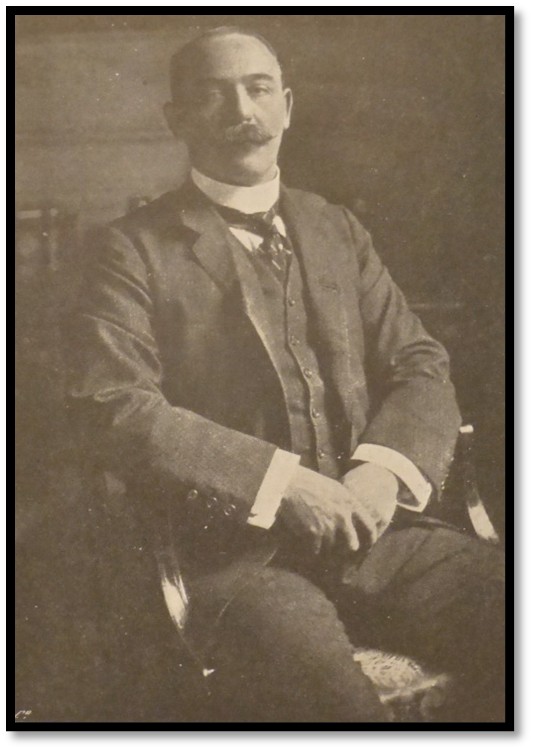
Dr Rutherfoord Harris the Company Secretary of the British South Africa Company at Kimberley
I was about 21 at that time.
Thompson said to me: “Fry, we know what you are here for and who you have come for and we are on the same errand. So if you get the Concession, we will come in on it. And if we get the Concession you come in on the other hand. Therefore, do not let us work against each other.”
I did nothing then because I had got my promise from the King. I understood that when the King said “Gashle” he meant that I was to wait before bringing the papers up to him.
I left for Kimberley about a week before the Rudd Concession was signed.[35] I know it must have been about a week, because after I went down, Rudd followed on. It might have been a month, but I do not think so. I must have had an inkling of the concession, because I remarked to my father on his deathbed: “Where is that agreement between Rhodes and ourselves?”
My father was in Kimberley more than a month before he died. He must have left Bulawayo about the end of September, or thereabouts. He died about the middle of November in Kimberley Hospital.[36]
After my father had gone down (it might have been two months after) I received a letter saying he could not live. I left for Kimberley about a week before the supposed concession was signed.
Fry leaves Bulawayo for Kimberley
There was a German count here, Count Sweinitz [Schweinitz] and Baron Crane. He had two titles. He was the son of the German ambassador at St Petersburg. Just at that time there was nearly war between France and Germany and he wanted to hurry back, so he and I left here together. The German Baron had been shooting in Matabeleland with a man in charge of his wagons.
We travelled quickly with relays of trotting oxen. We had post stations all the way down where we got relays of oxen. The system was in existence and I think the traders clubbed together to pay for it.
At Mafeking, we charted a post-cart and got to Kimberley on Sunday night. From Mafeking to Kimberley took about four days. I got there a week before my father died. I went to see my father and asked him where all the papers were, especially the agreement with Rhodes and he said: “Bob Graham has got them.” That was our attorney. I said: “He's got all our papers?” My father said “Yes.”
A week after that, I went to Bob Graham's office with my mother and demanded my father's papers. Bob Graham gave us all the papers, except the agreement with Rhodes. He pretended to hunt high and low for it. He said: “I can't find it.” And I never saw it from that day to this. The consequence was that I never got anything out of Rhodes as I should have.[37] Graham was a school fellow of my father's and we trusted him implicitly. We always thought the agreement would turn up. There was nothing more we could do. But I believe now that he sold it to Rhodes; because every time I met Rhodes afterwards and demanded a settlement he told me to “bring my agreement.”
We had done the spade work for the concession and the wording was that “in the event of the concession being granted” we were to get £55,000. Graham was an attorney in Kimberley and a member of the Club. He would have known Rhodes like everyone else.
Letter from F. W. Usher in Bulawayo
While I was down in Kimberley, I received the following letter from Usher, which goes to prove my claim on Rhodes. Usher called his place ‘Bug Villa.’ The farm he called Labouchere, after the editor of Truth magazine. The name is now changed to Fort Usher.
Matabeleland
Bug Villa
Feb 16, 1889.
Dear Fry,
I wrote you last month and am surprised that I have not had an answer from you. I had a letter from you by last post; but it did not bear on what I wrote you, so you could not have received my last one. Rudd’s party have your wagon here and they want the oxen too, but I told your boy not to give them up. I don't see why they should jump on everyone. You must let me know what to do in the matter. Am I to give up all to them and who is to pay your boys? You must write me fully all about it.
In my last letter, I told you that the King said your claim was good and that the King had not granted a concession of his country to Rudd's party. They are with the government party and the missionaries have tried to practise a fraud and they have been found out sooner than they wished.
The two Devils Rudd left behind [Rochfort Maguire and Francis Thompson] are accused of bewitching the waters[38] and are in anything but favour with the people and the King. I think you will be very foolish if you give up your claim or promise of the King’s.
The little dance is over and the big one will be in a few days.
The natives are not very civil and shout openly that the white people want to bewitch the King. I wish the dance was over. I think there will be a trial after the dance of some of the Devils and I will make it hot for some of those who have caused all the trouble here.
I am hard up for stuff[39] and there is none to buy here.
Hoping soon to hear good news from you.
I am yours faithfully,
W.F. Usher.
Meeting Rudd in 1889
When I met Rudd in Johannesburg somewhere in the beginning of 1889, he said to me: “Fry, I wanted you to take over our transport to Bulawayo.” But Rhodes would not hear of my coming into the country again. That was long before the Occupation Column.
Rudd told me then: “When the King agreed to our concession. He said Fairbairn and Fry had to be provided for. But don't look to me for it. You must look to the other side.” (i.e. Rhodes and Beit) Rhodes would not agree to my coming back with the transport. I had a lot of influence with the natives here.
Thompson drew up the supposed Concession. When Rudd looked through it, he saw that Thompson's name appeared on it. He then said to Thompson: “Remember, you are only a paid servant of ours.” Thompson replied: “I am well aware of that, but if the King signs it and my name does not appear, as we always talk about each other as ‘brothers’ it will only cause complication again and may delay the signing.”
Rudd let it pass at that. Afterwards, when the whole thing was over, Rhodes said to Thompson: “I am giving you £10,000 for the part you played in this.” Thompson said: “£10,000! Why I am one of the original concessionaires.”[40] Rhodes then went to Rudd and said: “You allowed Thompson's name to appear on the Concession and he demands £200,000, so you would have to drop two units.” That caused the row between Rhodes and Rudd. They never had anything to do with each other afterwards. I got this whole story from Rudd himself; I think it was in 1889. Rudd had a lot to do with everything after that, as a shareholder in the company, but he did not have much to do with Rhodes.[41]
Ivon Fry reiterates this after being confronted with Matabele Thompson’s book.[42]
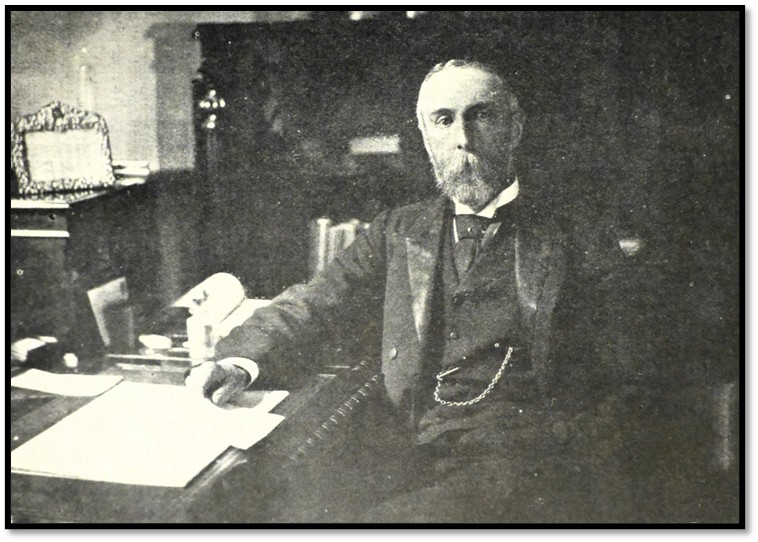
Charles Dunell Rudd
Rudd distinctly told me that Thompson had only come as the paid servant of the syndicate and that it was by putting his name on the concession that he got them to recognise him as one of the concessionaires. Rudd told me the story I have told. [This is hard to believe; see Footnote 40]
I left Bulawayo before the supposed concession was granted and I got to a place called Lemoeni Pan, where there was very little water left. I filled up our containers with water (we used to have little wooden kegs) and our cattle practically finished off the water. I then put a stick in the ground with a note in the cleft saying: “water north east, follow large footpath.”
Rudd was bringing back the concession. He reached Lemoeni and found my note. He buried the concession and what money he had in the sand under his wagon and tried to follow on the instructions with his mules; but the mules were very thirsty and kept going in all directions. Rudd, trying to get them together, eventually collapsed. Some natives found him, gave him water and took him back to the wagon. The natives gathered the mules and took them to the water and Rudd was able to set off again.
He said to me afterwards: “I got your note, Fry, but I could not get the mules to be driven along properly.” He did not get lost. He could not get lost on the main road. It was not Bushmen, but Bechuanas that found him. [more disagreements with Thompson’s account]
Subsequent attempts to upset the [Rudd] Concession
In the early part of 1889 a man came to me and made me an offer on behalf of principals of £2,000 cash and all expenses paid to fit me out if I would go back to Matabeleland and get the concession from Lobengula which had been promised me. He came to see me again next day and then he told me that his principle was Barney Barnato[43] and that the object was to upset Rhodes’ Concession, because Barney Barnato was up against Rhodes.
I met John X. Merriman[44] in the street and told him what had occurred and he told me that Barney Barnato was a scoundrel and that my father had nothing in common with him and advised me to have nothing to do with it. So I turned it down.
Sometime after 1893 Ikey Sonnenberg,[45] a well-known character, approached me to join him in an expedition to Matabeleland and find Lobengula and take him down the Zambezi and through Delagoa Bay to the Transvaal. The Transvaal government, he said, wanted him there to upset the concession.
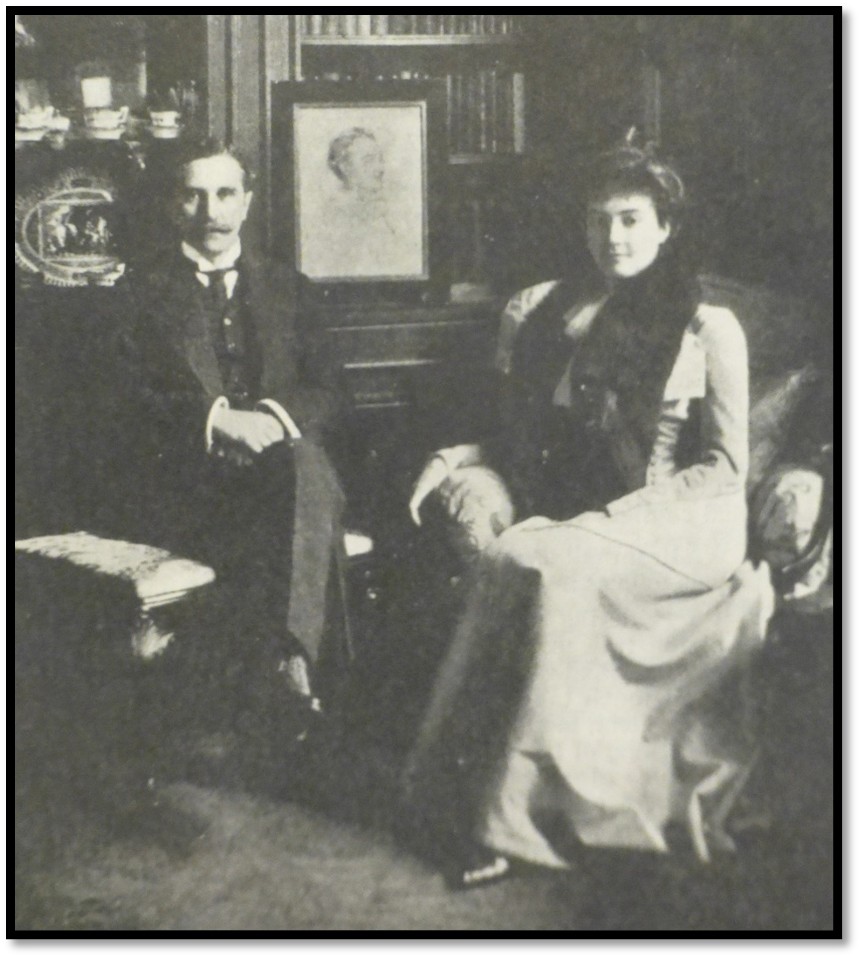
James Rochfort Maguire and his wife, note the sketch between them of Rhodes by the Marchioness of Granby
Fry goes back to Bulawayo to quieten the opposition to the Rudd Concession
While I was in Johannesburg in 1889, after Rhodes had refused to allow me to go back, I got a letter from Harry Curry, Secretary of Gold Fields South Africa Ltd, telling me I had to return to Matabeleland under the terms of my original agreement[46] and there to do nothing unbeknown to the company representative.
When my father and I arrived, we did not divulge our plans in any shape or form and we were always friendly with the local traders. They knew that we were out for a concession, but not that we had come to get the whole country. It was our plan to get a concession of the whole country for Rhodes, but we did not tell them that. They thought we were just after a concession.
My relations with the traders were very friendly, that was why I was sent back afterwards to quieten the opposition, which I did. The traders said they would not agree to the Rudd Concession because I had been promised a concession by the King and I had to be provided for before anything else happened. They knew well enough that if my concession had been granted in the first place, they would all have got something out of it indirectly. The reason why Fairbairn, Dawson, Usher, Tainton and the others were all so hostile to the Rudd party was that they all had in their minds the hope of getting a concession themselves.
I came up; it must have been about March or April, perhaps May in 1889. I know it was the dry season. I came up from Johannesburg with a wagonette and mules. When I met them all up here, I advised them not to kick against the pricks, but to get what they could out of the Chartered Company.
Shortly after I arrived, there was a meeting between Reverend Helm[47], John Moffat, Thompson and the traders - we were all there, with the King. One of the white traders asked the King the question if he knew that he had given the whole country away to the Rhodes party and the King said: “No, I want that paper back,” and Thompson said: “Yes, as fast as horses can go I will bring the paper back.”
In the meantime, before the concession arrived, Lotshe the Commander in Chief had been smelt out and killed and then Thompson bolted.
I was not there when the indaba took place with Helm; but I was there at another indaba that took place with Moffat and the other white people after my father's death. I suppose that would be in 1889. It was at the King’s [kraal] I forget what they discussed, but it must certainly have been about the concession because it was the one subject about which we were all constantly talking. The whole thing centred on the fact that Rudd's party had got the monopoly of the whole country.
I heard afterwards that the indaba with Thompson and Helm[48] and all the white men took place at the King’s over the concession, Helm and Moffat were present and Helm fainted with the heat. The others used to sneak off out of the back of the meeting and drink beer, but Helm and Moffat did not.
I stayed here for a few months and then went back again. The Chartered Company paid my expenses, but they paid me nothing for myself. I looked at it that I was to return to the country under the terms of my original agreement, and I was working for that.
I went back to Johannesburg. Rudd was away in England then. I think I went to Harry Curry and I am not certain whether he referred me to Rhodes or anyone else. Anyway, I was put off some way or another and I never worried any further. I was a young man dealing with a pack of thieves.
All the guns sent out by Rhodes had defective sights.[49] When Rhodes was asked why he sent the Matabele guns, his answer was that the natives were more dangerous with an assegai than with a rifle. I never tried any of the rifles myself; but that was the story current in the country and judging by the way the natives shot afterwards I should be inclined to believe it was true.[50]
The death of Lotshe who is blamed ‘for giving away the country’
Lotshe was not the Prime Minister, he was the Commander in Chief of the army. I was here when Lotshe was killed. Lotshe was not killed in front of Thompson. Thompson is lying.
Lotshe had been with the impi at Lake Ngami and there they made a mess of things. He was blamed by the King and the Indunas for having made a mess of things. The expedition to Ngami happened after my second visit to Matabeleland, when I came with my father to get the concession. It was probably in 1888.
Johnny Stromboom,[51] a Scandinavian, who had a store at Lake Ngami was away down at Mafeking at the time of the raid and a man by the name of Steele was in charge of his business. When the impi turned up Steele disappeared.
The Matabele got badly beaten there by Moremi’s people. Moremi’s people left a lot of canoes on the banks of the lake which the Matabele got into and could not work. Moremi’s people then fired on the Matabele from the reeds. The Matabele jumped out of the canoes and got drowned or eaten by crocodiles.
They then looted Johnny Stromboom’s store [in 1885] and came home and had a bad time generally.
Lotshe was accused of being to blame for the Lake Ngami failure and of being a great friend of Thompson’s who had always tried to get at the King through him. The Indunas brought a charge against Lotshe accusing him of having been too friendly with Thompson. He was smelt out and sentenced to death. Lottie was killed at his village and all his things were confiscated.
I dare say there was a smelling out of Lotshe’s people, but it is not true, as Thompson says, that they killed the women and children. The women and children were brought into the King’s and distributed as always.
The flight of Thompson, the Chartered Company’s representative at Bulawayo
Thompson, in the meantime, was over at Hope Fountain and did not hear of Lotshe’s death until two days afterwards. He was driving over from Hope Fountain with a cart and four horses to his camp on the Umgusa [river] and on the road he met a native with a youth driving a cow and a calf. The native stopped him and said: “White man, the King says, you must give me a rifle for this cow and calf.”
Thompson told him to go to his camp. In the meantime, he came on to Dawson’s store, where I was, got out and asked us if it was true that Lotshe was dead. We replied: “Yes, he was smelt out a couple of days ago.” Thompson said: “Who is this native who says the King says I must give him a rifle for a cow and a calf?” We said: “Take no notice of him. He tried to sell the cow and calf to us too for a rifle.”
Thompson then drove off. Very shortly afterwards I heard a horse coming towards the gates and there was Thompson, bare-back on the horse using a riem through its mouth for a bridal. When he saw me, he said: “Bring me a bridle like a good chap.” I put my head in the door and shouted to Dawson: “Here’s Thompson. He wants a bridle and saddle.” Dawson brought out a bridle and saddle and Thompson put the bridle in the horse’s mouth without taking out the riem. I said: “Hold on, you've got the riem in the horse’s mouth.” He removed the riem and put the bridle on with the curb in the horse’s mouth with the bit. I said: “Hold on, you've got the curb there.” He said:” It doesn't matter. It makes no difference.”
When he mounted the horse, he turned round and said: “What time do you fellows go to bed?” We replied: “About 8:30pm” He said: “I'll see you then.” So then we asked him where he was going. He said: “I am going to Hope Fountain to tell them the news for fear they may be anxious.” When Thompson rode off, I turned to Dawson and Fairbairn and said: “If Thompson bolts, I won't be surprised.” They pooh-poohed the idea. I said to them then: “You don't know Thompson as I do.” I then told them the story of how Thompson had seen his father killed and been wounded himself in the Griqua Rebellion of 1878.
The next day, Dawson went down to Usher’s Farm and then round by Hope Fountain and asked where Thompson was and he was told that Thompson had left the day before for Umguza. Then Dawson knew he had bolted as he had not been back to Hope Fountain.[52]
The following afternoon the wagons came in with loads from Mangwato and a native showed me a coat he had picked up in the road and in the pocket I saw letters addressed to Thompson. I said: “This is Thompson’s coat. Where did you get it?” He said: “At the Khami” [river] I said: “Did you see Thompson?” and he said: “Yes, Thompson passed us on horseback.”
We heard afterwards from Tom Maddocks[53] that Thompson rode to the Ramaquaban [river] and the horse was knocked up and he tied it up to a tree and ran and walked the 19 miles to Tati, shouting when he got there: “Span in! Span in.” Tom Maddox told us that he came out of his house and said to Thompson: “What’s the matter?” Thompson said: “The Matabele are after me.” Maddocks asked. “When did you leave?” and he replied: “Yesterday afternoon.” (It was a wonderful horse) Maddocks replied that the Matabele could never get there. Nevertheless, he sent for the oxen, inspanned an empty wagon and sent it down with Thompson to Mangwato with relays of oxen on the road and they did it in three days. They did about 50 miles, I think. In those days we used to have trotting oxen for the post-carts. Maddocks did not go with him. He was not afraid of the Matabele. Nobody was afraid of the Matabele except Thompson.
At Mangwato, Chapman put him in a cart and drove him off to Mafeking, where he met Dr Jameson and Dennis Doyle. Jameson asked where he was going and Thompson said the Matabele were after him. Jameson said: “You had better go back with us.” Thompson declined unless they insured his life for £10,000 which they did. Then all three came back again.[54]
The Matabele become hostile to the local traders resident at Bulawayo
In the meantime, the only thing that occurred in the country after Thompson had bolted was that the natives kept away from us. Not one came near us to trade, or anything else. We thought the natives might attack us, so we took precautions. Dawson had a flat-roofed house made of unburnt bricks – it was really a store room in which he kept explosives, gunpowder, dynamite and cartridges. We put in a supply of water and whatever we could in the shape of tinned stuff and made-up our minds that if we were attacked, we would put up a fight for it, and should the natives come onto the roof to try to break in, we would blow the whole thing up, ourselves with them.
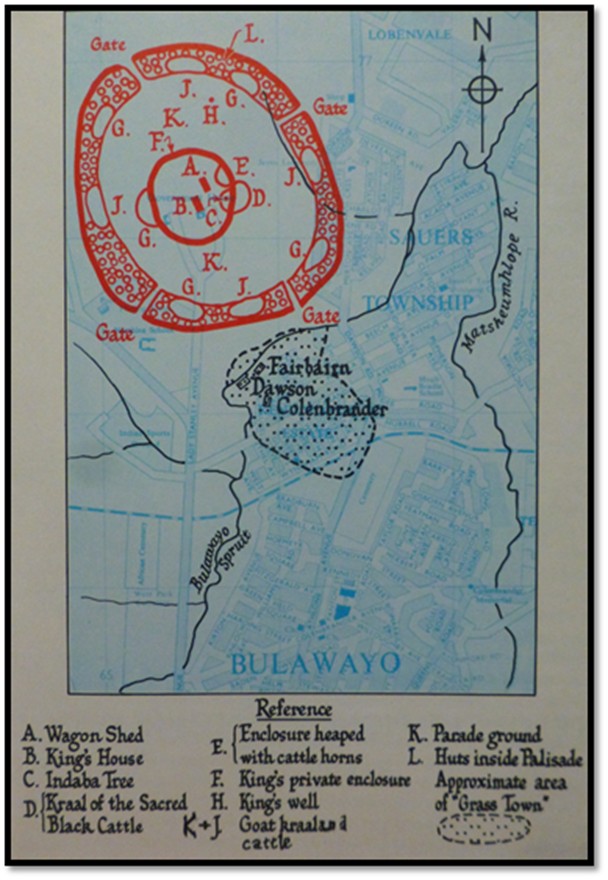
Bulawayo and White Man’s Camp from Bulawayo, Historic Battleground of Rhodesia, P52
Dawson, Fairbairn and Usher said to me: “You are in a different position from us, so go over to the King.” I rode over to the King’s at Intotini on the Umguza and the first person I meet was old William Mzizi.[55] Mzizi said to me: “Thompson has run away?” I said: “Yes.” He said: “Can Thompson bring an impi back with him?” I said: “No, He is only a Maholi among the white people.” He said: “Is that true?” I then spat on the inside of my forearm and rubbed the two forearms together above the elbow and said: “Noenisili” This was a form of taking an oath among the Matabele. Another method was putting your finger in your mouth and snapping it in the air.
I then went to the King, and before giving the King an opportunity of saying anything to me, I said: “King, Thompson has run away.” He said: “Yes, so I hear.” He asked me the same question as Mzizi: “Could Thompson bring back an impi?” I said: “No!” So he said: “Lungile” [sweet, pleasing] and after that the natives turned up again. When Thompson returned with Jameson and Doyle, they went to interview the King and the King said to Thompson: “You ran away like a rat.” Thompson said: “No, I went down to meet my friends.” The King said: “Amanga!” (lies)
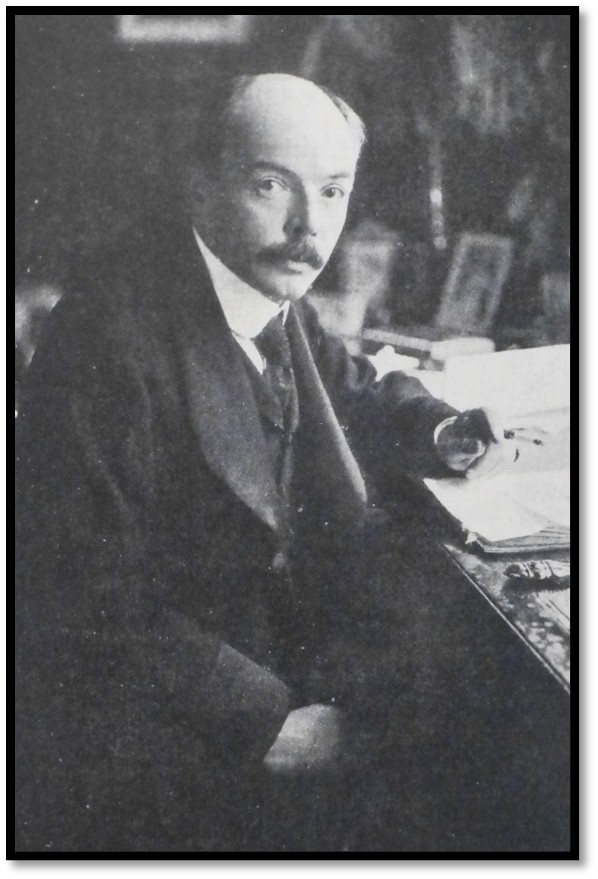
Dr L.S. Jameson
How could Thompson have heard the killing of the people of Lotshe’s family when Lotshe’s kraal was Lord knows where. And how is it that we did not hear it? Thompson's camp was on the Umguza River, just about where Sauers township stands today. It was not on the Umguza proper, but on the spruit that runs down below Government House. We called all that portion round there, the Umguza. It was not far from Dawson’s store, but it was some way lower down the spruit towards the Umguza River. It may have been a mile and a half or two miles. I never noted the distance.
No natives in the country owned horses except William Mzizi and the King; so I do not know who that native on a grey horse that Thompson refers to could have been. It was funny we never heard anything about a crowd of young Matabele in war dress approaching Thompson. Thompson is lying.[56] The King would no more think of killing a white man, then he would of flying, for fear of bringing the British Government on him. It shows you how he lies that he does not mention that he came to Dawson’s store where we gave him a bridle and saddle. He came from Hope Fountain in a cart and four horses but he did not cut the horse from the traces; he outspanned it.[57]
The reason why the natives thought that Maguire was ‘tagati’[58] was the fact that he went down to the river to wash armed with tooth powder and toothbrush and other toilet requisites. He was a bit of a dandy.
I do not know of any threat by the white men to shoot Thompson. I was not in Bulawayo when the first consignment of rifles arrived.
Curry’s letter
Afterwards, my brother, who was working at Gold Fields South Africa Ltd tried to secure a copy of the letter written to me by Curry, because it acknowledged my original agreement; but they would not allow him to examine the records of correspondence – the letter book containing the copy. I remember Curry's letter because at the time I had never heard of the word ‘unbeknown’ before and looked it up in the dictionary.
Meeting with Rhodes at Kimberley, 1888
The first time I met Rhodes, after my father's death, was at the Kimberley Club at the end of 1888. I then told him that I was prepared to accept £10,000 as I wanted to send my mother, brother and sisters to England. Rhodes said: “I haven't got £10,000.” My reply was: “You have just given £10,000 to the Parnell Fund.” He said: “What do you know about the Parnell Fund?” and then: “I won't settle with you until I take Matabeleland.” He added: “Bring your agreement.” I had already suspected that he had bought the agreement from our attorney Bob Graham and my suspicion was confirmed by his remark and by the fact that the attorney, who was insolvent before, had now retired to England and never returned.
The second time I met Rhodes was at Beira when we were building the railway, I was contracting on the Beira Railway. This was during the construction of the line and we laid the earthworks. Rhodes was with Colonel Machado, Governor of Mozambique. I approached him as he was walking along the foreshore. I said: “I would like to speak to you.” He said: “What is your name?” And when I replied: “Ivon Fry.” He sort of hopped around and said: “See me on board the Tyrion,” the English ship[59] he was on [the Pungwe river] this afternoon. I said: “No, we are here on neutral territory and Colonel Machado knows me.” Machado answered: “Yes, I know, Mr Fry very well.” Rhodes said: “I am going up the river and I'll be on board the Tyrion this afternoon.” Then I walked off and in the afternoon I went on board with Captain Andrews, the agent of the railway and general factotum at Beira for the Chartered Company.
Rhodes was surrounded by the captain of the ship, the first mate, the bosun and several others. I think he thought I wanted to shoot him. I had not made any sign to give him that idea, but he knew that I had agreements against him and perhaps he did not know what might happen in Portuguese territory. After I had said good afternoon to him, he said: “What you doing here?” I replied: “I am on the railway.” He replied: “This is no place for you.” I said: I am well aware of that and if you settle with me, Mr Rhodes, I promise not to remain here.” I meant that I was not accustomed to doing the work I was doing on the railway as I had been brought up for something different. Rhodes said: “I’ll not settle with you until I take Matabeleland.” He said: “You go ashore and I'll give instructions to Captain Andrews.” When Andrews followed me ashore afterwards, I asked him what Rhodes had told him. Captain Andrews then told me that Rhodes had instructed him to see me on board ship and send me down to Natal and to give me £25. I told Andrews he could keep the £25, actually, I told him he could stick it up.
Rhodes could not get rid of me when he came into Bulawayo after the Matabele War, he found me here again. I had joined the Victoria Column and came in with them. I did not speak to him then. But he knew that I had a lot of influence with the natives and so he insisted on my taking down the remains of Allan Wilson's party to the Zimbabwe ruins and I was kept there for two years as curator.[60]
I join the Pioneer Column in 1890
A little while after Jameson came up with Thompson and Doyle, I left the country - when everything was quiet. I had a letter from Jameson to Curry in Johannesburg. I had done my job and pacified the traders and that finished my part as regards the Rudd Concession. I cannot say how long after Jameson came up that I left. I did not return to Matabeleland until 1893 with the Victoria Column. In 1890 I came up to Mashonaland with the Occupation Column. I caught them up at Tuli.[61]
I was coming up to Matabeleland with two salted horses for Dawson and Fairbairn in case they wanted to do a bunk. In Palachwe[62] I met [Dennis] Doyle, one of Rhode’s jackals and he asked me where I was going. I told him and he told me that Jameson did not want me to go into Matabeleland. He asked me to hand over the two horses to him and gave me another horse and told me to follow after the Column. I think they did not want me to get back into the country because I had a lot of influence, especially with the King. I did as he asked, because I wanted to join the Column in the hope of being in any row going.
I caught the column at Tuli and reported to Frank Johnson and was attached to the transport under George Burnett[63] and I went into Salisbury with the Column.[64] After the occupation, I went down to the Hartley Hills, prospecting with some of the other pioneers.[65] Heany[66] turned up at our camp one night and asked me and several others if we would go into Salisbury and there we would get three months’ rations and more ammunition.
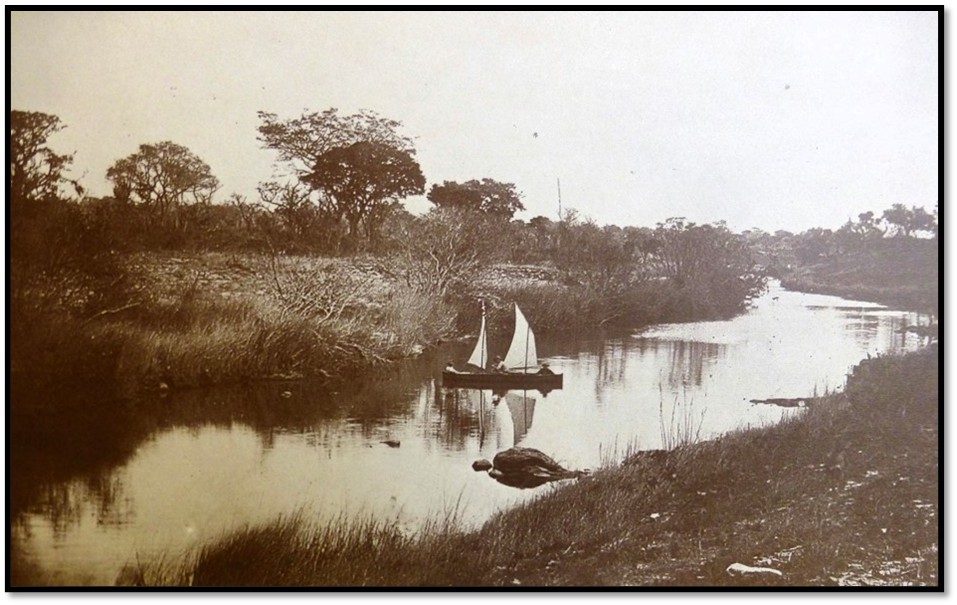
Ellerton Fry. The Berthon boat that ‘Skipper’ Hoste, Tyndale-Biscoe and Ivon Fry sailed on the Umfuli (Mupfure) river
How we gained Manicaland from the Portuguese
When we got there, we were told to trek down through the veld due east until we got to a place called Umtali and occupy the country there. I stayed in Umtali[67] until the railway started and then I went down contracting on the railway. People have now begun to come into the country. Sometime after the occupation of Mashonaland and before the railway was started, an old Jew peddler was coming into the country and he had a lot of watches of a particular make. As his people never heard of him again they instituted inquiries through the authorities. It was then discovered that a Hollander was selling these watches. The Hollander was arrested and tried for murder and hanged in Salisbury In the old original Fort.[68] Everybody sat round on the walls of the Fort and watched him being hanged. I was not there as I had just left Salisbury.
Sometimes afterwards, a man by the name of Mackenzie had something stolen by Xhosa boy in his employee. The boy cleared out and after a time Mackenzie caught him as he was travelling along on his wagon with his wife and child and a sick friend. He took this Xhosa into the police tied up in the front of the wagon. When they came to outspan the Xhosa complained that the reims were hurting him. MacKenzie loosened the reims a bit. On the inside of the wagon, hanging up, were the guns and this native grabbed a gun, shot MacKenzie, shot his wife, who fell over the baby and shot the sick friend who was on a stretcher at the back of the wagon and then bolted.
He was caught by the police afterwards and lodged in the Salisbury gaol. A mob from the kopje-side[69] went across and broke into the gaol, dragged out the native and were going to lynch him. A man by the name of Brewen, a baker on the kopje-side, brought his donkey cart and a rope with him. It was towards sundown. Jameson heard what was going on and came rushing down and said: “Hold on, boys let me have a hand in this.” Having gained their attention, he addressed them, saying: “You have all got properties in the country and if you lynch this native, nobody will invest money in the country because they will consider there is no law and order. So hand him back, and I promise you will be tried and I have no doubt found guilty, and then you can see him hanged.” The native was then taken back to the gaol and handed over to the gaoler, with a parting remark by Brewen telling the gaoler whose name was Law that if he did not bring the rope back the next day, he would be hanged. I was there and saw it all. I went along to look on.
Fry at the battle at Massi Kessi (Macequece) with the Portuguese
When we got down to Umtali, the Portuguese and French, who had been working round there had cleared out.[70] But the Portuguese sometime afterwards came back to Macequece with a baby army they brought out from somewhere.
They collected these young Portuguese boys in Portugal and they had about 300 Angolan natives with them. The Portuguese were so afraid of the natives generally that they used to capture natives in Mozambique and send them round to Angola where they could not escape and vice versa. We always called these natives ‘sepoys.’ Once upon a time when a Portuguese gunboat put into Delagoa Bay, every native in the town disappeared for fear of being collared and shipped away.
The Portuguese brought this baby army to Massi Kessi [Macequece] with the object of recapturing Manicaland from us. The government sent down a white flag to them and a message saying that there was a modus vivendi until May the 16th. i.e. that there will be no move until May the 16th. This was on May the 11th, 1891.
We had already taken up a position overlooking Massi Kessi[71] under Colonel Heyman.[72] I was one of the Troop. We had a nine-pounder [seven-pounder] with us. About the following day, the Portuguese advanced and fired at us. But all their bullets went high and we drove them back with Martini’s.[73] After they had retreated into Massi Kessi Fort we took one prisoner and a wounded sepoy, who afterwards died on our hands. None of us was hurt in the action. Then we elevated the nine-pounder and fired at the Fort. One of the shells struck a hill and bounced into the Fort, and the next morning there were no Portuguese left in it. A month afterwards, I followed down to Beira and I saw sundry, freshly made graves on the roadside which I took to be the graves of the wounded who had died.
We attempt to gain a land corridor to Beira
Then we got orders to take Beira. Rutherford Harris sent a dispatch from Kimberley to Jameson saying: “Take Beira.” Jameson sent back the answer: “Balls, take it yourself.” All we knew about it was that we were told to proceed and that we had to go and take Beira. We got as far as the next place after Vila Pery (now Chimoio) and then we got orders to turn back. I remember now the place was Sarmento.
There was a reporter from the Times who went down with us to capture Beira. He was the last man bringing up the rear. One man saw him tying up his boot lace and that was the last ever seen of him. We presumed a lion had jumped out and got him. We had a hell of a hunt for him because he had a sixty guinea watch with him and I thought the lion would not have eaten that.
I think we must have started off for Beira first and then come back to Umtali. Then the Portuguese came up with their army, and then we took Macequece. The Portuguese retired to Chimoio and built a stockade. We went down to attack them. Before we attacked, Major Sapte[74] sent into message out to us telling us not to do anything as he had come up from Cape Town for the British government to enquire into the business. So Billy Finds [The Hon Eustace Fiennes] a man by the name of du Maurier,[75] [Morier] whose father used to be British ambassador at St Petersburgh) a man by the name of Stuart and myself went down - Fiennes to interview Major Sapte and we really to escort him.
We heard afterwards that what happened was this. Before we got Sapte’s note we had captured an Angolan sepoy doing sentry duty and frightened the life out of him, disarmed him, and let him go. When he reached the Fort every bugler there began blowing a different call. Major Sapte had in the meantime arrived at the Fort from the opposite direction (from Beira) and when he heard all the commotion he wondered what it was. The Portuguese told them we were going to attack. He said: “I must get out of this. I don't want to be shot by my own people.” But the Portuguese said: “No! No! we will surrender.”
Sometime later I went down with Maritz contracting on the railway construction to Mpondo on the Pungwe River. We took on contracts from there right away up to Chimoio. When I go back sometime later to Umtali I met Jameson who asked me where I came from and when I told him, he said: “You have come through the valley of the shadow of death!” The men died like flies on that railway. There was no doctor and no medicine. They used to say afterwards there was a man under every sleeper.
When I came back from the railway construction, I went up to Salisbury from Umtali and Jameson appointed me as mining commissioner at Hartley. But before I could take up the post, they sent me to Fort Victoria as Magistrate’s clerk, because they wanted a shorthand typist from there named ‘Lucy’ Drew to come up to Salisbury. I was sent to relieve him. Then the war broke out.
The Fort Victoria Incident
I left Salisbury by post-cart drawn by trotting oxen for Fort Victoria. When we got to the Shagashi river (the last outspan from Victoria) a man by the name of Brown,[76] who was killed with Allan Wilson later, rode up and warned us to get in as quickly as possible as the Matabele were raiding the country. As I got to the town I saw a man on horseback with his wife and child with him on the same horse going into town.
The Fort in Victoria had wagons drawn into it and the women and children were all in the Fort. The cattle had been sent out to Great Zimbabwe. I saw no Matabele. In the course of time, horses from the Transvaal were brought up from Tuli way. In the meantime, Jameson had arrived from Salisbury, and he sent out and told the Matabele Indunas (Manyao and Umgandan) to come in; he wanted to speak to them. The Indunas came in and Jameson went out to meet them with Napier.[77] Everybody in the Fort was hanging over the wall looking on. Jameson approached the Indunas and asked them through Napier what they meant by killing the Mashonas and raiding the country. The reply was: “We have come to punish them at your request.”
Jameson said: “If you have any case against these natives, you must bring them before our court.” Their reply was: “We don't recognise your courts, and this is Lobengula’s country!” Jameson turned to them and said: “You have got to cross the border by 2pm or otherwise I'll drive you across!” Jameson then left and walked towards the Fort leaving Napier behind. Then Napier ran after Jameson and said the natives don't know what is meant by the border. Jameson turned round and said: “They know where the border is.” Napier went back and told the natives what we considered the border[78] (I have forgotten what it was) and pointed to where the sun would be at 2pm. The indaba took place, it might have been about 11am, or so, because Jameson had arrived that morning and he had to wait till the natives turned up.
A little after 2pm, Lendy[79] told every man who had a horse to mount. As Harry Ware was drunk, Argent Kirtin (who was killed with Allan Wilson) said to me: “You take Harry's horse” and away we went after the natives. By that time the natives were retiring back to Matabeleland and as they had not reached the border, we dismounted at 300 yards and opened fire on them. When they tried to charge, we retired again. I think I only heard two rifle shots from their side. Then we went back to Fort Victoria. When we reached the town, the walls of the Fort were still crowded with people. Jameson came out and Lendy rode forward and said: “Doctor, you told me if I struck, I was to strike hard and I think I have accounted for 300!”[80] Jameson then turned round to the people on the walls and said: “I hereby declare war on the Matabele.”
The reason why the Matabele raided the country was that the natives down towards Fort Victoria had been cutting the telegraph wire for making bangles, not knowing they were doing damage. Lendy went down and punished these natives and took some cattle away from them, which were afterwards sent down to Tuli to Peter Heugh, the magistrate there, to sell. In the meantime, Lendy came into Matabeleland and met Lobengula on the Hunyani [Manyame River] in the hunting veld and complained to the King about these people having cut the wire. Lendy then asked the King to punish these people. Lendy like all these Johnny-come-lately's did not know the Matabele. The only punishment the Matabele knew was death. The King replied to Lendy: “You have taken away cattle from these people and they are my cattle. These people are only my cattle herds.” Lendy replied: “Very well, we'll get the cattle back.” The cattle was sent for and brought back to the Shagashi river. There they were kept for several months and never sent back to Loben. When the Matabele raided around Victoria, they took these cattle with them. Jameson wired to Rhodes and said: “I have declared war on the Matabele!” Rhodes wired back: “Read Luke so and so.” As Magistrate’s clerk, I saw the message.[81]
The 1893 campaign
When we joined up for the Matabele campaign in 1893, the conditions were five shillings a day and rations as far as the border and after we crossed the border, we were to live on the country and were promised half the loot and a farm each.[82] Before proceeding to invade Matabeleland, Jameson wired to the Governor of the Cape Colony,[83] saying: “I'm entering Matabeleland with some of the police to recover native women captured by the Matabele.” I may tell you that these women had probably been captured ten years before and no one knew their whereabouts; but that was the excuse he made for taking the police in with him.
The transport drew out to the Shagashi river and camped there and from there we proceeded into Matabeleland. At Iron Mine Hill, or Ntaba Insimbi, we met the Salisbury column and we travelled along to Matabeleland in two parallel columns and laagered at night. At the Shangani River, the natives attacked us at daybreak. We drove them out. There was a young Jew killed and a Cape coloured boy in our lot - the Victoria Column. Before this Ted Burnett, Ian Grant and Percival Swinburne had been out on patrol. They reached a small village of about four or six huts. Burnett had warned Grant to be careful of the Matabele here. Grant said: “They are only Mashonas!” They dismounted and a native from out of a hut shot Ted Burnett in the liver. Swinburne and Grant leant over him to look and the native fired again and put a bullet through Swinburne's tunic. They then fired at the native and wounded him and he got back into the hut. They went round and set light to the hut. The native was driven out and they shot him. This happened about the day before the attack at Shangani river (Bonko)
After that we had several small encounters, in one of which Grant's horse bolted right through the Matabele. The natives fired at him, wounded the horse in the leg. Grant made for a kopje and tied his horse up to a tree, took off his Stetson hat and waved to the natives to come on. He fired at the natives and they fired at him and at last he was killed. We got the story afterwards from a native who brought Grant’s watch in to sell. The natives stripped the body, tied it on a horse and took it to the nearest Induna. The Induna said he did not want a dead white man and told them to take him back where they found him. They took him back and tied the horse up to a tree and left it there to die, with the body on its back. (This was the same horse that Thompson had bolted on. We called the horse ‘Loben.’)
After the war was over, a native brought me a watch and when I opened the inside of the watch, I saw Ian Grant's name in it. I took the boy down to Dawson's and I told Dawson to close the doors and hang on to this native and not to let him escape. I took the watch to Jameson. They sent for Grant's brother, who recognised the watch at once. We cross examined the native who said he got the watch from his brother, who had got it from the man who died with the horse. They then inspanned two Cape carts and the native went with them to show them the remains. The bones were brought back and buried here in Bulawayo; but were taken up afterwards and taken to his home in England. The bones were found mixed up with the bones of the horse Loben in one heap. That was the end of the horse. He was a fine horse.
Originally, the horse Loben was brought up to this country by George (‘Ocht’) Viljoen. He offered the horse, which was then unsalted, to me for four trained oxen; but I had not got them to spare. He then went over to Inyati and exchanged the horse for some broken ivory and two slaves, a boy and a girl, with George Martin. The horse salted with Martin,[84] who sold it afterwards to Boggie.[85] It was too fiery for Boggie, so he exchanged it with Thompson. It was a company horse. I do not remember how it got to Victoria, but it was there when the horses were dished out and Grant was warned not to take it because of its habit of bolting ever since Thompson’s ride. On one occasion, Percy Inskip[86] was riding it and it bolted with him into the stable and Inskip ducked his head just in time under the door.
The alarm at Shangani was given by the Mashonas we had with us. I believe one went down to the river for water and did not come back. Then another went down and did not come and then, I think, a third went down and the Matabele jumped at him and he fired at them and gave the alarm. Then the Matabele came on and attacked the laager. It was all in the dark. It was about 3am, I suppose, 3am or 4am. It was still dark, I know.
Then there was the incident of White’s Run at the Bembesi [Egodade] on the way to Bulawayo. Ken White and some other fellow had to do vidette duty amongst some camelthorn trees. White had tied his horse to a tree and went over to speak to the other chap and when he looked round, he saw a Matabele running for his horse. White rushed for him and shot him quite close to the horse. The shooting stampeded the horse, which ran to the camp. The other man on horseback went to White’s assistance and they argued the point. This fellow told White to hang on to the stirrup and to run for it and White said: “You go.” In the meantime, the natives were coming on. The other fellow was killed[87] through staying behind to try to protect White and White ran for the camp about half a mile.
We saw what was happening. There was one native just behind White with his assegai raised to strike; but he just could not get that extra yard. We could not train the machine gun on the natives because White was in the line of fire. The other natives were coming along some distance behind. So White whipped round and the native nearly ran onto his gun and he pulled the trigger and shot him. White swerved a bit doing this, and we opened fire on the Matabele. The other fellow had stayed behind to protect White and was pulled off his horse. There was a big battle at the Bembesi at this place, called White’s Run and we bumped the natives badly there. After that we marched into Bulawayo.
Dawson and Fairbairn and Usher[88] was sitting on the roof of Dawson’s store looking out for us when the Column approached Bulawayo. After Lobengula cleared with his people, these three went up to his house (the brick house built by Johnny Mubi) and looted it and blew it up with dynamite.[89] The huts were all standing just as the natives had left them. There was not one native to be seen in Bulawayo. There were any amount of dogs; we used to shoot them. They existed on the trek oxen that died. The natives had burned all the veld in front of us and our cattle had a pretty lean time. A lot of them died of poverty and heavy trekking. After the war was over, we went round and collected cattle from all the kraals. The loot cattle were kept at the loot kraal near Bulawayo. We did not take all the cattle from the natives, we took a certain proportion. There was a loot committee elected by the members of the forces in charge of it. I suppose we could have gone on doing it; but we got tired of it. After we had collected and sold and distributed some thousands of head of cattle, we got sick of it. The loot worked out at about £83 a man.
Comments on Teddy Campbell
The indaba was not at the gate of the Fort Victoria. It was a little distance away from the gate, perhaps 150 to 200 yards. Jameson sent for all the Indunas. Jack Redmond was not interpreting, it was Napier. I told you that the natives were in the open country behind the hills, down on the flat. But I think they were more than three miles from Fort Victoria. My own opinion is that the natives were retiring. How did the native know Jack Brabant by sight to call him by his native name when Jack Brabant had never been in Matabeleland! I never saw a native throwing an assegai. As we were coming home, Jack Brabant had a bottle of whisky and he had no corkscrew so he knocked the neck off and handed it to me. So I do not know where the flask that Teddy Campbell talks about came in.
We were riding along anyhow, and the natives were there in mass formation, and we hopped off our horses and let rip at them at about 300 yards. The Matabele then tried to advance. We mounted our horses and retired for another 300 yards and hopped off and fired again. There were only about three or four shots by the Matabele, all of which went high. They only had assegai’s.
My own idea is that we were driving the Matabele west over the border; but I did not take much notice of what direction it really was. It is true that everyone went for himself. I remember my half section yelled out: “Sergeant! Sergeant! This man won't keep section.” But I rode off and took no notice. I was chasing a native through the paddy fields (there were rice fields all over Mashonaland) and Bob O’Maker from the other side had hopped off his horse and shot him. We were all on our own. We were all very keen on shooting the Matabele. We had carte blanche to do it. The natives could never have turned on us because they were on foot and we were on horseback. That is how the Boers beat Mzilikazi. I do not believe for a moment there were 3,000 natives there, I should say 1,800 at the most. Loben would not need to send 3,000 to punish a few Mashonas. I reckon we did not chase the Matabele very far, if at all. We just fired two or three volleys at them and then they broke and cleared. We left them. We did chase individual natives, but not the whole mob when they cleared. A Martini-Henry bullet makes a hole as big as a jam tin.
The Grobler Mission
[Piet] Grobler came up to Bulawayo while I was here with my father, when we came up for the concession. Grobler introduced himself to us. But we were not in the habit of inquiring into other people's business. He saw the King. Before he left, he told us, myself and others there, that he had got the King to renew the original agreement that the Boers had made with the Matabele,[90] but that he had added other words to it. What he said was: “Maar ons het ander words bygesit.” By this I understood him to mean that they had added something to the original agreement without the knowledge of the King.[91] Grobler then asked us (that is Dawson and me) to give him an imprint of the King’s seal. He said he was collecting those sort of things. We refused to do so without the King's permission. Dawson had the seal and I kept the key. Grobler had Antoni Greef with him. Greef, I should say, was a mixed-race from the Dutch East Indies. He passed as a white man. I am sure Grobler was shot by his own people.[92] He was shot by Greef. I got that from the Lottering’s, who were there at the time. They told me that Grobler cried out: “Ek is geskiet, maar by een van onse ege mense!”
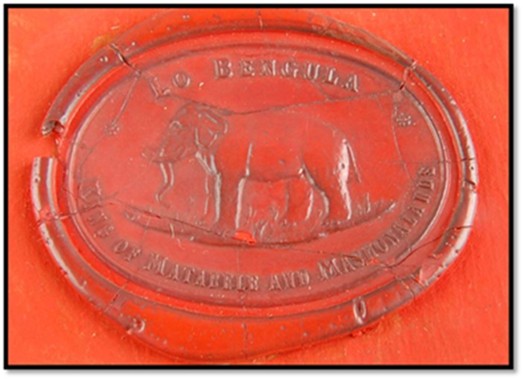
Lobengula’s wood-cut seal carved by Thomas Baines
Swinburne Jnr’s visit to Bulawayo in 1887
When Percy Umberville Swinburne, son of Sir John Swinburne, came to Bulawayo in 1887 with a man named Arkell, and saw Loben, he asked him: “Why have you given the Tati to Sam Edwards when you had given it to my father?” Loben's answer was: “When a man has a knife and he loses it, the finder returns it to the loser. But when a man throws away a knife, the finder can keep it. Your father had the Tati concession and he threw it away. Sam Edwards picked it up and it is his!” Swinburne then asked the King to give him a concession from Ramaquaban to Mangwe. The King agreed. The next day, finding he had got what he asked for so easily, Swinburne asked if he might have a grant up to Minyama kopjes, further up this way. The King said: “Oow! You want to come amongst my people.” Loben then refused to give him anything at all and told him to go down and ask Sam Edwards nicely to give him ground between the Shashe and the Macloutse rivers. Swinburne declined it. Later Loben offered the same ground to Joe Wood and Chapman, who also declined it. Loben's idea was to have a buffer between his country and the south.
When Grobler returned to the South African Republic, the Induna Gambo disappeared from Bulawayo, fearing the King's wrath because he had put one of his daughters with child. Shortly afterwards Swinburne was leaving the country after having tried to get a concession and this girl asked him to take her down to go and join Gambo, which he agreed to do. Swinburne left with his wagon, and the girl and her two slave girls followed on and caught up the wagon. On Swinburne's instructions they did not travel with the wagon, but walked alongside in the bush some little distance off the road and came into the outspan at night. They put their things on the wagon however. An impi was sent after them and caught up the wagon. The girl was not there; but the Matabele noticed her things in the wagon. They said nothing and came back after the wagon had outspanned that evening and surrounded it and caught the girl. Everyone was brought back to the King. I was not here at the time, though I must have been in Matabeleland, but I heard afterwards that the King had a lot to say and turned Swinburne out of the country. Told him not to come back. Actually, Swinburne did not come back until the Matabele War. The girl was not killed. It is not true that he had an affair with the girl. It was not safe for a white man to have anything to do with the King's daughters. Loben afterwards sent word to Gambo to come back and it would be all right and Gambo came back and married the girl.
The journey up to Bulawayo in 1888
Thompson says his party started from Kimberley on 15 August 1888; took 22 days to Shoshong and 7 days from Shoshong to Tati. He arrived in Bulawayo between 21 – 23 September. He travelled with mules.
Water was scarce on the old Tati road. Once upon a time, after leaving Mafeking we used to turn off eastwards and make a detour through the Transvaal in order to be sure of water, until they caught one or two of our fellows and made them pay import duty. So that stopped that. Our road from Mafeking used to be to Kanya and from there we used to go to Ramoutsa. Then, if there was water at Tsama Kop, we would then go via Molepolole. The natives would tell us if there was water or not, or we would know ourselves that there was water if rain had fallen. We always had to go by the rains.
From Molepolole we used to trek across to what they called Wegdraai on the Limpopo River. We would strike the Crocodile or Limpopo usually below the junction of the Notwani and then from there, we would trek to Shoshong, a matter of nearly 40 or 50 miles without water. The way we did it was, we would rest the cattle at the river for about a week. Then we would trek forward a long trek, send the cattle back to drink and when they came back we would trek forward and then send the cattle forward to drink and then bring them back again.
At other stages on the road there was water if you knew where to find it. There was one point on the journey where Patterson lost his valet, a steward from on board the ship that he brought up with him. Patterson could not find him and trekked on. The Bushmen followed his valet’s spoor and it led back to the camp and away again. They found him dead of thirst.
Coming up with a waggonette and mules, I had a friend with me of the name of Harry Lovemore.[93] Travelling along among the granite kopjes there we saw two native youths asleep in the road. I told the two Dutchmen driving to stop and Lovemore and I took our guns, walked up to the sleeping natives. We each kicked one in the ribs, fired off our guns simultaneously, and grabbed them: and I shouted: “Muna, metsi ukai” (Where is the water?) They both said: “Kwa, Kwa!” (There, there!) We marched them on and they led us to a rocky pool a quarter of a mile off the road, a nice deep pool. While we were there, two adult natives turned up and asked me who showed us the water and when I told them, both cut heavy switches and gave the two youths a thrashing! Before we left we blazed the trail to show everyone.
After that many of the chaps called the water ‘Fry’s Pits.’ Khama’s rule was that all travellers had first right to water. There was a place called ‘Sofala’ the same name as the place on the East Coast, and the first place coming from the south where you will find wild figs growing. I know of only one other wild fig in South Africa and that is in Uitenhage. On reaching Sofala the second time I came up (the first time we came round by Tsama Kop) we found ourselves at three water holes in what seemed by the water worn stones around to be the bed of an old river. We took possession of one hole, cleaned out all the cattle, dung and mess from the cattle which were allowed in freely and put bushes around it to keep the cattle off and put a pole across two fork sticks at the opening which would allow two cattle at a time to come in and drink at the edge; but would keep them from walking into the water. The natives came along and demanded what right we had to do this: but when I threatened to report them to Khama, no more was said.
White Inhabitants of Matabeleland in 1888
Foster Windram had the list of the white population in Matabeleland in 1886 published by Alex C. Bailie and asked Ivon Fry how many of those named he knew personally. Fry states that when he came to Bulawayo there were the following white people in the country.
Boers (Afrikaners) Down at the Tati there will also lots of Dutchmen, but none in Matabeleland. I do not think they fancied us. We did not encourage them, but Dutch hunters used to come up in their wagons with their wives and all their kids.
George Dorehill[94] hunted in Matabeland with a native tracker called ‘Hell hound.’
Alex Brown He married a tall Dutch [Afrikaner] girl. When he was courting her, he was sitting in the front room with her and there was a dog under the table. The upper half of the stable door was open. A leopard jumped in and Alex said: “Shut the door!” and he chased the leopard round the room with an assegai. It jumped on the old people who were in bed and the old man pulled the blanket over his head. Brown kept stabbing at the leopard that was growling and striking at him until he turned the point of the assegai on the wall, and could do nothing, and shouted: “Open the door!” and so she did and the leopard flew out again.[95]
Johan Colenbrander came in with Edward Renny-Tailyour and became the British South Africa Company representative at Bulawayo. Trusted by Lobengula, he accompanied the Indunas Mshete and Babayane to England to see Queen Victoria and protest the Rudd Concession. However he supported the BSAC in their attempts to build up to the 1893 Invasion of Matabeleland.
James Dawson[96] had a store with James Fairbairn just below the King’s kraal. He had been here for some time. Native name Jim-solo. Subsequently married Allan Wilson’s fiancée named May Manson Thomson 1896 before returning to Bulawayo where he and his brother established eleven branches of Dawson’s Stores in locations such as Balla Balla, Essexvale, Fairview, Filabusi, Geelong and Khami river.[97] The marriage did not last and May returned to Scotland with their son Ronald Maurice and James Dawson left for Lealui in Barotseland where he lived for the rest of his life.
Sam Edwards (Samu) who had the Tati Concession, was made an Induna by the King. It was an honorary title with no duties, or perquisites attached. But he was supposed to interview anyone wanting to come into the country. Sam Edwards was stationed at the Tati Concession and people used to stay with him until they got permission to come into the country. No one could come in without asking for the road, and when you left, you asked for the road too. But Sam Edwards was always in and out of Bulawayo. The prospecting parties that came up in 1868 were all gone by the time Fry arrived in 1886 and he says they were only pottering around with the gold mining.
Edwards died in Port Elizabeth in 1894. He got £34,000 for his share of the Concession. I got £14,000 out of it.[98] Edwards was one of the first white men to come up here after Mzilikazi came up. His father, Reverend Edwards was a missionary at the place Livingstone first came to in the Transvaal and Sam interpreted for Livingstone. When the Boers came up they destroyed all the Reverend Edwards’ books. I heard Sam speak of his early visit to Mzilikazi.
James Fairbairn had been here a good many years, longer than Dawson. Both he and Dawson were quite decent fellows. Neither of them had native wives, but they had intercourse with native women.[99]
Tom Fry (no relation of Ivon Fry) was the brother of Ellerton Fry, who took the Pioneer Column photographs) and lived mostly in Mangwato, was called ‘Old Boozy Tom’ and died up in the north of present-day Botswana.
Harry Grant had a native woman at one time; but I think she was dead and he had a mixed-blood son with him. He lived in his wagon and moved about the country doing odd jobs for the other white people. Grant was sent out from Inyati once to go and buy cattle for Robert McMenemy in the back veld. The lions followed him all along and pestered him so much that he came back to Inyati. He was in his wagon, some distance from the other people, and he had a calf tied under the wagon and a lion came along and killed the calf in broad daylight. Grant was with his native wife and a boy rushed off to the others down at Martin’s Store, where I was too at the time. The Dutch speaking boy then said: “Baas, Baas, there’s a lion under the wagon!” So the question was put to him: “Where is Grant’s woman?” and the boy said: “Bo in die boom, Baas” (up in the tree) “Where's the beast?” “In the wagon, Baas.” So we rushed out and the lion came out and we shot it. We heard from the natives afterwards that each time the lion growled under the wagon, Grant would say: “Oh God!” in Dutch and take another swig at a bottle of dop. Grant had a red birthmark on his face.
George Hall was an American who came out with Cobb and Co, the coach manufacturers. He ran the coaches from Port Elizabeth to Kimberley in 1871. They had those spring coaches. Then he was at Tati for some years, then when the Pioneer Column came he was at Tuli he took part in forwarding goods. When Fry first came up in 1886, Hall was at Tati.
C. Hesketh moved from Matabeleland to the Zeerust district
John Lee and his two sons C.T. Lee and R.P. Lee lived at Mangwe on the road to Tati from Bulawayo
Robert McMenemy was Frank Mandy’s trading partner at Inyati in 1875, but Mandy had gone back South. McMenemy was trading all around the country. Later, he retired to Tati. They used to trade limbo (cloth) beads, blankets, guns and gunpowder and ammunition generally to the natives for cattle and ivory when they could get it. The Mangwato people were the people for skins.[100]
George Martin had a trading store on the Inkwekwesi river at Inyati. He had a white wife with him and children.[101]
The Missionaries In addition to the English Missionaries of Helm, Carnegie and Rees, there were the Jesuits. Father Prestage[102] and two others, I think, whose names I have forgotten.[103] They were out towards Inyati[104] in my time and then at Empandeni Mission.
Johnny Mubi[105] (John Halyet) was a runaway sailor who lived next door to Hope Fountain in a place called Happy Valley. He had been here some years. He used to do odd jobs for people here, including the King. He built the King's house for him. I do not remember the King’s wagon shed. It may have been there.
I once asked Johnny Mubi how he got his native wife. He used to call her ‘Hannie’ and he told me some slaves were brought in front of the King one day while he was present. They had been taken away from somebody who had been smelt out. Among them John saw a young woman and he said in English: “King, give me that woman for my umfazi”[106] and the King replied in isiNdebele: “Do you want her for your umfazi?” and Johnny Mubi said: “Yes!” so the King said he could take her. You could get as many wives as you liked in the country. Someone wrote to the paper the other day that Johnny Mubi had a wrestling match with the King. That is all nonsense, it never happened. Johnny Mubi never learnt to talk isiNdebele, he used to talk English to the King.
Paddy O’Reilly was a trader who had been here a long time. He and Dawson went up in 1893 and pegged the Victoria Falls for Julius Weil; but when they got back to Bulawayo, the German would not acknowledge the pegging and refused to register it. They wanted to peg it for farms.
Peterson a German had a trading store down at Old Bulawayo. He had been up here some years.
George Arthur Phillips, otherwise ‘Elephant Phil.’ He was a very good chap and a very big fellow. He had been here a long time. I think he was the Phillips originally connected with George Westbeech. He was doing nothing, just living here. You did not require money here in those days. We lived on each other. A man would come and stay with you for a year and you thought nothing of it. Phillips was living with Dawson and Fairbairn.[107]
William Tainton lived down at Old Bulawayo. He had a farm there and a native wife. He was squatting on a piece of land. The ruins of his old house are there still. He had been here for a good many years. His native name was ‘Indunyaan’ (the little Induna)
William Filmer Usher had a farm granted to him by the King at Fort Usher, now Government property. It was granted to the two of us; but I never claimed any half of it. Usher came up here originally in the early 80’s to try to get a concession; and he simply remained here, never went back. I never found out who he came up for. He had a native wife. He was just squatting. Native name Mapondine.
George Westbeech lived up at Pandamatenga.
George Wood was a trader and hunter, but he did not stay in Bulawayo. I do not know what happened to Wood; he disappeared somewhere.[108] He used to be up on the Zambezi and at Pandamatenga. He had a daughter named Mary by a native wife who worked for the Helm’s.
Fry says that Chapman and Wood came in and young Percival Umberville Swinburne. I do not remember any others who were here when I arrived. Afterwards Boggie, Renny-Tailyour and Ben Wilson, Chadwick, Colenbrander and others came in, also Dr Schultz and Vaughn Williams. Haasfarther[109] was a German whose brother was afterwards Mayor of Vryburg and who was up here trading.
Fry states that anyone who did not have anything to do seemed to drift down to Tati and they included Robert McMenemy, George Hall, Piet Oosthuizen and William Norkie and others whose names he had forgotten.
Fry did not know everyone and that included , E.W. Alexander, Henry Byles, N. Cameron, H.N. Gatonby, George Gordon, John Gosling, Charles B. Harsant, C. Johnson, McArthur, C. Meyers, Henry B. Ogden, H. Petersen, V. Smith, W.P. Smith, N.G Swart (he thought Brown married Swart’s daughter) W.T. Thomson
Visitors to Matabeleland 1886 - 1890[110]
Frank Johnson, Maurice Heaney, Henry Borrow and Ted Burnett got a concession from Khama for the mineral rights of Bechuanaland. They then came up to Matabeleland in 1887 to get a concession from Lobengula; but were unsuccessful. The Khama Concession was afterwards sold to the British South Africa Company.[111]
Alfred Haggard. He was coming up to try to get a concession. He had a little fellow by the name of Jimmy Williams, as a cook. When I visited their camp there was Williams with an axe chasing Haggard round the wagon and Haggard had a revolver in his hand. Sergeant ‘Daddy’ Farrell[112] was with me. Haggard shouted to him; “Constable! Constable! Do your duty!” Daddy Farrell replied: “I am not a constable; I belong to the Bechuanaland Border Police” (B.B.P.) Farrell then disarmed Williams and told Haggard to put his revolver away. I met Haggard in Bechuanaland when he was on his way up to Bulawayo and I was leaving the country.
I was on my way down to Tati when Sir Sidney Shippard[113] came up to Bulawayo. Goold-Adams[114] was with him. They had a water cart, which the natives thought was a cannon and they would not let them go on and subjected them to continuous threats and insults.[115] They were hard up for food. I heard they were hemmed in by the Matabele on their way to Bulawayo, so I bought a couple of sheep for them and I had a couple of bags of native rice and some tomatoes and eggs, which I was taking to Tati, so I gave them these.
That night I was invited to dine with them. Then Goold-Adams remarked that the Matabele were getting very truculent. They wanted putting in their place, he said and we only wanted an excuse to do it.[116] So I remarked I thought the British Government had gone in for the emancipation of slaves, and as slavery was rampant in the country, why not take that as an excuse? Shippard said that was a question not easily answered. So I said: “Why isn't it easily answered?” I then said to Good-Adams: “If you want to put up a fight, I'll stop and give a hand. I'll give you ‘til 12 pm tomorrow.” They did not say anything and I duly left them.
The Boers from the Transvaal used to come up here hunting with a wife and five children and go out with six. It was a common thing for the wife to give birth in the veld. The Boers were very clever in the field. They used to refill empty Martini cartridges themselves by taking out the old detonator cap and replacing with new. Their bullets they moulded themselves and gunpowder they brought with them. I never heard of the Boers making their own gunpowder, but the natives around Umtali and Fort Victoria used to make their own gunpowder. I expect they learned it from the Portuguese.
Henry Clay More was an American who came up here to get a concession. He was not here when my father and I arrived. He came up sometime later.
Baker came up here to visit Usher and he stayed here some little time and then went back again.
Life in Bulawayo in 1886 - 1890
Every white man living in the country was attached to some Matabele regiment. The regiment claimed him. My own idea is that they hoped to get beer and things out of him. He was supposed to belong to the regiment and when any members of the regiment turned up at his place, they would demand beer from him. It was the custom that he had to give them beer because he was one of them.
The law of the country was that every stranger in the country had to belong to the town of Bulawayo. Old Loskei[117] was the Queen of Bulawayo and she undertook to look after you. Of course, she always expected something in return. If you wanted to beer or meat, you sent down to her.
There was an Induna whose job was to protect you if you had any case with a native and he defended you. I know nothing of the method of choosing the King’s wives described by Thompson.
Married women
Married Matabele women wore kirtles down to their knees. The Queens alone wore black kirtles of skin. The unmarried girls often just had a few strings or a flap of animal skin in front. Every woman who was married, or unmarried and had a child, had a tuft of hair left on top that was not cut and stuck up. Single women with a child often tried to flatten it down out of sight. We used to pull it up as we passed them, just to annoy them, and they would swear at us.
They used to come down to the white men's wagons four at a time. You were expected to operate on the whole lot; and you had to pay them all, even if you did not. The payment was a length of limbo (cloth) or something like that. Every one of the traders had native women, except the married ones like George Martin. Thompson’s story that unchastity was rare is pure rubbish.
One day, Mrs Helm said to me: ”I do not like the white men in this country having this promiscuous intercourse with native women. I would much prefer to see them taking one woman and keeping her.”
John Moffat had an escort of police (BBP) as the Government representative. These men had bivouacked inside the scherm of bushes around Moffat’s wagon and at the back of their shelters there were entrances into the scherm where the girls used to come through without Moffat ever knowing anything about it.
Cape dop was our favourite drink in those days. We also drank peach brandy (Mampoer) which we bought from the Boers. The Boers also used to make a distilled brandy called stamvrug[118] sop. Peach brandy was alright if you kept it in wood for three years. When we had it, we drank champagne; we brought up any amount of cases. We used to give it to the King, but his champagne never lasted very long as his Queens used to drink it up. The Swazi Queens introduced the art of distilling liquor (arrack) out of rice.
The Boers never sold brandy to the natives as they had nothing to buy it with. The Boers wanted cattle and the natives would not sell his cattle for liquor.
When I lived in this country I used to have a cup of coffee in the morning only. After that it was native beer all day long. We all drank it freely; it was good beer. The best beer being made from native corn, beer made from mealies was too sweet. They never grew mealies to any extent in the country, in those days it was all native corn.
Grain pits for storing native corn were dug in the cattle kraals with a flat stone covering the opening and sealed with cattle dung – the ammonia fumes kept the weevils out of the grain. It certainly allowed the native corn to be stored but smelt strongly of ammonia when retrieved and needed to be washed before it could be eaten.
We were very troubled with bugs when I was living with Dawson. Someone suggested a barbel’s head under the bed. I said: “No fear, the stink will drive me out too!” We found a better plan to get the bone of a sheep's tail and put it down at an ant’s nest. When it was covered with small black ants, you picked up the bone and put it down under the bed in the corner and left it there. The ants would then make a new home. You then removed the bone and the ants had to forage to feed, so they caught the bugs and ate them all.
We did not like the missionaries. Once I said to Reverend Helm: “Mr Helm, have you ever made any converts?” He said: “No. I can't say I have, but I think I have sown the seed in good ground.”
We all subscribed and set up a service of native runners from Bulawayo to Zeerust to carry our post.
There was not a tree or a bush to be seen round the King's kraal for quite a distance when I first came up in 1886, as the natives had cut them all down.
The Matabele were against prospecting. Nobody prospected in the country, but in a quiet sort of way prospecting did take place. If you saw a likely looking place, you would get a boy to dig a hole and pretend you were doing something else. The natives did not know much about gold and how it occurred. I had a box of specimens that I collected, which I gave to Ben Wilson. Some of them came from Tati.
When Loben sent his natives with the hunters, he did so primarily to see that they obeyed his instructions as regards what game to shoot and what not to shoot. For instance, he said Selous was not to shoot hippo and when he did he got fined.[119] The missionaries took Lobengula’s side in the matter and Selous wrote to the missionaries and told them that one day when the natives went to the well, as they would have to do eventually, then they would find the Christian watchword of peace and goodwill towards men was a snare and a delusion. Selous told me that himself, I knew him well.
Matabele raiding
When the warriors were away raiding they only took a length of double-width unbleached calico to sleep under and they always slept around their fires at night. When the impi returned from raiding, all the stones used around their fireplace for resting the cooking pots on were thrown away and replaced by new ones. Whilst an impi was away raiding those left behind were not supposed to wash.
Lobengula once said to Fry that he wished the impi would come back as he wanted to wash. He used to take his mabetshu, the skins he wore in front, and bury them in the goat kraal for the ammonia to drive away the insects.
William Mzizi – the Matabele war doctor[120]
No whites ever saw the doctoring of the regiments before they went on a raid. Fry was told the war doctor mixed medicines and went round and sprinkled medicine on each warrior from the tail of a blue wildebeest. William Mzizi was the war doctor. He was brought up by Alex Baillie before Fry came to Matabeleland. He was a Fingo and Thompson’s description of Mzizi as a renegade and Xhosa is not true and Mzizi did not plot the King’s downfall. Loben married one of Mzizi’s daughters.
He wore a top hat which got very shabby and my father brought him a new one the second time he came to Matabeleland. The ring on Mzizi’s head was made of copper wire with a bead attached to it and he wore his top hat over it. He suffered from an eye cataract that Jameson said he would operate on, but Mzizi would not agree. He used to ride a horse with a boy leading him. He spoke Afrikaans and was fond of a drink. One time Dawson, Usher and I went to his kraal on the Khami road. We heard loud wailing as we rode up: “Mi ma moo! Mi ma moo! “ (my mother) A child had died and they were mourning it, but William stopped wailing to talk to us. Then he asked us if we brought any ‘sea water’ meaning liquor with us, but we had none. William suddenly remembered his wailing and started off again: “Mi ma moo!”
Native magic
One day at the King's wagon, I saw the King talking to an old woman and in front of them, about six feet away, was a small calabash decorated with beads, shells and wire. The old woman would repeat the King's questions as if talking to the calabash. After a bit, the answer would come from the calabash. I looked at her and saw the muscles of her throat working as the voice came out of the calabash showing it was ventriloquism. I laughed and the King said: “You white people are clever, but you don't understand this!” But I left it at that.
One time on my way to Tati at the Shashani river we heard there was a Mlimo nearby. We asked a native to take us to the cave. When we arrived the native clapped his hands and a voice came from the cave asking what we wanted. We said we wanted to see the Mlimo. The answer was white men could not see him. I looked at the native and noticed his throat muscles working. It was all ventriloquism! We went inside the cave which had poles at the end. We pulled them aside but found there was no further opening. There were several enamel plates full of cold porridge, but someone had turned the porridge upside down, eaten it, but left the upper porridge skin. I suppose they wanted to show the Mlimo did not touch it with his hands!
Another time Usher told me that he had bought one of the few Mashukulumbi[121] heifer calves that survived a raid north of the Zambesi river, the remainder having died from tsetse fly, from a left-handed native who lived on the Umgusa river. One day the heifer disappeared and Usher refused to pay the herd boy until it was found. The boy’s father asked if Usher would pay a healer to ‘throw the bones’ and Usher agreed.
The healer threw his bones and said: “You bought this heifer from a left-handed man who lived in a small village.” He said not to worry, the heifer had been stolen by this man and been taken to better grass in the east (it was winter) and when the rains came, the cattle would come back and if we went to the man's village we would find the heifer. It all happened! Usher recognised his heifer and told the man he would take him before the King, but he begged him not to and paid Usher three cows as punishment.
Slavery
Slaves were the rule. They had usually been captured as young boys and girls on raids and brought back to Matabeleland as captives. Fry had a young slave boy given him by Willian Mzizi. Women as well as youngsters were captured on raids. The King always had plenty of boy slaves, the ‘black ants.’
When they were about 10 or 11 years old, Pula, the royal cook, would take them and slit their ears with an assegai and put the pith of a corn stalk into the hole to keep the ear open. This was the Matabele mark and you could hear the boys yell like blazes when he was doing it. When they got to the age of 18 or 19 years old they were drafted into the different regiments.
Anecdotes of Lobengula
Lobengula was not tall, I should say he was about 5 foot 7 inches (170 cm) but he was stout. He always wore one of two or three kilts made from the skins and tails of blue monkeys and wildcats. His shoulders were all bare and he usually walked with a staff. He had a rather pleasant face and his eyes were inclined to be a little bloodshot. Ordinarily, he did not wear a crane’s feather, only the ordinary head ring. All the male natives dressed the same way.
The Queens wore big necklaces and armlets of beads and wore a kirtle of skins, or limbo around their waists and often some limbo over the shoulder. Blue and white were favourite colours and they seemed to fancy coloured spots. Some carried a stick. They came out in a procession after Lobengula and sang and ululated by putting their hands over their mouths to ululate.
It is not true that the whites at Bulawayo were accustomed to crawl on their hands and knees when coming into the presence of the King; even the natives did not do that. They merely bent down sideways and walked in a crouching position and shouted his titles, but they never spoke until he spoke to them, and always in reply to him. When I approached the King, I always walked straight in and all the white men did the same. All we did was to say: “Kumalo!” Everyone talked quite naturally to the King. There was no exaggerated humility, or fear of him. Loben practically lived in his wagon which was a full tent wagon. I do not know how he slept in it; but I believe he usually did. He had huts too. I never saw Lobengula sitting on a block of wood, but he was always surrounded by dogs.
He had a brass dish and ate whole mealies and beans cooked in a grass basket with a lid on it that was boiled in a pot of water. The basket was emptied into the brass dish and the girl who did the cooking took a pinch of it to prove there was no poison. His meat used to be grilled by a Bechuana named Pula. His meal always consisted of meat, whole mealies and beans.
If he gave us anything to eat, he would make a sign and the attendants would grill the undercut for us and bring it to us. No knives or forks. And there was a girl, we used to call her the Schenker (the disher -out) Her name was Velagubi. She brought a billy-can with beer, knelt down in front of the nearest white men in the line, took a sip to show it was all right and put it down in front of him. The white man then used to say: “Kumalo” That was to thank Loben. This happened every time we went there.
The Missionaries never partook of the beer on religious grounds, that is why Helm fainted in the sun one day at an indaba after the Rudd Concession. When the can was empty, after being passed down the line, the last man, if he wanted more, turned it upside down. That was our way of hinting that we wanted more beer.
Loben was very liberal. He often used to send down a hind leg of beef. Once when Usher and I were up at his kraal, some sheep have been brought in and there was one particularly fat white one. I remarked to Usher in an undertone: “I would like to have that sheep” and a little while afterwards Loben called a slave boy and told him to catch that sheep and take it down to Fry's wagon. He must have guessed at what I said.
Usher and I went out shooting most mornings. We often presented the King with a couple of birds or something we had shot. We never gave him a portion of a buck; he always got the whole carcase. He always accepted meat gratefully from us, but never from his own people as he was afraid of poisoning.
Pula had a cleft in the back of his head that you could have put two fingers into. The story I heard was that this happened when Mzilikazi was coming through Bechuanaland to Matabeleland and one of the Matabele gave Pula a blow with his battle axe. He was a boy then and one of the Queens picked him up and brought him along. I believe that the King felt he could trust Pula better than one of his own people with his food. Lobengula was by no means a drunkard, but we always put his gout down to the liquor he drank.
One day we were down at Intotini (In the smoke) with the King and the women were dancing for him. One would always dance out from the others and sing the King's praises. On this occasion, the King was eating and the woman who was dancing out from the others shouted out: “You are a dog. You eat before me.” (i.e. in front of me) A man was never supposed to eat in front of his mother-in-law. She then joined the others. Loben sent a slave to call her out and he put the question to her: “Did I marry your daughter, or did I sleep with you?” And she replied: “No, King, I didn't mean what I said.” With that, all the slave youngsters [the black ants] that he had around him rushed out and flogged her out of the enclosure with sjamboks and anything else they could get hold of and then stoned her to death. Her husband was present and saw the whole performance and could not open his mouth.
Women were allowed a certain amount of latitude on these occasions, but she went too far. I never saw the King give an order or make any sign. I think his slaves must have taken it on themselves to punish her, with his tacit approval.
A strange thing happened that day, it was a day of excitement. The King tried a case against a slave (Maholi) and a Matabele. I do not remember the charge against them, but the King ordered them both to be killed. The Matabele turned round and said to the King: “King, if I am to be killed, I object to being killed with a Maholi.” So the King thought for a moment and then said let them both go. Loben was a wonderful man.
Another incident that occurred was this. The Jesuit priests were at Loben’s kraal and a bullock ran amok amongst us. We wasted no time in climbing up the poles of the stockade. The priests got under Loben's wagon and he hopped onto the wagon box. Loben’s big pack of dogs and the slaves chased the bullock out.
No one was allowed to approach your wagon at night. You could shoot anyone as the Matabele considered only witches and wizards (tagati) walked about at night. One night Loben sent a slave down to Usher and me. The slave was scared to approach and shouted out at a distance. When we approached he told us the King wanted to see us both. We went to the King’s kraal and had to beat back his dogs until they were called off by the slaves. The King wanted to see us about the Rudd Concession.
Fry says the country swarmed with hyenas. One sneaked into the royal kraal, having slipped past the sentries, looking for bones. The dogs set up a row and the natives tried to kill it, but it managed to get away.
Loben was very fond of children and also animals. He had some wonderful dogs. One time I was present when he sent a little slave boy to go and call someone. The slave had been grilling some meat at the fire but put it aside and ran off immediately. A dog then approached, but Loben kept it away to protect the slave boy’s meat!
The slaves ate any amount of meat, but no grain and used to break out in sores on their legs. When the King was asked: “Why don't you give those boys grain?” he replied: “No, I want them to grow up big and strong.” They would come down to the wagon to grease their sores and we would give them a little grain.
Once the King was walking through one of his kraals when he saw a Queen with a baby of about nine months in her arms. He took the baby from her, looked at it, and the baby yelled like blazes. He handed it back with the remark: “You make as much noise as your mother does!”
Loben had some good horses, which he had bought from hunters. They were sent out every day to graze in the veld. Then it was reported to him that the herd boys were riding and racing them. He told the head herd boy that it had to stop. But a few days later, he heard the races were continuing and he said again to the head herd boy: “I warned you, but you won’t hear. Cut his ear off!”
I once asked: “King, how far does your country extend?” He replied: “As far as my assegai’s have been.”
On another occasion Reverend Helm came with a Bible for Loben and said: “The Mlimo gave me this book and told me to come and teach it to you.” Loben replied: “The Mlimo gave you the book and he gave me the shield and assegai. You keep the book and I'll keep my shield and assegai!”
The Mlimo was considered to be everywhere. Once when there some tremors from a mild earthquake, Fry was told: “it is the Mlimo going to some other place.”
When the King's house was built in Bulawayo the women went into the countryside to collect ant’s nest soil of a certain kind for the floor of his house. Then with round stones they worked the earth down by pounding it followed by covering it with bullock’s blood and it became like black glass. We used to slip on it with our boots as it became worn smooth by the soft feet of the natives.
Another time, Usher, Phillips and myself were asked by the King to go and shoot four hippo bulls and bring the heads back to him so he could make rain. We shot them and brought the heads back, but before we left several of the Queens asked us to bring back a lot of the hippo fat. The hippo heads were put in the goat kraal facing north, south, east and west.
Rights and privileges
Traders and hunters who came to Bulawayo were encouraged to make a thick scherm around their wagon and they could cut as much wood and bush as was needed. This was your ground; nobody could enter without permission and certainly not carrying arms. It was a great help in preventing stealing.
An oxen kraal was also essential as if they got into cultivated lands at night, you became responsible for the damage.
Plan of Lobengula’s kraal
They were openings in the inside of the ring of huts to allow the people to get into the main enclosure and each stockade around a group of huts had an opening to allow the occupants to go out into the veld to relieve themselves.
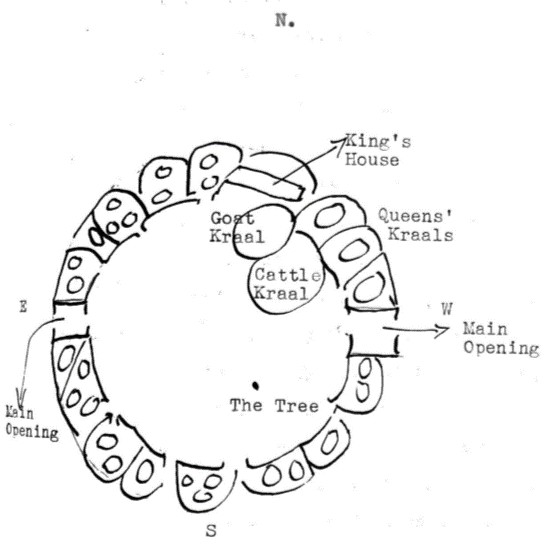
Fry says there were just two openings into the King’s kraal and he thought there were about ten thousand people at the Bulawayo kraal. Water was obtained from a spring just below the kraal in the river bed, but he says by 1938 this spring had quite dried up.
Threats from the Majakas (young warriors) to the white inhabitants
The regiments used to come up from time to time to dance before the King on occasions like the Big Dance (Inxwala) Once the Imbeza Regiment were dancing before the King and watching were Usher, Fairbairn, Dawson, Phillips and myself. The Majakas shouted to the King: “King, Give us those white men to wet our assegais.” Cold shivers went down our backs. The King replied: “No, these are my friends. If you want to wet your assegais I will give you some of the old men to show you the road to Kimberley where there are lots of white men and I’ll give you cattle to eat on the road.” That settled the argument.
But they danced up to within four feet of us, stabbing with their assegais, their eyes bulging. We were feeling pretty uncomfortable, but we didn't show it. We just turned our heads aside and spat on the ground to show our contempt.
Dawson and Umzondaz
One of Loben’s slave girls, named Umzondaz died in childbirth with Dawson’s child. According to Matabele custom, a death in the family meant you had to stay away from the King for a month to become cleansed. She was not Dawson's wife in the true sense of the word, but he had been cohabiting with her. When Dawson came to see the King there was no mention at first of the event. Then as he was leaving, the King said: “Where is Umzondaz?” and Dawson replied: “she is dead, King.” “Oow,” said the King, before adding: “Well, you had better start pulling out cattle.” So next day, Dawson sent two cows to Loben. After that, every Sunday when he visited Loben as he left the King would say: “Where is Umzondaz?” and when Dawson got home, he would send off two more cows the next day. This went on for five weeks until he had paid ten cows, when the King said to Dawson as he left: “I have seen Umzondaz.”
Tainton and the Maholi
Tainton lived at Old Bulawayo; one day a Maholi went into his store and stole some sheep skins. When Tainton heard this he said: “I’ll give him what for!” A few days later the Maholi turned up armed with a stick and said: “Who is the white man who said he would teach me?” Tainton grabbed the stick out of his hand and hit him in the ribs. The man walked about ten or fifteen paces and fell down dead, the blow had ruptured his liver. Tainton stayed away, but after a month he explained to the King the circumstances of the Maholi’s death and the King replied that Tainton would have to pay compensation.
Tainton said all the whites should help him with the compensation, but we declined, and Tainton was forced to send two cattle weekly to the King until told to stop when ten cattle had been sent.
The Patterson incident[122]
One day Fairbairn, Phillips and myself were at the King’s kraal discussing Tainton’s case and the Maholi and Loben remarked: “How many white people have I killed in this country?” I said to the others in English: “What about those fellows (Patterson and Sergeaunt) who died on the way to the Victoria Falls?” to which Fairbairn replied: “I'm not going to ask him about that” and so we let the matter drop.
Silver cup presented to Lobengula
My father, John Larkin Fry, presented Loben with a silver drinking cup with an elephant engraved upon it that he had made at his own expense. The silversmith copied an Indian elephant that has a slight hump on its back, whereas the African elephant has a straight back. Loben did not seem to notice the smaller ears, but he noticed the back at once and said: “That is not an elephant of this country.”
Fry goes on to say that Lobengula’s seal, kept for him by Dawson, also featured an elephant and that his father had the seal made for Loben.[123]
The parrot
Once I said to the King that we had a bird that could ‘Konza’ him - meaning ‘sing his praises.’ The King expressed doubt. On our return south we bought a West African parrot that could not talk that we kept in a cage covered with hessian inside the wagon. Every night I would poke it with a stick and say “Kumalo.” My father often said it would never learn to talk, but after a couple of months, I heard it one morning saying in an undertone “Kumalo.” Then I started to teach it to say “Bayete” and “Babasinkula.”
We got a big brass cage for the occasion and on our return to Matabeleland covered the parrot up with hessian and took it to the King’s kraal. We put it to the left of the King and slightly behind him and began talking. As we did, natives entered shouting the King's praises: “Kumalo! Bayete! Babasinkula!” as usual. The parrot copied them and also shouted: “Kumalo! Bayete! Babasinkula!” The King looked sideways to see who it was; this was against all royal rules for anyone to approach the King from behind.
But he saw nobody and we continued talking. A new native came in and shouted the King’s praises. The parrot did the same. The King looked sideways over his shoulder at the covered cage and asked what it was. I got up and pulled the hessian off the cage and the parrot repeated the King’s praises! The King put his hand to his mouth and I said: “King, I told you we had a bird that could Konza you.” He said, “Ncenisela” (what you say is true)
Peacocks
My father sent up two pairs of peacocks that were kept in a little kraal to the right of the Matsheumhlope river on the road to Hope Fountain called ‘Peacock Town’ by local whites. Any feathers shed were kept for the King, although I never saw him wear them.[124] Loben had a hut built with perches for them to sleep on, they looked after themselves and were left alone. After the 1893 Matabele War, Jack Brabant, Nobby Clark and myself caught all the peacocks and brought them down to Dawson’s store. We broke the leg of one of the peacocks so it was given to Dr Jameson to roast and eat. The remainder were given to chaps claiming their ‘loot’ farms; Rixon got a pair.
Lobengula and the Mlimo
The Matabele once told me that Lobengula went to visit his father’s grave at Entumbane.[125] A voice called out from the inside of the grave; “Who are you and what do you want?” The King replied: “I am Lobengula, King of the Matabele and I have come to see my father's grave. Who are you?” The answer came: “I am the Mlimo.” Lobengula replied: “You are not, your voice is that of a Makalaka.”[126]
The Big Dance (Inxwala)
The Big Dance started a few days after our first arrival at Bulawayo. We saw the natives were beginning to gather together for the event. On the day we went across to the King’s about 10am and saw all the regiments forming up in the big enclosure in the centre of the ring of huts that made up the kraal. Each regiment had its own colour pattern on their hide shields to distinguish them. One regiment’s shields were black and white, others were red and white, some red alone and others black. The shields were always made from a single hide. The warriors each carried two short Zulu stabbing assegais and a knobkerrie. I never saw battle axes; axes were generally used for chopping wood.
At the top of their shield each warrior carried a stick with an attached jackal tail. As they danced and chanted, these sticks were waved in unison from side to side, resembling native corn waving in the wind. Each man had a strip of otter skin tied around his forehead with a long blue crane feather attached at the back. They also had a cape over their shoulders of black ostrich feathers that reached down to the chest.
The dance started soon after we arrived when Lobengula came into the big enclosure. The warriors all shouted: “Bayete! Babasinkula! Kumalo!” and rattled their assegais on their shields. There were no musical instruments or drums, it was all singing and ululating. The regiments started to chant and stamp their feet in unison, beginning slowly and this went on for several hours. A warrior would break from the regiment and dance towards the King, stabbing at imaginary enemies and shouting: “Zhi! Zhi!” and all the others would repeat the shout. Then he would return to the ranks and another would take his place.
Each dancer would indicate where he had fought by stabbing his assegai in that direction and then he would stab the ground to indicate he had killed.[127] Some of the older men pointed to the south, stabbed a cake of cow dung and threw it over their shoulder to indicate contempt for Khama’s people. I only saw two old men stab upwards, indicating they had fought the Boers on horseback in the Transvaal during Mzilikazi’s reign.
Lobengula sat outside the stockade around his house on a riempie stool[128] the regiments perhaps thirty yards from him arranged in a half-moon shape in front of him. The Imbezu regiment, his crack regiment, with Mjaan its Induna, was in front. On these occasions large numbers of cattle were killed, perhaps five or ten cattle a day, and allocated as food to each regiment.
This was the dance of the First Fruits and everyone ate a piece of pumpkin, or melon, or anything that was green as a symbol of the first fruits. Fry states the dance lasted on and off for about thirty days with different regiments coming and going for the feasting and drinking around Bulawayo. On the opening day of the First Fruits he remembered the King coming out in front of the whole army with an assegai in his hand, but he did not dance, he was too dignified for that. He pointed first to three points of the compass, finally turning to the fourth point and throwing the assegai and whistling shrilly at the same time. This was done in the enclosure in front of everyone and indicated to everybody the direction of the raids in the next winter. Raiding never took place in the summer on account of the flooded rivers.
In 1888 he threw the assegai northwards and the Mashukulumbi were raided north of the Zambesi river.
The dancing stopped about midday, although small groups went on dancing amongst themselves for another hour or two afterwards before everyone dispersed to their kraals. Many had come a long distance and camped in the vicinity of the King’s kraal during the ceremony.
Fry states the Matabele lived on meat and beer, a complete contrast to Khama’s people who lived on milk and grain, with very little meat and no beer. Khama would not allow liquor to be brought into the country.
References
R. Cary. The Pioneer Corps. Galaxie Press, Salisbury, 1976
J.S. Galbraith. Crown and Charter; The Early Years of the British South Africa Company. University of California Press, 1974
S. Glass. The Matabele War. Longmans, Green & Co Ltd, 1968
H.F. ‘Skipper’ Hoste. (Editor N.S. Davies) Gold Fever. Pioneer Head, Salisbury 1977
O. Reitz. The Pioneer Corps: Addenda, Rhodesiana Publication No 37 of September 1977, P17 - 25
N. Rouillard. Matabele Thompson. Books of Rhodesia – Silver Series, Vol 13, Bulawayo 1977
E.C. Tabler. Pioneers of Rhodesia. C. Struik (Pty) Ltd, Cape Town 1966
E.C. Tabler. The Far Interior: Chronicles of Pioneering in the Matabele and Mashona Countries, 1847 – 1879. A.A. Balkema, Cape Town, 1955
R.F. Windram. The Reminiscences of Ivon Fry as told to Foster Windram during interviews in September / October 1938 (also in National Archives of Zimbabwe FR/2/1)
Notes
[1] Ivon Fry lived 1864 – 1941. He is listed in Robert Cary’s The Pioneer Corp as attached to the Pioneer Corps (P114) as a civilian, presumably because he joined late at Tuli and was not previously recruited and then trained at Macloutsie.
[2] See the article Matabele Thompson: his role in the Rudd Concession under Bulawayo on the website www.zimfieldguide.com
[3] Ivon Fry is listed in the Frederick Clayton Trust Act Ord 10/1918 under Schedule as a member of the Pioneer Corps
[4] Matabele Thompson is the autobiography written by Francis Robert ‘Matabele’ Thompson and edited by his daughter Nancy Rouillard
[5] John Larkin Fry is named in an article The Pioneer Corps: Addenda by Otto Reitz in Rhodesiana Publication No 37 of September 1977, P17 - 25
[6] Sir John Swinburne, Bart (1831 – 1914) served in the Royal Navy until 1871 with rank of commander. He led the London and Limpopo Mining Company expedition to Mashonaland. However his underhand attempts to exclude other concession seekers, such as Thomas Baines, made him unpopular and he was a poor manager. Although he gained the Tati Concession, it was not a commercial success and he left Southern Africa
[7] Samuel Howard Edwards (1827 – 1922) His father was a LMS Missionary, he was fluent in Sechuana and began hunting and trading in present-day Botswana in the 1840’s – 50’s going to Lake Ngami several times to buy ivory. In 1854 he went with Robert Moffat to Matabeleland and met Mzilikazi . He farmed and traded in South Africa before taking the London and Limpopo Mining Company expedition to Tati in 1869 as guide, interpreter and transport manager. He then worked for 5 years at the Kimberley diamond fields and served in the Griqua War of 1878 before returning to Matabeleland in 1881 and gaining the Tati Concession where he lived for the next 11 years as managing director of The Northern Light Gold and Exploration Company and as Lobengula’s ‘immigration officer.’ He assisted with the Rudd Concession negotiations in 1888-9, was a confidante of Khama and Lobengula and liked by everyone who met him. Known as ‘Far Interior Sam’ Samo and Induna Sam.
[8] Daniel Francis (1840 – 1921) was a miner and prospector, not to be confused with William Curle Francis, half of the firm Francis and Clarke and the most important trading business at Shoshong in the 1870’s. However both men were associated in reopening the gold mines at Tati in 1881 after Edwards gained the concession from Lobengula with the new firm being called The Northern Light Gold and Exploration Company
[9] There are five articles on Thomas Leask (1839 – 1912) on the website www.zimfieldguide.com
[10] See the article The Great Dance or Inxwala Festival under Bulawayo on the website www.zimfieldguide.com
[11] John Larkin Fry is Ivon Fry’s father
[12] Sir Hercules Robinson was High Commissioner for Southern Africa May 1881 – April 1889 and he was a close friend and ally of Rhodes as they shared a common view on the benefits of territorial expansion. He resigned after making a public speech saying he opposed the active involvement of the Colonial Office
[13] Sidney Shippard served as Resident Commissioner of the Bechuanaland Protectorate 1885 - 95
[14] John Smith Moffat who was Robert Moffat’s son, who began (like his father) with the London Missionary Society. J.S. Moffat had been appointed Assistant Commissioner for Bechuanaland in 1884, the Resident Commissioner at the time being John Mackenzie and in 1888 was Francis James Newton.
[15] Galbraith, P47
[16] The Founder, P255
[17] Charles D. Rudd knew Rhodes from the early days of the diamond rush at Kimberley where they each purchased a quarter-share in ‘Baxter’s Gully’ in a partnership that lasted most of their lives. Rhodes had the plans and ideas; Rudd supplied the detail and business acumen and developed Gold Fields of South Africa, the second pillar of Rhodes’ wealth after De Beers. Rudd was selected because he was a skilful negotiator having bought many Boer farms on behalf of Gold Fields. Galbraith states, “There was a price for which a bargain could be made, and Rudd was the man to settle the price.” Crown and Charter, P61
[18] See the article Matabele Thompson; his role in the Rudd Concession under Bulawayo on the website www.zimfieldguide.com
[19] James Dawson, a Scot who came to South Africa in 1870, worked briefly in a Grahamstown solicitor’s office, worked briefly in 1872 as Khama’s secretary until they quarrelled and visited Matabeleland in 1873 working for the trader James Cruikshank. Managed Cruikshank’s store at Shoshong 1875 – 1877 before moving to Bulawayo and becoming James Fairbairn’s partner where he stayed. Dawson, Tainton, Fairbairn and the other traders opposed the Rudd Concession of 1889 as they wanted a concession themselves. At Jameson’s request Dawson and Patrick Riley looked for Lobengula in 1894 and brought back the remains of the Allan Wilson patrol. Stayed on until 1898 in Matabeleland before moving back to Scotland in 1898 when he married Wilson’s former fiancée.
[20] Many references refer to the tree at Bulawayo. Oliver Ransford in Bulawayo: Historic Battleground of Rhodesia even has a photo of it with Government House in the background taken in 1897 (Plate 41)
[21] Fry states Lobengula’s wagon was the only one in Matabele hands. The traders lent their colonial native drivers and voorloopers whenever it moved with Lobengula.
[22] De Beers Consolidated Mines was launched by Rhodes and Rudd in March 1888. Galbraith in Crown and Charter writes, “… In 1888 he was still almost unknown outside the circles of the diamond merchants and what was. Known to British politicians, was not in his favour.” P56
[23] J.S. Galbraith was the only source that highlighted that J.L. Fry snr had a written contract with Rhodes by which he would receive £55,000 if the concession was obtained. P43
[24] Despite saying this Helm did interpret and explain the Rudd Concession to Lobengula on 31 October 1888
[25] William Filmer Usher came to Matabeleland in 1883 and was given his wife Mzondwasi Kumalo by Lobengula and had seven children. A newspaper cutting dated 1971 sent by Rob Burrett had an interview with his only surviving child and son, James Usher, then 83 years old. Lobengula’s name for Usher was Mampondwene because he came from Pondoland. His store was at Usher’s Kop, near present-day Fort Usher. He died on 28 Sept 1916, his grave near a stone kraal he had built on Tshabalala Farm.
[26] Francis Thompson accompanied Charles Rudd and Rochfort Maguire in their negotiations on behalf of Cecil Rhodes with Lobengula that resulted in the granting of the Rudd Concession on 30 October 1888.
[27] Lotshe (also spelt Lotjie) is often described as the Matabele Prime Minister but Fry states he was the Commander in Chief of the army. He was made a scapegoat and killed after the Rudd Concession was granted for being too friendly with the whites and supporting the granting of the Rudd Concession
[28] This was a common explanation amongst the traders and concession-seekers in Bulawayo at the time
[29] Lobengula often moved away from the royal capital to nearby cattle kraals where he could escape the pressure of having constant visitors
[30] Presumably this was an informal arrangement, unlike Matabele Thompson who Rhodes appointed by letter and agreed a salary of £2,000 a year to be their Bulawayo agent
[31] Gashle meaning slowly or carefully
[32]This would be John Smith Moffat
[33] Dr Rutherfoord Harris (1856 – 1920) was the Company Secretary of the British South Africa and based at Kimberley. All correspondence from Matabeleland and later Mashonaland went through him. He had a political career after leaving South Africa as an English MP
[34] Fry uses the word ‘jackals’ to refer to all of Rhodes’ associates in a derogatory way
[35] The Rudd Concession was signed on 30 October 1888
[36] Galbraith writes that Rhodes’ epitaph for J.L. Fry in a letter to Rudd was, “never have anything to do with failure” P61
[37] Clearly this sentence sums up Fry’s dislike for Rhodes and all those associated with him, including Matabele Thompson
[38] The following extract is from the article A Visit to Lobengula at the King’s Kraal or Umvutcha in 1889 – Lieut-Col. H. Vaughn-Williams recalls his stay after 57 years under Bulawayo on the website www.zimfieldguide.com and explains this incident: “Anything out of the common was suspected and treated as witchcraft. When Rochford-Maguire went down to wash and clean his false teeth at the (Long) pool, he took his toothbrush and pink toothpaste with him. Of course there were young Matabeles watching him from the bush. There was a deuce of a row and they dashed down and took away all his shaving material, false teeth, even his eyeglass; accusing him of bewitching the water and turning it pink; taking his teeth out was certainly witchcraft. When the matter had been explained to Lobengula, Maguire's property was returned to him. Rider Haggard made use of this story later in his book King Solomon's Mines.”
[39] By ‘stuff’ Usher means items to trade. Beads were sought after; Fry states that the Matabele preferred small beads. Originally the red-white eye, the Ingazi, were all the fashion, costing about 1/6d per lb in Kimberley. Then a pink bead became fashionable, then small white and blue beads, Intutuveyani. If the traders brought in coloured beads the Matabele did not like, they would sell them to the Makalaka who would not wear the same colours as the Matabele.
[40] Thompson’s statement was correct. He was part of the original syndicate comprising Rhodes, Rudd and Thompson. See the article Matabele Thompson: his role in the Rudd Concession under Bulawayo on the website www.zimfieldguide.com
[41] Galbraith writes that Rudd became increasingly irritated at Rhodes megalomania and this became a complete break in 1896. From that time Rhodes biggest supporter was Alfred Beit who became a devoted follower. Then “Ask little Alfred” became Rhodes’ catch phrase whenever there were complicated business issues thereafter. Crown and Charter, P59.
[42] Matabele Thompson died in 1927; his autobiography was published in 1936, prior to Foster Windram’s interviews with Ivon Fry and clearly, Fry had read Thompson’s book
[43] Barney Barnato is a rags to riches story. Born in 1851 in a Whitechapel slum in East London, Barney moved to South Africa and by the 1880’s owned the Barnato Diamond Mining Company. Rhodes was Barnato’s biggest competitor and the two had an ongoing rivalry. In 1888, Barnato sold out to Rhodes, the amalgamation lead to the formation of De Beers Consolidated Mines, the name identified with diamonds and which dominated the world's diamond market for many years.
[44] Merriman was an MP in the Cape Parliament; he was a leading light in pushing forward the Cape’s new railway and telegraph systems. A good administrator he was the Cape Colony’s Prime Minister in 1908-10.
[45] There are a number of references to Ikey Sonnenberg as a very colourful and celebrated character in relation to the early days of the diamond business at Kimberley
[46] It is hard to know whether this is Ivon Fry trying to reinforce his view that there was a written agreement between Rhodes and his father – he never states that he personally had any written agreement with Rhodes
[47] Reverend Charles Daniel Helm (1844 – 1915) and Mrs Helm were at Hope Fountain from 1875 until their deaths with furlough leaves away. They took over Thomson’s pole and dhaka house and gradually developed the Mission for the London Missionary Society. Helm witnessed the Rudd Concession on 31 October 1888.
[48] Rev Charles D. Helm as the interpreter of the Rudd Concession also fell under the Induna’s suspicion as being an accomplice. There is no doubt he favoured the Rudd party but from a different perspective to the others. Galbraith calls him a pastor without a flock’ (P70) He feared a rush of concession-seekers would cause chaos and secondly he hoped the Charter monopoly might create the conditions in which the amaNdebele were converted to Christianity. This was echoed by Rev Elliott who wrote to the London Missionary Society, “It is clear that Thompson and his party are gentlemen, and equally clear the others are not.”
[49] This was a ruse put out by Rhodes’ allies to persuade Robinson and the Colonial Office that the amaNdebele were unable to set their gun-sights properly and to ensure the supply of guns and ammunition was acceptable. Shippard even said the threat of the amaNdebele would lessen if guns were to replace their assegai’s! Matabele Thompson explains in his account that gold or money were of no value to the amaNdebele; only guns and ammunition were considered valuable
[50] The Rudd Concession provided for 1,000 Martini-Henry rifles along with ammunition provided a key reason for Lobengula granting the Rudd Concession. There are no references in other sources that the rifle sights were defective
[51] Jan Oscar Stromboom made annual journeys to Lake Ngami in 1867 – 9 to buy ivory and became a close friend of George Westbeech at Pandamatenga trading from Lake Ngami but travelled extensively inland. He was in partnership with Solomon from 1876 – 9. J.H. Saunders assisted him at Lake Ngami and in 1885 the Matabele destroyed his store, wagons and property in 1885 when he was at the Zambesi river. In 1886 he came to Bulawayo and obtained compensation in cattle from Lobengula. He gained a mineral concession from Chief Moremi in 1888. He gained the confidence and friendship of many tribal chiefs to the west and northwest of Lake Ngami and was often consulted by them and lead many expeditions into the area. Died at Mafeking in 1892
[52] None of this is mentioned in Thompson’s autobiography
[53] Tom Maddocks was a miner at Tati
[54] There is a good description of Vaughn-Williams meeting up with Jameson, Doyle and Maxwell returning with Thompson at the Macloutsie river in the article A Visit to Lobengula at the King’s Kraal or Umvutcha in 1889 – Lieut-Col. H. Vaughn-Williams recalls his stay after 57 years under Bulawayo on the website www.zimfieldguide.com
[55] Lobengula’s War Doctor
[56] Fry continues to refute Thompson’s account in his autobiography Matabele Thompson
[57] It is possible that Thompson’s version may have been edited by his daughter, Nancy Rouillard after his death in 1927 and before his autobiography was published in 1936
[58] Tagati – practising witchcraft when Rochfort Maguire’s pink toothpaste turned the water pink!
[59] The Tyrion was a tugboat that towed barges up the Pungwe river with railway materials and passengers from Beira to Fontesvilla, the highest navigable point on the Pungwe where the Beira and Mashonaland Railway crossed the river. See the articles The Beira and Mashonaland Railway – the Contractor’s stories and The ordeals in bringing the railway line from Beira to Umtali (now Mutare) under Manicaland on the website www.zimfieldguide.com
[60] There are no references to Fry being the curator at Great Zimbabwe in The Ancient Ruins of Rhodesia by R.N. Hall and W.G. Neal or G. Caton-Thompson’s The Zimbabwe Culture or in P.S. Garlake’s Great Zimbabwe. Hall and Neal mention some of the earliest persons associated with Great Zimbabwe – Adam Renders, Karl Mauch, Thomas Baines, Willie and Harry Posselt, Edward Muller and that Sir John Willoughby conducted exploration work from November 1892 so it is possible that Ivon Fry was curator after this period
[61] Ivon Fry’s name appears as a member of the Pioneer Corp in Schedule D of the Frederick Clayton Trust Act that left the residue of his estate after the death of his wife to the Pioneers of Rhodesia and their descendants who were in need of help
[62] Palachwe is now Palapye, a town between Francistown and Gaborone in Botswana
[63] George Burnett (1863 – 1893) was the Chief Transport Officer of the 1890 Pioneer Column. Served in the Salisbury Column in the 1893 Invasion of Matabeleland and was killed near the Shangani river on 23 October 1893
[64] Skipper Hoste in his book Gold Fever (P65) writes for 7 September 1890, “That day, as there was a pool of water just below the drift about half a mile long, we put together the sections of our Berthon boat which we had carried all this way with us. With great ceremony, we launched it in the pool. Biscoe and a man named Ivan (sic) Fry came with me and we sailed it up and down the pool to the great astonishment of some Mashonas who had turned up and who had never seen a boat or even a canoe in their lives.”
[65] The Hoste brothers after the Pioneer Column was discharged also went to Hartley Hills
[66] Maurice Heany (1856 – 1927) an American and previously in the Bechuanaland Border Police (BBP) commanded A Troop of the Pioneer Column and partner in Messrs Johnson, Heany and Borrow after the disbandment of the Pioneer Column
[67] For a description see the article Old Umtali – the second site under Matabeleland on the website www.zimfieldguide.com
[68] Today the site of Zimbabwe Republic Police Harare Central on the corner of Kenneth Kaunda Avenue / Inex Terrace
[69] What used to be Pioneer Street, Salisbury now Kaguvi Street, Harare
[70] They had been prospecting for gold at Penhalonga at the future Penhalonga and Rezende gold mines
[71] Near to the present-day town of Manica
[72] ‘Colonel’ should be Captain and ‘nine-pounder’ should be seven-pounder. This extract from the article How Mutare and Manicaland were annexed from the Portuguese under Manicaland on the website www.zimfieldguide.com
…..News came the Portuguese under Major Xavier were marching on Massi-Kessi with the Manica Governor J.J. Ferreira with 100 volunteers from Lourenco Marques and a large force of Angolan and local askaris; as they advanced the BSACo police under Heyman fell back on Chua Hill and the Portuguese re-occupied the fort on 5 May.
The same day the seven-pounder gun set left from Fort Hill on the wagon road hauled by ten oxen and with its crew of six men with instructions to get within five kilometres of Massi-Kessi and wait to be joined by the remaining force. The same evening news came that the Portuguese had occupied Massi-Kessi with 70 white men and 600 – 700 Angolan and local African askari’s armed with machine guns. They had hoisted the Portuguese flag and were strengthening the fortifications.
On Wednesday 6 May Captain (later Sir Melville) Heyman’s small force comprised Morier, Drs Farrell and Lichfield, thirty men of “A” Troop plus six men with the seven-pounder gun and ten volunteers which included Fairbridge, Tulloch, Palmer, Crawford, MacLachlan, Russell, Pike, Cripps and Maritz…a total of fifty and these numbers are corroborated by Heyman and Tyndale-Biscoe. Lieut Fiennes was left in charge of Fort Hill whilst the others left for Massi-Kessi, a distance of about thirty kilometres, camping at the Crow’s Nest on top of “the divide.” (see the Fort Hill article under Manicaland on the website www.zimfieldguide.com) The gun-team had great difficulty in getting the seven-pounder gun over what is now called the Christmas Pass, but also crossed swamps, reeds, scrub and heavy timbered country. This laborious task took three days. However, they arrived at their destination and took up a position on Chua hill overlooking Massi-Kessi Fort.
The Portuguese were aware that Capt. Heyman and his force might advance soon and had decided to take the offensive.
[73] Martini-Henry rifle fires a .577/450 black powder, centrefire cartridge
[74] Major Sapte was the military secretary to the High Commissioner of Southern Africa, Sir Henry Loch
[75] There is an article on Victor Morier in Rhodesiana No 13 of December 1965 titled Extracts from his South African Letters and Diaries
[76] Sgt Harold Brown, listed in Robert Cary’s A Time to Die
[77] Captain William Napier who was a merchant at Fort Victoria and became a senior Captain in Major Wilson’s 1893 Column. At the Fort Victoria Indaba he was the main interpreter assisted by John Brabant
[78] According to Jameson the border ran down the Umniati (present-day Munyati) then a line south to the Shashe river, then along the Tokwe river. However this may not have been known by the amaNdebele Indunas
[79] Captain Charles Lendy was at the time the Resident Magistrate at Fort Victoria. He became the Artillery Commander in Major Wilson’s 1893 Column. Notorious for the Ngomo incident.
[80] Stafford Glass writes (P118) that the Newton Commission reported: “The number killed during the brief period of the pursuit has been variously estimated. The Indunas Manyao and his colleague Umgengwane say - and they should know best - that 11 men were missing, of whom 9 are believed to have been killed and 2 to have run away.”
[81] Rhodes telegram read “Read Luke XIV, 31” which states: “Or what king, going to make war against another king, sitteth not down first, and consulteth whether he be able with ten thousand to meet him that cometh against him with twenty thousand?”
[82] Under the so-called Victoria Agreement half the loot meant Lobengula’s cattle would be shared 50:50 between the volunteers and the BSAC, each volunteer was entitled to mark out a farm of 3,000 (6,351 acres) morgen in Matabeleland and allowed fifteen reef and five alluvial gold claims – much more generous than the Pioneer Column terms
[83] Sir Henry Loch was the High Commissioner of Southern Africa from 1889 - 1895
[84] A salted horse meant it had recovered from horse sickness and would not catch it again
[85] This must refer to Alexander Boggie, as William Boggie came from Australia to Rhodesia in 1894 according to the article The Boggies in Heritage Publication No 31 of 2012, P89 - 105
[86] Major P.C. Inskipp OBE, joined the Pioneer Column, then rose through the ranks of the British South Africa Company to become General Manager from 1922-28
[87] The man killed was Trooper Thompson (no relation to Francis Thompson) and his grave is still at the battle site. See the article Battle of Bembesi (called Egodade by the amaNdebele) on the 1 November 1893 under Matabeleland South on the website www.zimfieldguide.com
[88] Dawson was not at Bulawayo; just Fairbairn and Usher were on the roof of Dawson’s store
[89] Fry is incorrect here, the amaNdebele set fire to Lobengula’s kraal that caused the explosion and destroyed the house
[90] The original ‘treaty of friendship’ between Matabeleland and the South African Republic was negotiated by Pieter Grobler dated 30 July 1887 recognized Lobengula’s independence and declared him an ally of the South African Republic. But the treaty was suspect: it was not witnessed by any resident missionaries or local traders, the white signatories were P.J. Grobler and his brother F.A. Grobler, three of the four Indunas’ names were unknown as was the place ‘Omchaunien’ where it was signed. In return Grobler gave Lobengula £140 in cash, a rifle and some ammunition.
[91] There is more detail on Lobengula and those that attempted and those that were granted concessions in the article Were Lobengula and the amaNdebele tricked by the Rudd concession? Under Bulawayo on the website www.zimfieldguide.com
[92] Pieter Grobler was killed in an affray with Khama’s men on the Limpopo river in 1888
[93] Harry Carrington Lovemore (1866 – 1945) was also a member of the Pioneer Corps
[94] Arrived at Cape Town on the same ship as F.C. Selous and they journeyed together with Sadlier and Frank Mandy to Matabeleland in 1872. Dorehill initially traded for Kisch. In 1874 he trekked with Frank Oates and was persuaded by Selous not to go to the Victoria Falls during the rainy season but did go next winter. He was at the Zambezi again in 1876 – 7 before returning to the Transvaal. In 1882 he brought his wife and two children, they journeyed with Selous and went to Mashonaland and hunted until September before leaving for Klerksdorp
[95] Alexander Brown, another Scot, managed the London and Limpopo Mining Company for a period and owned a trading store at Tati
[96] Dawson first visited Matabeleland in 1873 working for Cruikshank at Shoshong, but in 1887 became the trading partner of James Fairbairn. Along with Fairbairn, Tainton, Phillips and Martin he opposed the granting of the Rudd Concession. Very friendly with Ivon Fry who stayed at Dawson’s store. Escorted three amaNdebele envoys with a letter from Lobengula for the authorities in October 1893 protesting the BSAC’s actions – two of the envoys were shot by Goold-Adam’s Bechuanaland Border Police at Tati due to a misunderstanding. Dawson thus missed the invasion of Matabeleland but returned to Bulawayo in December 1893. With Patrick O’Reilly, at Jameson’s request, they located the remains Alan Wilson’s patrol and learnt of the King’s death.
[98] This £14,000 from Rhodes and the BSAC is the first time Fry mentions receiving any remuneration apart from having his expenses reimbursed
[99] Fairbairn was definitely one of the most established interior men trading in Matabeleland from 1872 as Cruikshank’s partner. Knew all the hunters and traders who journeyed to Bulawayo until dying at Inyati on 11 April 1894
[100] McMenemy kept cows, poultry and a garden at Inyati. A practical man who mended guns and repaired wagons at his workshop and smithy. Well-liked by all.
[101] Martin was at the Zambesi in 1870 buying ivory; initially traded from Kanya in Bechuanaland but in Matabeleland from 1879 and were still there in 1888 before retiring to Zeerust
[102] Fr Peter Prestage S.J. first arrived in Bulawayo in 1870 and managed to persuade Lobengula to allow the Jesuits to stay. A Greek trader, Greite, sold his store to the Jesuits. The remains are the oldest European building in Zimbabwe. See the article Old Jesuit Mission under Bulawayo on the website www.zimfieldguide.com
[103] The two Jesuit fathers who stayed on were Fathers Depelchin and Croonenberghs, who lived at the mission at Old Bulawayo and entertained Lobengula to tea in the centre room of their little cottage
[104] The London Missionary Society was established at Inyati by through Robert Moffat’s friendship with Mzilikazi, but the Jesuits were at Old Bulawayo
[105] Should be ‘Johnny Mawby’ his isiNdebele nickname which means either ‘Johnny Stink’ or ‘Johnny Ugly’
[106] Umfazi meaning married woman
[107] Phillips first visited Matabeleland in 1864 and hunted in the Fort Victoria (now Masvingo) district in 1866-7 but was not shown Great Zimbabwe. Formed a partnership with George Westbeech in 1867 until Westbeech’s death in 1888 with Westbeech at Pandamatenga and Phillips at Bulawayo. Opposed the Rudd Concession along with the other traders, left Matabeleland in 1890. Described as ‘a gentleman by birth and education’
[108] George Wood and his brother Swithin also hunted in Mashonaland. Thomas Baines mentions him frequently in his diary. See the article Thomas Baines journey to Mashonaland in 1870 after Lobengula granted a verbal mineral concession and the first mining claim at Hartley Hills - Part 2 under Mashonaland West on the website www.zimfieldguide.com George’s first wife and child died of malaria on the Chirundazi stream that flowed into the Umfuli river (Mupfure) near Hartley Hill. Geirge’s second wife, their infant and he hunted in the Barotse Valley where they all caught malaria, retreated across the Zambesi river and all died near Deka or Pandamatenga
[109] No mention of Haasfarther in Tabler – perhaps he only came up once to Bulawayo to trade
[110] Surprisingly Ivon Fry does not mention Edward Maund who represented the Bechuanaland Exploration Company and who arrived at Bulawayo three weeks after the Rudd party. Maund had already met Lobengula in 1885 as an emissary of Warren to inform that Bechuanaland was a British Protectorate. Now seeking a concession, he convinced Edwards, Phillips and Tainton, all Bulawayo locals, to support his concession bid
[111] These four in 1890 were all officers in the Pioneer Corps that occupied Mashonaland
[112] Edward O’Connell Farrell (1850 – 1910) was later appointed a Lieutenant and the Veterinary Surgeon in the Pioneer Corps. He took part in the Battle of Massi Kessi (Macequece) and was then appointed manager of the Johnson, Heany and Borrow proposed coach service between Beira and Umtali, but a rinderpest epidemic ended the project. He took part in the 1893 Invasion of Matabeleland and the Jameson Raid and was captured at Doornkop in January 1896. Died at Bulawayo in 1910
[113] Sidney Shippard’s African name was ‘Amaranamaka’ – the father of lies!
[114] Goold-Adams was at the time in command of the Bechuanaland Border Police (BBP)
[115] The amaNdebele majakas threatening behaviour towards Shippard and his party gave rise to his deep resentment and he wrote to Newton, “I do not think that I am naturally of a cruel, bloodthirsty disposition, but I must confess that it would offer me sincere and lasting satisfaction if I could see the Matebele Majaka cut down by our rifles and machine guns like a cornfield by a reaping machine and I would not spare a single one if I could have my way….” Crown and Charter, P68
[116] Shippard wrote to Newton in October 1888, “the accounts one hears of the wealth of Mashonaland if known and believed in England would bring such a rush to the country that its destiny would soon be settled, whether the Matabele liked it or not.” Crown and Charter, P68
[117] Loskei the great wife of Lobengula
[118] Englerophytum magalismontanum commonly known as milk plum and found throughout Southern Africa; first described in the Magaliesberg
[119] Selous says it was one of his hunting party who shot the hippo, but Selous himself was fined by Lobengula
[120] See the article The Mzizi Family War Doctors to Lobengula by R. S. Roberts in Heritage of Zimbabwe Publication No 41 of 2022, P13-16
[121] The Mashukulumbi tribe lived along the Kafue river. Fred Selous was attacked by them, many of his carriers killed and he only just escaped with his life
[122] Captain R. Patterson and W.C. Sergeaunt were on a hunting trip to the Victoria Falls in 1877. In return for £500 Patterson undertook on behalf of Sir Theophilus Shepstone to act as an envoy and carried official letters to Khama and Lobengula and was asked to investigate complaints of bad behaviour by the Matabele. Lobengula was friendly, but the letter was written undiplomatically and Patterson was tactless in discussing their business. The Matabele Indunas remembered Frewen’s threats to bring a British impi to Matabeleland, Shepstone’s support of Kanda, a rival for Lobengula’s Kingship, and a Boer rumour floated that they were spies. At the Gwaai river on their way to the Victoria Falls, Patterson, Sergeaunt and their guide Morgan Thomas, their two servants and five Matabele died suddenly from poisoned water and were probably murdered on Lobengula’s orders
[123] This is not correct; the wood-cut elephant seal was carved for Lobengula by Thomas Baines. See the article Thomas Baines journey to Matabeleland in 1871 to obtain a written mineral concession from Lobengula and his return through the Limpopo Valley - Part 3 under Mashonaland West on the website www.zimfieldguide.com
[124] Lobengula wore blue crane (Anthropoides paradiseus) feathers at the Big Dance. The birds are also known as the Stanley crane and the Paradise crane and are now the national bird of South Africa
[125] See the article Mzilikazi’s Grave under Matabeleland South on the website www.zimfieldguide.com
[126] Makalaka was a name given to the various tribes that inhabited the area of Western Matabeland, present-day Botswana adjoining Matabeleland and the present-day northern territories of South Africa before and after the arrival of the amaNdebele in the 1830’s
[127] Fry did not believe the stabbing indicated the number of people they had killed, but symbolised killing in general
[128] Riempie chairs and stools were first used by the early 1820 South African settlers who needed lightweight chairs using local materials available - the riempies (leather thongs) are simple, lightweight and strong.